For the Love of The Game: A Student’s Journey in Bioengineering Research
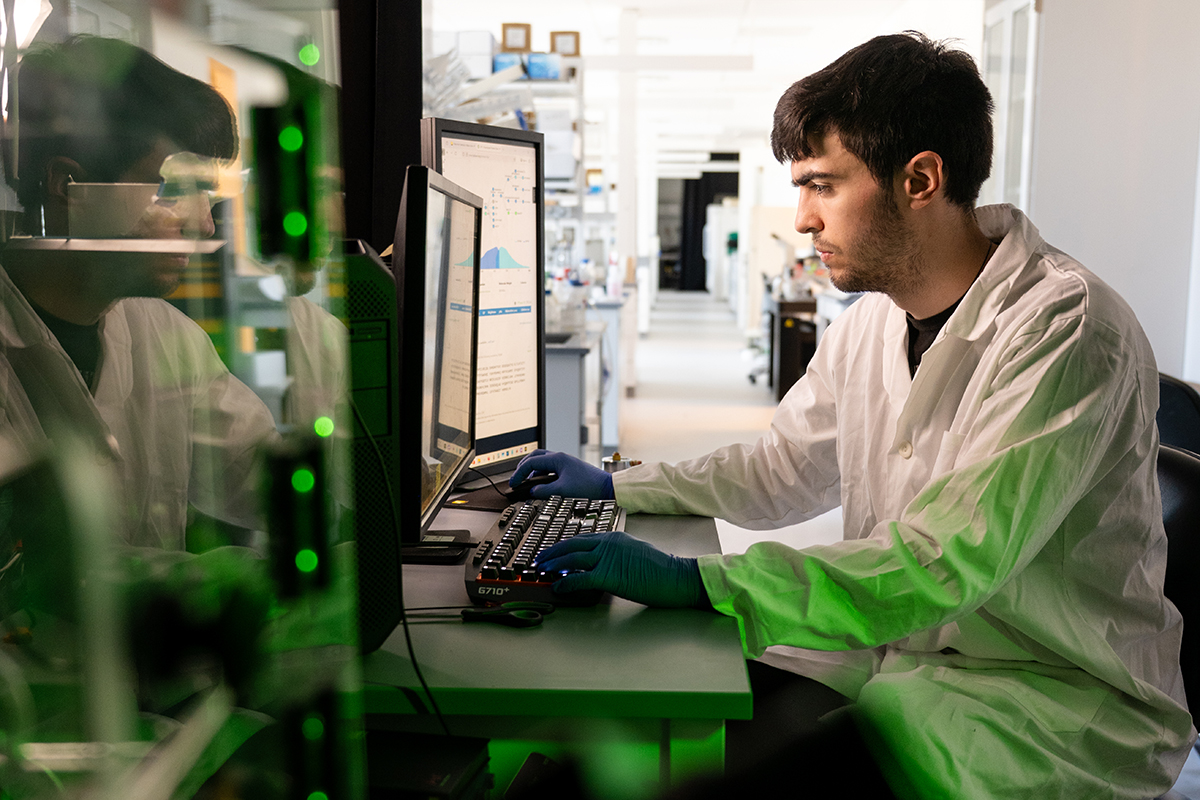
Matteo Couto Frignani in a PhD lab at Princeton. Photo by Sameer A. Khan/Fotobuddy.
Matteo Couto Frignani graduated last year with a bachelor’s degree in bioengineering and biochemistry from Northeastern. Couto Frignani was drawn towards engineering from a young age, spending countless hours building with Legos. In high school, a biology class sparked a second passion, where he was given a take-home DNA editing kit and became fascinated by how scientists could alter living organisms at the most basic level. Much of the science was new to him, and that mystery sparked a curiosity in him that drove him to pursue bioengineering. Couto Frignani added biochemistry later on in his degree because he thought having a stronger foundation in chemistry would round out his expertise.
Couto Frignani knew a college degree was the best way to fully explore the field, and a friend who attended Northeastern encouraged him to apply, pointing to the school’s Co-op Program as a major advantage for gaining real-world experience. After being accepted into the Honors Program, Couto Frignani was given even more incentive to come to Boston. In fact, the city itself was a deciding factor, as he wanted to study in “the biotech hub of the world,” where his co-op experience could directly result in a position at a top biotechnology company.
Influence and extracurriculars
Two courses stood out during his time at Northeastern. One class was Cornerstone of Engineering, taught by Teaching Professor Joshua Hertz and the first class he took at Northeastern. The class was impactful to Couto Frignani because of Professor Hertz’s passion for the material, where his genuine enthusiasm for teaching and the grace with which he taught solidified Couto Frignani’s love for engineering. He appreciated that Professor Hertz struck the right balance in his expectations—challenging students without overwhelming them, and often including optional bonus questions that Couto Frignani found too interesting to skip. Another impactful course was Biomechanics with Associate Chair of Undergraduate Studies and Teaching Professor Timothy Lannin. Couto Frignani enjoyed this class for a similar reason, appreciating Professor Lannin’s passion for the subject and how he intertwined real stories with the material. His enthusiasm made the class engaging, with Couto Frignani sharing, “he really cared about us learning and thought it would be useful to us.” From both professors, Couto Frignani took away a lesson that went beyond the curriculum: the importance of being truly passionate about your work.

Couto Frignani presenting at the RISE Expo. Courtesy photo.
Outside of class, Couto Frignani joined Beta Gamma Epsilon, an engineering fraternity on campus that became influential in his college experience. It was a great way to meet like-minded peers, and connected him with mentorship from older peers who were further ahead in their engineering degrees. He also found community in an unexpected way—the fraternity’s volunteer work around Boston introduced him to people and neighborhoods far beyond campus, making him feel like a true resident of the city. Even helping maintain the fraternity’s historic brownstone turned out to be useful, teaching him practical skills like patching drywall and fixing appliances that he still relies on today.
Couto Frignani served as both treasurer and eventually president for a year, teaching him the importance of trusting those around you. He had an executive board to support him, and learning how to delegate tasks effectively helped the fraternity accomplish their goals. Just as important, Couto Frignani learned that “you can not make everyone happy [as a leader],” a difficult realization when one considers that all the members are also his friends. As the president, he had an obligation to do what was best for the fraternity in that moment, even if his decision was unpopular. It was a formative experience that left him with lasting friendships and a leadership record he’s proud of.
Research and co-op experiences

Couto Frignani during his research experience in the Atacama Desert. Courtesy photo.
Couto Frignani’s research journey starts with a Dialogue of Civilizations in Chile, run by Associate Professor Yunrong Chai and Professor Veronica Godoy-Carter. During the trip they gathered and isolated bacteria and yeast samples from the Atacama Desert (one of the driest and most extreme environments on Earth) to study how they survive such extreme climates and ultraviolet radiation. He enjoyed this research a lot, and was offered an undergraduate research position at the Chai Lab back at Northeastern. This turned into an enormous research endeavor, which Couto Frignani breaks down into three stages.
First, the team sorted and identified the samples, discovering along the way that some of what they thought were bacteria were actually yeast—a different type of single-celled organism. In the second stage, he was given his own strain of yellow-pigmented bacteria. Knowing from other research that this species could have antibiotic properties, Couto Frignani ran a series of experiments to test whether this strain could do the same. Ultimately, nothing came from it. Rather than stop there, Couto Frignani shifted focus and started investigating why the bacteria produced so much yellow pigment in the first place. He figured out that the pigmentation came from carotenoids—a compound commonly linked to antioxidants and vibrant colors. It also made sense in context: certain carotenoids help protect against UV radiation, which would be essential for surviving in the desert. From there, he examined the genetic makeup of the compound, identified the proteins it was made of, and worked toward inserting the relevant genes into a simpler test organism. The goal was to use this model to better express or block certain genes, but Couto Frignani ended up graduating before its completion.
The experience was transformative and ignited his passion for research. At the Chai Lab, he developed strong scientific habits, especially how to backtrack when something does not go as planned. Northeastern was vital to the continuation of his research, with Couto Frignani being given three PEAK awards to be able to support his project. He is also grateful for the graduate students in the lab, answering his questions and giving him a window into what a career in research actually looks like. Seeing his project grow over time made him eager to keep going beyond his undergraduate degree.
Couto Frignani also completed two co-ops alongside his lab work. The first was located at Seres Therapeutics, a company focused on treatments that support the gut microbiome. His project here focused on understanding how unique pathogens infect the stomach and intestines, and building lab models to replicate what happens in patients undergoing antibiotic treatment. This included working with live mice, making their immune systems vulnerable to infection and then using the company’s treatments on them to see how well they worked. It was his first professional experience, and he came away with both technical skills and workplace fundamentals like communication and time management.
His second co-op was with Asimov, a synthetic biology company that designs and programs living cells to produce therapeutic proteins. As a process development engineer, he was responsible for keeping those cells healthy and productive. For Frignani, this co-op showed him “a completely holistic view of bioengineering, where I delved into so many subdisciplines during my time there.” He is also grateful for his mentor there, a Northeastern alum, who gave him meaningful responsibilities while also leaving room to learn independently. Couto Frignani was pulled into client projects, which was daunting at first, but ultimately helped him build his confidence, something he says, “is hard to take away.” His biggest takeaway was learning to adapt quickly and understanding how research priorities differ between a company setting and an academic one.

Couto Frignani at the Commencement exercises for his Bachelor’s degree. Courtesy photo.
Advice and ambition
One piece of advice Couto Frignani offers to other students is “to try to be the best at everything,” with an emphasis on try. Whether it was coursework, an internship, or simply being a good friend, he approached everything with a desire to do it well. He explains that in an environment of constant exposure like Northeastern, this mindset helped him grow exponentially. Couto Frignani also offers a reminder that resonates well beyond college: “We do not have time, we make time,” a nudge for students to be intentional about how they invest their energy, especially when it comes to meeting people and exploring new things.
Couto Frignani is currently a second-year PhD student at Princeton studying bioengineering. In the short term, he’s rotated through different research groups to find the focus that excites him most, while also preparing for his general qualifying exam. His longer-term path is still open: to enter either academia or industry as a high-level researcher. Either way, his motivation stays simple: he wants to ask new questions, and to find answers that matter to a lot of people. Couto Frignani loves the research environment and does it, in his own words, “for the love of the game.”