Nature Spotlights the Rise of Single-Cell Proteomics — and Slavov Lab’s Role in Its Founding
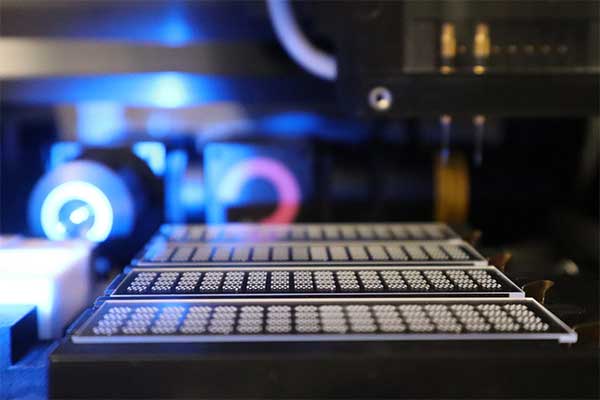
Nikolai Slavov, a COE Distinguished Professor and director of the Single-Cell Proteomics Center, is featured in a Nature technology feature tracing the field’s evolution from an unproven idea to a robust, discovery-driving technology.
This week, Nature published a technology feature charting the rise of single-cell proteomics — a field that has moved, in roughly a decade, from open skepticism to a mature set of tools now driving new biological discoveries. The feature highlights pioneering work that took part at Northeastern University in the Slavov Laboratory.
The feature opens not with instruments or methods, but with a discovery: a finding made possible only because researchers could finally measure proteins in individual cells rather than averaging them across millions of cells at once. From there, it traces the story back to the field’s earliest days, when Slavov Lab and a handful of other pioneering groups published the first proof-of-concept work showing that mass-spectrometry-based single-cell proteomics was not just an interesting idea, but an experimentally feasible one. That early work — met at the time with considerable doubt from the broader proteomics community — helped set the field in motion.
“Single-cell proteomics has transitioned from the shadows of skepticism to the forefront of research,” said Slavov, who directs the Single-Cell Proteomics Center at Northeastern. The technologies his lab and others developed, including methods such as nPOP and plexDIA for preparing and multiplexing single-cell samples, have since been adopted and extended by labs around the world, expanding what can be measured in a single cell from a handful of proteins to thousands.
Slavov and his team say the pace of progress in the field continues to accelerate. Much of that work now continues through Parallel Squared Technology Institute, where Slavov and colleagues are building next-generation capabilities for single-cell protein analysis aimed at unlocking biology that has so far been out of reach — from protein modifications and interactions to the molecular differences between individual cells that bulk measurements erase.