
Research
The College of Engineering has over 240 tenured/tenure-track faculty, each bringing complementary areas of research expertise to address pressing global challenges. Their state-of-art-research looks at critical issues in materials, processes, systems, infrastructure, hardware and software at every scale—nano to macro to global—grounded in a translational approach that integrates the values of fundamental and applied research.
Our faculty boldly innovate by collaborating across engineering disciplines and the university, as well as with government, academia, and industry. The College of Engineering has more than 20 multidisciplinary research centers and institutes with funding from eight federal agencies. Our commitment to conducting transformative research to better the world can be seen by our growth in external research funding, which exceeds $100 million annually, and by an investment in research facilities such as our 223,000 square foot, six-story Interdisciplinary Science and Engineering Complex and 367,000 square foot, eight-story EXP facility for teaching and research.
Research At-A-Glance
External Research Funding (FY2024)
Research Centers and Institutes
Young Investigator Awards (as of Aug. 2024)
Patents 2018-Aug. 2024
Related Resources


Understand how Northeastern partners with industry for research and workforce development

View the faculty directory for more information on individual researchers.


Recent News

Su and Fu Receive Best Paper Award at ECCV DriveX Workshop
ECE Assistant Professor Lili Su and Professor Raymond Fu, alongside their research group, received the DriveX@ECCV 2026 Best Paper Award at the DriveX Workshop during the European Conference on Computer Vision (ECCV) 2026 in Malmö for their paper titled “Post-Training in End-to-End Autonomous Driving: Taxonomy, Methods, and Challenges.”

Patent for Robust Wi-Fi Environment Sensing Technology
ECE Associate Professor Francesco Restuccia was awarded a patent for “System and method for sensing an environment.”

Patent for Zeta-Based AC Link Power Converter
ECE Associate Professor Mahshid Amirabadi was awarded a patent for “Zeta-based AC link universal power converter.”
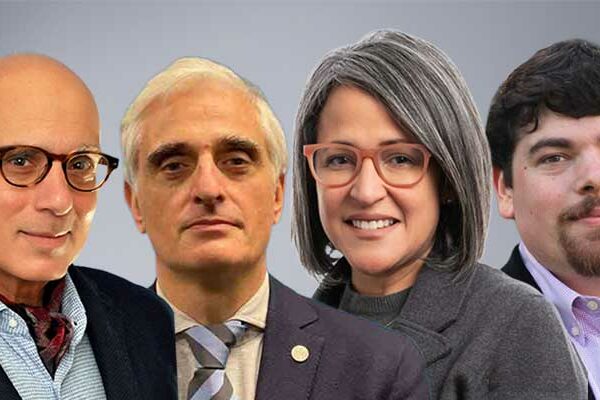
Interdisciplinary Team Receives NSF FIRE Grant to Study FireScreens for Wildfire Safety
MIE Professor Yiannis Levendis, CEE Professor Luca Caracoglia, Affiliated Faculty Michelle Laboy, and MIE Assistant Professor Jeffrey Lipton were awarded a $1.06M NSF Fire Science Innovations through Research and Education (FIRE) grant for “Investigating Potential Solutions to Reduce Wildfire Risk Through Structural Hardening.”