Predicting the Next Move with the RHYTHM AI Tool for Disaster Response

CEE Associate Professor Qi “Ryan” Wang and his team developed RHYTHM, an AI tool that leverages large language models to accurately forecast human movement for urban planning and disaster response.
This article originally appeared on Northeastern Global News. It was published by Cody Mello-Klein. Main photo: RHYTHM, a large language model-based tool developed at Northeastern University, can predict human movement patterns well into the future. Photo by Getty Images
With help from AI, your next move can be predicted
Using large language models, Northeastern University researchers can predict human movement. They hope it can help with transportation planning and responding to natural disasters or public crises.
AI might know where you’re going before you do.
Researchers at Northeastern University used large language models, the kind of advanced artificial intelligence normally designed to process and generate language, to predict human movement. RHYTHM, their innovative tool, “can revolutionize the forecasting of human movements,” forecasting “where you’re going to be in the next 30 minutes or the next 25 hours,” said Ryan Wang, an associate professor and vice chair of research in civil and environmental engineering at Northeastern.
The hope is that RHYTHM will improve domains like transportation and traffic planning to make our lives easier, but in extreme cases, RHYTHM could even be deployed to respond to natural disasters, highway accidents and terrorist attacks.
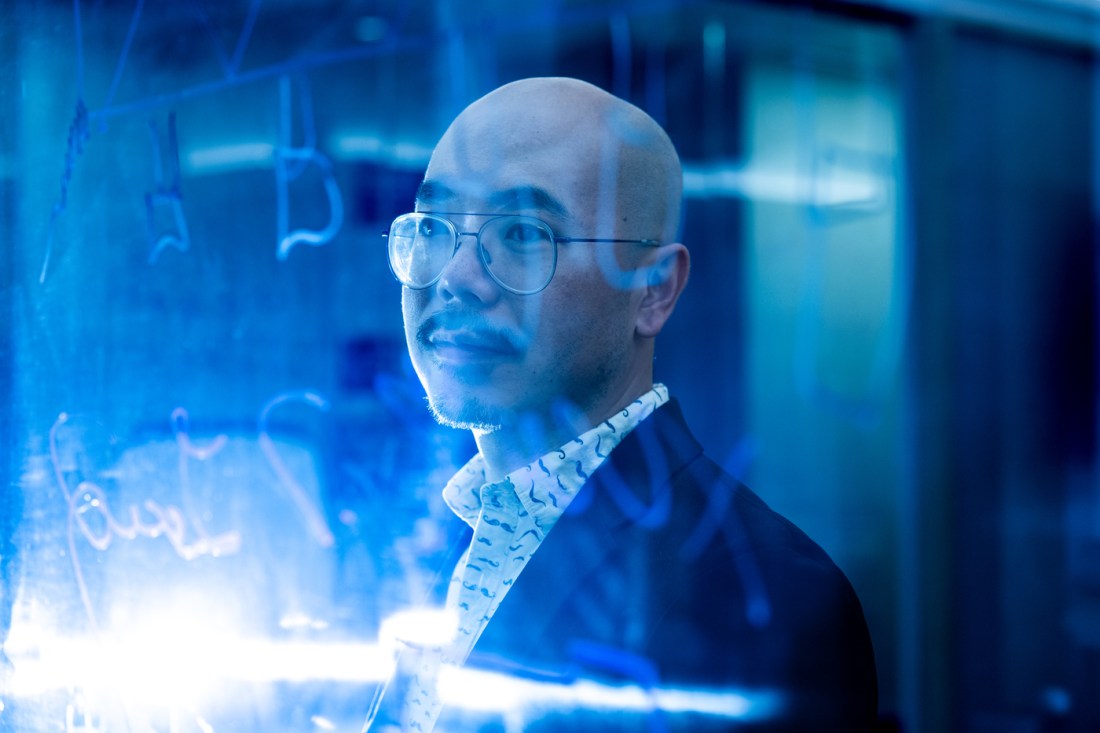
With RHYTHM, Ryan Wang, associate professor of civil and environmental engineering and vice chair for research, hopes to predict how people move during extreme events like natural disasters, highway accidents or even terrorist attacks. Photo by Alyssa Stone/Northeastern University
“Accurate prediction is very important for people to understand what’s going on and where they should go,” said Haoyu He, a civil and environmental engineering Ph.D. candidate at Northeastern.
Historically, predicting how people move has been a challenge for one simple reason: Human movements are often random. However, look more closely and it’s possible to see the patterns, or rhythm, of human movement. People might go to the grocery store, school or gym on the same day, at the same time every week.
By using open source mobility data, and the contextual understanding that LLMs have, Wang and He built a model that doesn’t just imitate previous patterns but creates predictions based on certain conditions.
“It’s understanding that people have these 24/7 or weekly or monthly patterns that help to predict people’s location,” Wang said. “It makes the abstract pattern more concrete. That can be interpreted by the model and then used to improve our prediction.”
Read full story at Northeastern Global News