Two Northeastern Students Helping Increase IVF Success Through Co-op
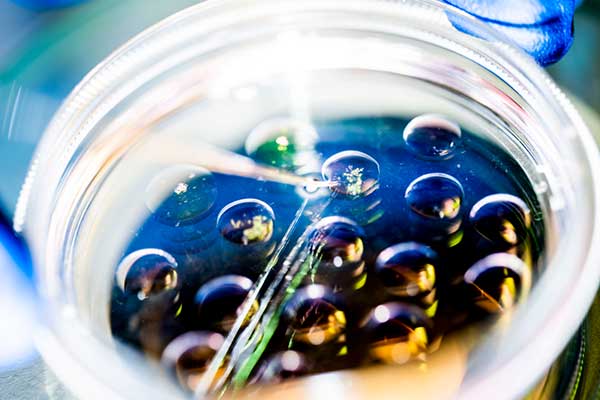
What if there’s a better way to find eggs for the in-vitro fertilization process? Northeastern co-ops are helping improve a machine that does so. Photo by Matthew Modoono/Northeastern University
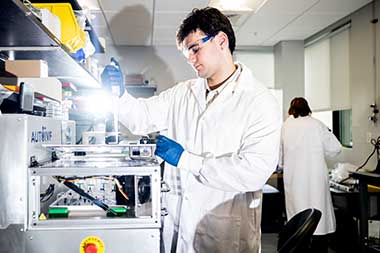
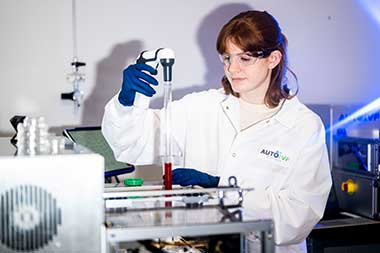
Two Northeastern students––Jake Percival, E, mechanical engineering and bioengineering, and Tori Christianson, E, chemical engineering and bioengineering––are completing their co-ops at AutoIVF. They are working on a device that can find “hidden” egg cells in follicular fluid, helping to increase the chance of successful IVF by increasing the number of eggs retrieved.
This article originally appeared on Northeastern Global News. It was posted by Hannah Morse.
Northeastern co-ops are helping this machine find undetected egg cells
Going through in-vitro fertilization to conceive a child can be a complicated and demanding process, with many different parts all having to fall exactly into place. Improving one’s chances at a successful birth – from the levels of hormones to the number of eggs and the quality of sperm – can feel like a numbers game.
It’s why some who are focused on improving the treatment are also trying to improve numbers. Two Northeastern University students have been directly involved in one part of that effort, which is to increase the number of egg cells that can be retrieved for IVF.
Tori Christianson, 19, and Jake Percival, 20, are about a month away from completing their first co-ops with AutoIVF, a Natick, Mass.-based biotechnology startup.
Percival, a bioengineering and mechanical engineering student, said he specifically chose AutoIVF because he wanted to work at a startup.
“I didn’t want to be stuck behind a computer for six months. I like hands-on work,” said Percival. So when he saw that the job description said, “Your job is always going to change. You’re going to have a lot to do. You’re going to have a lot of responsibilities,” it felt like a good fit.
Christianson said that while the lab experience at the co-op has been valuable, she has learned how to think critically about presenting data and findings in a way that makes sense.
“That’s not something I thought I would need going into this job, as I was thinking of it as more of a lab scientist kind of job. But it’s something I’m really thankful for because I think it is one of the most helpful skills that I’ve learned,” the bioengineering and chemical engineering student said.
AutoIVF’s work includes a wide range of technology, all with the aim of optimizing and, in many cases, automating parts of IVF treatment. Percival and Christianson were specifically working on the company’s OvaReady device, which is designed to find what the company calls “stealth oocytes.” Current methods of finding and retrieving egg cells, or oocytes, don’t capture all possible cells, but OvaReady purportedly increases the number of cells that can be retrieved.
In a study published in Nature in February, the company reported that its OvaReady device can find more “stealth oocytes,” hidden in the follicular fluid, which is fluid that is typically removed along with the ovarian follicles that are embedded with and emptied of egg cells. That fluid is typically discarded after an embryologist retrieves the oocytes, but OvaReady can find more cells in that fluid.
Emre Ozkumur, vice president of research and development at AutoIVF, said that the device found one or more oocytes in half of the follicular fluid samples included in the study.
“This can be very significant especially for patients who have less than 13, 14 oocytes,” he said. “Even a single oocyte makes a big difference.”
 |
 |
Photos by Matthew Modoono/Northeastern University
Read full story on Northeastern Global News