A Robotics Graduate Student’s Role in Pioneering Space Travel
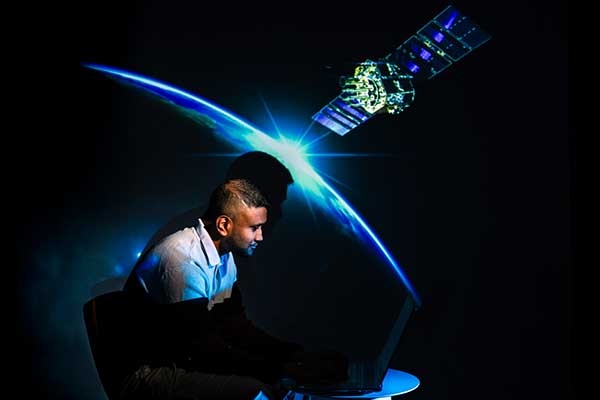
Siddarth Dayasagar is pursing his masters in robotics at Northeastern University. Photo by Alyssa Stone/Northeastern University
While on co-op for Space Data Inc., Siddarth Dayasagar helped develop, support, and test the company’s open-source operating system for space stations. The company hopes this software can one day be used globally to ensure the safety of those traveling in space.
This article originally appeared on Northeastern Global News. It was published by Cesareo Contreras.
He’s building the brain of the space station of tomorrow
Siddarth Dayasagar watched his screen with excitement.
He didn’t know that his career path would crystallize after he clicked on a technical primer on YouTube describing NASA’s Perseverance rover, the six-wheeled specialized mobile vehicle designed to traverse Mars.
Yet something awoke inside him as he learned about Perseverance’s 293-million-mile journey to the red planet.
“Watching Perseverance functioning and how it [was going] to land on Mars really fascinated me,” Dayasagar recalled thinking after watching the video, which had been uploaded by former NASA engineer Mark Rober.
The video was posted days before Perseverance successfully landed on Mars on Feb. 18, 2021. Rober worked on Perseverance’s predecessor, Curiosity.
Dayasagar’s career in space robotics can be traced back to that moment. And now he can say he’s helped make meaningful contributions to the industry.
This fall, the second-year robotics graduate student completed a co-op at Space Data Inc., a Japanese-based space technology company working in artificial intelligence, robotics and digital twin technologies, software that recreates physical spaces in 3D simulations.
While on the co-op, Dayasagar played a leading role in helping improve the company’s Space Station OS, an open source operating system project designed for space stations.
Think of it like Google’s open source software platform, Android. But instead of powering phones, Space Station OS one day could power massive orbital space stations similar to the International Space Station, Dayasagar explained.
 |
 |
Siddarth Dayasagar, a second year masters student in the robotics program at Northeastern, completed the co-op this fall. Photos by Alyssa Stone/Northeastern University
The company hopes that by developing a standardized platform, countries around the globe can take advantage of it. That type of unity and open collaboration could be useful for speeding up software development, removing fragmentation and improving accessibility.
“If we have a standardized operating system, then we can make sure during any emergency across all space stations, you’ll have a good manual that you can use to mitigate those challenges,” he said.
One of Dayasagar’s roles during his co-op was to help develop, support and test the OS’s subsystems used to control a space station’s life support infrastructure, electrical power systems, thermal controls, guidance and navigation capabilities.
Since Space Station OS is still new and isn’t connected to specific pieces of hardware, Dayasagar ran the operating system through a series of disaster scenarios using the company’s still-in-development simulation software.
“Let’s say your space station’s vents fail,” he said while describing a potential disaster scenario. “Your vents have been closed and they’re not opened at a particular time and carbon dioxide concentrations have increased inside the space station. Astronauts might faint. … Space Station OS provides an emergency response. It tries to signal to the astronauts that ‘Your vents have been closed. Please see if you can repair those vents.’”
Read full story at Northeastern Global News