Choose Your Own Path: Sara Capella’s Journey at Northeastern
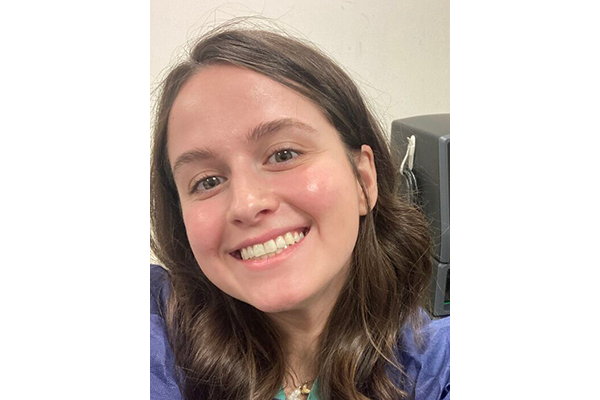
Portrait of Sara Capella. Photo sourced from LinkedIn.
Sara Capella, E/MS’22, bioengineering, graduated with both a bachelor’s and a master’s degree from Northeastern University. Using the experiences and skills she gained at Northeastern, Capella now works full-time at Medtronic installing novel cardiovascular technology.
Sara Capella completed a bachelor’s and master’s degree in bioengineering at Northeastern in 2022, through the Plus One Program. Prior to that, while in high school, Capella came across an article about biomimicry during her PSAT exam and was immediately interested in the topic. She then completed multiple school research and design projects related to the subject, including using spider silk for less irritable medical tape for infants and creating a helmet resembling a woodpecker’s skull for its abilities to disperse force from direct trauma. Applying to college, she ultimately chose to major in biomedical engineering, giving her a wider academic scope while allowing her to pursue her interest.
While researching prospective colleges, Capella came across Northeastern by chance. Coming from a theoretical heavy education in high school, she was searching for a university that could give her practical engineering experience. She was drawn to the hands-on approach to learning the university provides through its project-based curriculum and the Co-op Program. She committed to Northeastern after learning about the first-year Engineering Cornerstone course, admiring the applied nature of the course and projects.
Mentors and influence
Capella worked under various mentors while studying at Northeastern. One of them was Associate Teaching Professor Stephan Golden, with whom she took an entrepreneurship course as well as attended a Dialogue of Civilizations experiential. She found that taking business classes as an engineer changed her perspective, as she explains “you can design whatever you want but if you’re not designing something that people can use or want then it’s essentially pointless.” Capella also found the discussions in the class opened her eyes to a broader way of thinking, which she now uses in her career. Overall, she is grateful for Professor Golden’s guidance and notes, “he had a very big impact on me.”
Another influential mentor to Capella was Teaching Professor and Associate Dean of Teaching, Susan Freeman. Capella took first-year Cornerstone Engineering with Professor Freeman, who she describes as very supportive. Capella lacked confidence as an engineer in her first year, feeling behind her peers for her lack of robotics and coding experience. After a particularly tough exam, she began attending Professor Freeman’s office hours, where she developed a better understanding of the material after repeated sessions. She aced her retake exam. In her words, “I’ve never forgotten what she’s taught me, how it’s not the end of the world and you will get it.” Capella was also part of Professor Freeman’s service-learning course, where she learned how simple and easy it was to use engineering skills to make an impact.
Capella also highlights Associate Dean Richard Harris, who began mentoring Capella during the NU PLACE Fellows Program, a pre-college program she continued throughout her academic career at Northeastern. His philosophy of the three T’s—time, talent, and treasure—has stuck with her to this day. Basically, experienced people investing time with students can build talent which creates treasure, leading to those students eventually guiding the next generation. Capella uses this philosophy now within her career, and seeks ways of giving back, which motivates her daily.
Beyond the classroom, Capella was one of the founding members of Phi Sigma Rho, the engineering sorority at Northeastern. Lea Fusco, a classmate of Capella’s had seen the success within the engineering fraternity and wondered about opportunities women engineers could be missing out on. Fusco recruited Capella and other members of the founding class in 2018. She served as Social Chair for the sorority, and planned events like rock climbing, community cleanups, and brunch with the focus on building a community of friends and peers. Capella was grateful to have been part of creating a supportive network of engineers—which also gave her the lifelong friends she has now.
Co-ops to full-time roles
Capella completed three co-ops during her time at Northeastern. Her first role was a lab-based position focused on cardiovascular devices, serving in mechanical circulatory support R&D at Abbott. Her interest in cardiovascular systems was deepened during this co-op, and she realized that this would become her specialty. Meanwhile, Capella decided to pursue co-ops in other fields to gain a broader scope of experience.
Her second co-op was at Medline Industry Inc., as a mechanical engineer working on a minimally invasive skin grafting device. Prior research proved one could use all layers of the skin in tiny filaments to repair ulcers, burns, and other instances that would require a skin graft without needing to remove a large piece of skin. The five-person Medline team in their Watertown facility was tasked with creating the mechanical device that would put this research to use. Here, she designed and tested the artificial skin material to better replicate the environment in which the device would be used, while teaching vendors how to detect faults, as well as lifecycle testing for verification and validation procedures.
Her third co-op was in Ireland, where she worked as a disruptive research solutions co-op for Stryker. Initially delayed due to visa processing challenges, Capella was grateful for the chance to work abroad. Her work involved looking at innovative materials to add to the Stryker manufacturing portfolio for the neurovascular and cranial/maxillofacial divisions. Capella created both a business case and scientific case for why Stryker should invest in a start-up company or a material/technology about ten years before it becomes “mainstream”. While she may never know the impact of her work, her peers at Stryker joked that, “if you see said material ten years from now, know that this was you.” This experience gave her a new perspective on advancements in technology while developing her interpersonal and engineering skills.
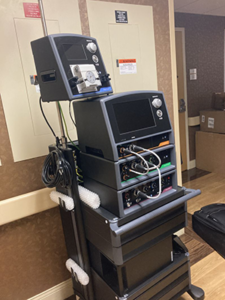
Picture of AFFERA device. Photo sourced from LinkedIn,
Now, Capella works full-time as a field engineer for Medtronic. Formerly, she worked in manufacturing Tri-Staple for Medtronic, where she was introducing new manufacturing equipment—most noteworthy, a $7 million asset that would reduce the cycle time from part-to-part manufacturing by over fifty percent. Her current work involves installing and testing new cardiovascular equipment in hospitals around the country. The current product is called AFFERA, used for cardiac ablation. Typically, when doctors perform ablation procedures, they need different machines and catheters to gauge radiofrequency (RF), pulsed field ablation, and to create a 3D map of the heart from inside the heart, but AFFERA combines all these into one system with one catheter called the Sphere-9. Multiple moving parts can be inefficient, and potentially dangerous, but AFFERA allows for more efficient procedures and shortens recovery time for the patient.
Lessons and ambitions
Capella’s most important lesson from Northeastern is that “the experience is what you make of it.” When she was told she needed to give up a co-op to complete her Plus One program on time, she pushed back—sitting down with her advisor to carve out a plan that preserved as much industry experience as possible. It wasn’t the only time she charted her own course: she also designed her own study abroad program in Cork Ireland, arranged a schedule of taking night classes to keep her third and final co-op, and completed a double minor. In each case, the university met her halfway. That problem-solving instinct, and the confidence it built, is something she carries into her career today.
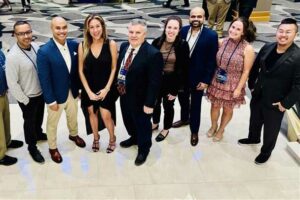
Capella and her team at Medtronic. Photo sourced from LinkedIn.
Looking ahead, Capella wants to transition into R&D, focusing on new product development—driven by a passion for understanding a product’s design and function deeply enough to identify gaps and make improvements for both patients and providers. Her motivation is deeply personal. When her grandfather survived esophageal cancer in 2005, it was thanks to an esophagectomy performed with the newly released Tri-Staple—the same product that would become the first medical device she worked on after graduation. Seeing the direct impact of medical innovation play out in her own family’s life is a daily reminder on why she and her colleagues “do what we do.” It’s a full circle moment that keeps her drive alive as she looks to continue advancing and innovating in the medical device field.