Climate and Wildfires Drive Persistent U.S. Formaldehyde Levels
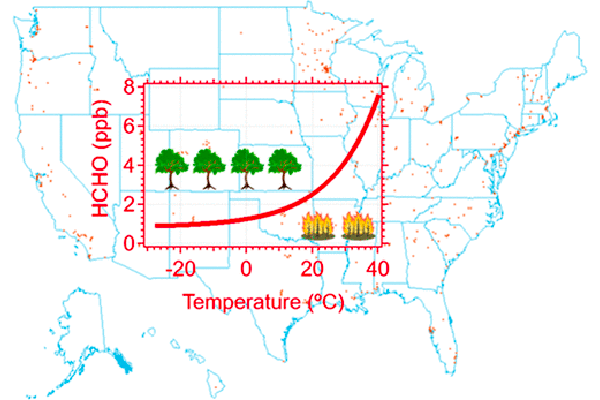
CEE Assistant Professor Shang Liu’s research on “Surface Atmospheric Formaldehyde Trends in the U.S. Driven by Temperature-Dependent Biogenic Precursor Emissions and Influenced by Wildfires” was published in ACS ES&T Air. The study reveals that while urban levels have declined modestly, widespread reductions are absent due to a strong dependence on temperature-driven biogenic emissions and the increasing influence of wildfire smoke.
Abstract:
Formaldehyde (HCHO) plays significant roles in atmospheric chemistry and human health, but limited surface data hinders our understanding of its sources and variability. This study compiles ambient HCHO data from U.S. air monitoring sites over the past 36 years. Trend analysis shows that HCHO concentrations have declined modestly in urban areas; however, widespread downward trends are absent across most regions, despite substantial reductions in NOx emissions over recent decades. This persistence is explained by strong exponential dependence of HCHO on temperature, with temperature alone accounting for approximately 50% of HCHO variability. The observed temperature dependence closely resembles that of precursor biogenic volatile organic compound emissions rather than chemical rate constants. In addition, wildfire smoke enhances HCHO concentrations by 53% on average. We further employed ensemble and deep machine learning models to predict HCHO using routinely measured variables, with the eXtreme Gradient Boosting (XGBoost) model achieving the best performance. Combining XGBoost with explainable machine learning reveals that temperature is the dominant predictor, followed by particulate matter, with NOx as a relevant contributor. These models capture average HCHO variation at regional scales, which enables estimation of HCHO concentration in areas lacking monitoring data and prediction of its future trends under climate warming scenarios.