Collaboration and Commitment: Creating Impactful AI Research
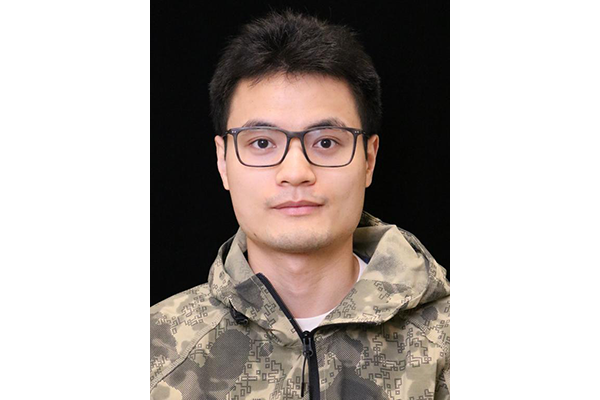
Jianglin Lu portrait. Courtesy photo.
Jianglin Lu, PhD ’27, electrical and computer engineering, works at the SMILE Lab under the supervision of Professor Raymond Fu. He has completed internships at Adobe Research and Amazon. In a rapidly expanding AI industry, Lu emphasizes collaboration and grounded discussion as the keys to research that translates meaningfully to the real world.
Jianglin Lu is pursuing a PhD in electrical and computer engineering at Northeastern University. Before beginning his doctoral program, he had already built a research record and accumulated publications in machine learning, with interests spanning multimodal large language models, generative AI, and reinforcement learning. Eager to continue that work in a doctoral environment in the United States, Lu began searching for the right program.
His search was guided by one clear priority: finding an advisor whose research aligned with his own. After looking closely at the work being done at various universities, he discovered Northeastern and became particularly interested in Distinguished Professor Raymond Fu and the SMILE Lab. Northeastern’s reputation for industry connection through its Co-op Program also caught his attention. For someone working in AI—a field where industry often moves faster than academia—Lu sees collaboration with the private sector not as a perk but as a necessity. Staying current, he believes, requires staying engaged. With that in mind, he applied to Northeastern’s PhD program and began his journey in Boston.
Research at the SMILE Lab
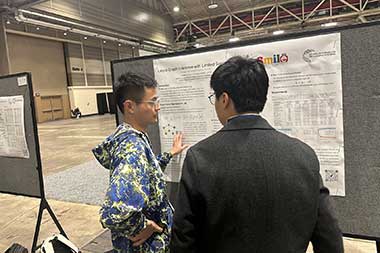
Lu presenting his research. Courtesy photo.
One of Lu’s recent projects tackles a fundamental challenge in AI: getting models trained independently on different types of data—such as images and text—to work together seamlessly. Because these models each develop their own internal ways of organizing information, their representations don’t naturally align, making integration difficult without additional training or shared data. To address this, Lu proposes the Indra Representation Hypothesis, which suggests that well-trained models naturally develop a shared understanding of how concepts in the world relate to one another—where each piece of data is understood through its relationships to other pieces. He formalizes this idea using an advanced mathematical framework and introduces a new method of representing data based on these relationships, enabling different AI models to be aligned with one another without any additional training. The work was accepted to the Neural Information Processing Systems Conference 2025, one of the top venues in AI research.
Lu is grateful for the guidance Professor Fu has provided throughout his PhD. He regularly discusses research ideas with his advisor, who offers direction on how to sharpen the work and maximize its impact—as well as more practical support, including mentorship on paper writing and funding for conference attendance. Lu also appreciates the institutional support Northeastern provides, including access to GPU computing resources that form the backbone of his research and travel funding that allows him to participate in conferences and advance his career.
Outside the lab, Lu develops his leadership through collaboration—working with fellow students and lab members, helping others with experiments and publications. He has also served as a teaching assistant for several courses at Northeastern, an experience he considers essential to doctoral development. “Having teaching experience is important for one’s development during a PhD,” he says. Teaching has both deepened his foundational knowledge and strengthened his communication and presentation skills. His contributions in the classroom were recognized with a CSSH Outstanding Teaching Award in 2025.
Internships at Tech Companies
Lu has completed two internships during his degree. The first was at Adobe Research, where he worked on improving image search using natural language. He proposed a framework that trains an AI language model to better interpret and refine user search queries, then combines it with a model that understands the relationship between text and images—resulting in more visually relevant and higher-quality search results. That work was accepted to the 2026 International Conference on Learning Representations.
His second internship was at Amazon, where he worked as an applied scientist intern. There, Lu developed an AI-powered system for restoring damaged or low-quality images. The system fine-tunes a model to identify what is wrong with an image, uses a language model to plan the best approach to fix it, and trains a reinforcement learning agent to carry out the restoration steps in the most effective sequence. The project was accepted to the 2026 Conference for Computer Vision and Pattern Recognition.
Lu considers both experiences invaluable. Working on problems with real-world applications—solutions that are widely accessible rather than confined to academic literature—gave him a clearer sense of how research can be translated into tangible impact. He also found meaningful mentorship at Amazon, noting that the guidance he received from colleagues there “is also very important and helpful for your PhD degree.”
Advice and What Comes Next
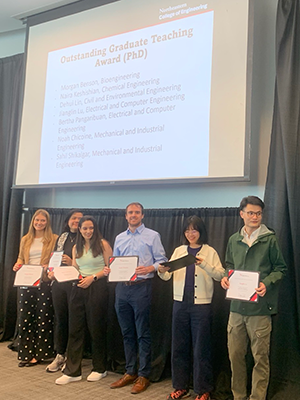
Lu accepting the CSSH Teaching Award. Courtesy photo.
For fellow PhD students in computer engineering, Lu stresses the importance of building strong foundations. He points to Northeastern’s Advanced Machine Learning and Data Visualization courses as examples of the rigorous coursework available. He also encourages researchers to seek out collaboration at every level—with advisors, lab mates, and students from other disciplines. Discussing research plans and progress with others, he believes, not only surfaces valuable feedback but opens the door to unexpected contributions. A recent paper he co-authored with a network science student, for instance, was accepted to ICLR 2025, a prestigious AI conference. His broader message to anyone working in the field: the AI industry is moving “too fast” to look away—“we should keep our eyes open to new technologies and approaches to be able to make more impactful research.”
As a graduate research assistant, Lu has developed the problem-solving skills and research experience that industry actively seeks. Employers in AI look for candidates who can identify a problem and work it through to a conclusion—and a strong publication record signals exactly that. His time at Northeastern has given him the opportunity to build both.
After graduating, Lu plans to move directly into industry to gain hands-on experience in applied AI research, where he can watch new technology become accessible to the public in real time. Further down the road, he may return to academia as a professor, bringing his industry perspective to enrich both his research and teaching. His core motivation, throughout all of it, is to develop research that is useful—research that works in the real world and makes a difference to the people who use it. With the foundation he has built at Northeastern, Lu is well positioned to do exactly that.