Connection Through Aerospace Engineering: Daniel Cabestrero’s Northeastern Journey
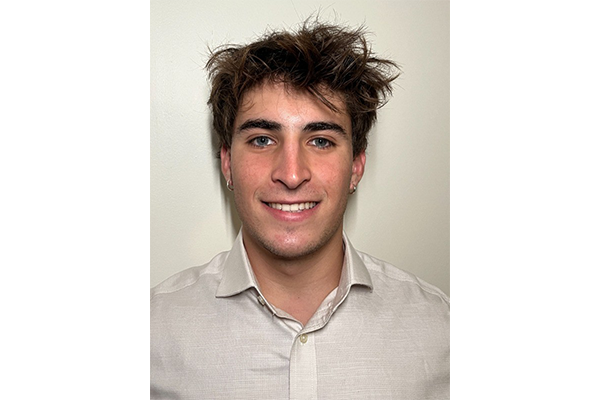
Daniel Cabestrero portrait. Courtesy photo.
Daniel Cabestrero, E’26, MS’28, mechanical engineering, and will pursue a master’s degree through the PlusOne Program, after a gap year. Currently on co-op at Rivian, Cabestrero plans to complete his master’s before pursuing a career in the commercial aircraft industry, with a focus on engines and thermofluids.
Daniel Cabestrero earned his bachelor’s degree in mechanical engineering from Northeastern this year and will pursue a master’s in the same field with a concentration in thermofluids. Growing up, he was drawn to geography, travel, and different cultures—interests that gradually evolved into a fascination with commercial aircraft. It wasn’t until his senior year of high school that he settled on aerospace engineering as a direction, and when Northeastern—his top choice—didn’t offer that program, he chose mechanical engineering for its breadth and applicability across industries. The school had long been on his radar; his mother is a Northeastern alumna. He was further drawn in by the university’s location in Boston and its Co-op Program, which he recognized early on as essential for an engineering career.
Research and Influences
Cabestrero’s most recent research project, conducted through the Multiphase Transport Research Lab at Northeastern, is the Viscous Fingering Instability Project. The experiment examines what happens when a thin fluid—a dyed calcium chloride solution—is injected into a thicker, more resistant fluid (sodium alginate) while compressed between two glass plates. The calcium chloride triggers a striking phenomenon the team calls “fingering,” in which tendril-like branches spread outward through the denser fluid. Because no prior research on this specific phenomenon exists, the team runs controlled experiments to understand its causes, adjusting variables such as the gap between the plates, the concentration of the calcium chloride solution, and the speed of injection to see how each factor influences the pattern. In the process, they discovered a second phenomenon they call “wrinkling”—a buckling of the thicker fluid between the plates that produces an almost wave-like shape. Cabestrero has recently been testing a new batch of sodium alginate to examine how material variation affects both behaviors.
The research has practical implications, particularly for enhanced oil recovery. In porous materials like soil or rock, fluids move through complex pathways, and similar fingering instabilities can occur when one fluid displaces another—leaving behind significant amounts of unrecovered oil. The team hopes that a deeper understanding of these dynamics could point toward approaches that recover what is currently left behind. Cabestrero will present this work at the RISE Expo. He is grateful for the support Northeastern has provided through the Fall 2025 PEAK Base Camp award, which funded his travel to a conference and gave him the opportunity to network with other researchers. Beyond the recognition, the project has sharpened his problem-solving approach and built research skills he expects to carry throughout his career.
One course that captivated Cabestrero was Gas Turbine Combustion, part of his thermofluids concentration. The class deepened his interest in aviation engines, and he found Distinguished Professor Yiannis Levendis to be both an engaging instructor and a valuable guide to campus resources, particularly around research opportunities. His most formative mentor in the lab was a former graduate student, Matthew Coughlin, with whom he worked until Coughlin left to pursue a PhD. From Coughlin, Cabestrero learned how to think and question like a scientist—and, just as importantly, what thoughtful mentorship looks like. He carries those lessons into his own mentoring in the lab today. Assistant Professor Xiaoyu Tang, the lab’s principal investigator, has also been a steady source of guidance, helping him navigate research challenges and plan his next steps.
Co-op Experiences
Cabestrero will have completed two co-ops by the time he finishes his studies. The first was at Axcelis Technologies, a semiconductor manufacturer specializing in ion implantation—the process by which a beam of ions is directed onto silicon wafers to give them the conductive properties used in electronic devices. As a manufacturing engineer, he spent much of his time designing test fixtures using CAD software, primarily Creo Parametric, and 3D printing solutions when technicians identified problems on the line. He also prepared engineering change orders, updating blueprints and documentation as innovations required. The most important technical lesson from Axcelis was designing for manufacturability—understanding that features that look clean in CAD may not be feasible to actually fabricate. That gap between design and production, he believes, is exactly why manufacturing engineers matter.
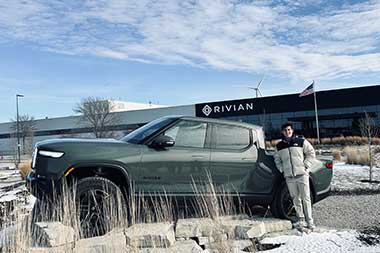
Cabestrero outside of Rivian, his second co-op. Courtesy photo.
His work at Axcelis helped him land his current co-op at Rivian, an electric vehicle manufacturer, where he works as a manufacturing engineer on the general assembly team. His responsibilities include troubleshooting assembly problems, improving processes and cycle times, and building test fixtures—work familiar from Axcelis, now applied in a new context. He enjoys the immediacy of the role: the ability to create tangible solutions and see their impact in real time. Recently, he took on the responsibilities of a line lead when a colleague went on paternity leave, a significant amount of responsibility for an intern. The experience has done more than build technical skills—it has built his confidence as an engineer, something he has actively worked on throughout his studies. Having that trust placed in him has affirmed his own abilities in a way that classroom achievement alone couldn’t, and he knows that confidence will open doors going forward.
Advice and Plans
For prospective college students, Cabestrero’s first piece of advice is to earn as much college credit as possible in high school. His transfer credits allowed him to jump ahead early in his degree, which opened up more advanced coursework, better research opportunities, and more flexibility in his co-op timeline. For students already in college, his message is broader: “Be open to trying new things and do not restrict yourself, because you might find new interests you would not have originally had.” What you study going in, he notes, may not be what you study going out—and that’s not a setback, it’s part of the process.
After returning from his current co-op, Cabestrero plans to take a gap year to pursue a lifelong goal: traveling to every country in the world. He will then return to finish his master’s degree before heading into the commercial aircraft industry, with a focus on plane engines as an aerothermal fluids engineer. His love of travel is more than a personal passion—it’s the driving force behind his professional ambitions. He believes air travel is one of the most powerful tools for deepening human connection across cultures and geography, and he wants to be part of making it more efficient and accessible. With the engineering knowledge and hands-on experience he has built at Northeastern, Cabestrero is well positioned to bring that vision into the work ahead.