Curiosity in Motion: Sofia Odeh’s Journey Through Research, Co-ops, and Beyond
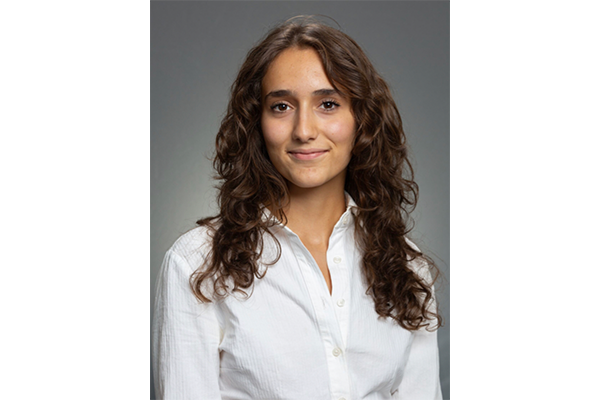
Portrait of Sofia Odeh. Courtesy photo.
Sofia Odeh, E’26, mechanical engineering, has completed two co-ops and is currently an undergraduate researcher at the Aramaki Lab. With extensive experience in both research and industry, Odeh is open to multiple paths after graduation—driven, above all, by her innate curiosity.
Sofia Odeh recently completed a bachelor’s degree in mechanical engineering with a minor in astrophysics at Northeastern. Outer space has been a passion since childhood—she used to seek out space-themed picture books at bookstores—but her interests have never been confined to a single lane. She was drawn to her STEM and physics classes while also loving literature, debate, and the arts. Though aerospace engineering was an early pull, she ultimately chose mechanical engineering for its breadth and flexibility. If her interests shifted, she reasoned, mechanical engineering would give her the room to move. Growing up in New England, Boston felt like a natural fit—she gravitates toward city life and the diversity of people and ideas that come with it. Among Boston’s universities, Northeastern was her clear first choice, drawn by the strength of its engineering program, the Co-op Program, and an urban campus with strong opportunities for student involvement.
Research
Odeh’s first research experience grew out of her involvement with Students for the Exploration and Development of Space (SEDS), which entered a NASA design competition. The team built COBRA, a snake-like robot composed of multiple linked units designed to traverse the hard-to-reach craters of the moon—and placed first. The project was compelling enough that the Silicon Synapse Lab adopted it as an official research initiative. Odeh began by integrating Intel RealSense cameras onto the robots to help them interact with their environment, and later contributed to the development of miniature COBRA units designed to operate as a coordinated swarm. As a mechanical engineer, her work centered on the physical side—3D printing components, installing hardware, and troubleshooting on the fly. It was a valuable introduction to research, though she eventually pivoted away from robotics to pursue different interests.
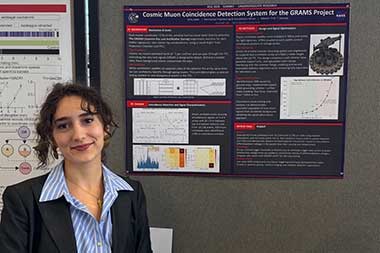
Odeh presenting her research from the Aramaki Lab. Courtesy photo.
She is currently a research assistant at the Aramaki Lab, where the team is working to detect dark matter—the invisible substance believed to make up the majority of matter in the universe. The core challenge is interference: particles called muons, which are similar to electrons but far heavier and constitute a significant portion of the cosmic radiation that reaches Earth’s surface, create noise that obscures dark matter signals. Odeh’s role is to build a component within the dark matter detector that identifies the energy signatures produced by muons and filters them out, leaving only the signals that might indicate dark matter. She describes it with an analogy: if you only want the red Skittles, you have to sort through every other color to make sure you don’t pick the wrong one. The detector itself is a chamber submerged in liquid argon with an electric field applied across the tank. When a particle enters, it produces a flash of light as it collides with the argon and leaves a trail of electrons. By analyzing where and when those electrons are recorded, Odeh can reconstruct the particle’s path and determine whether it was a muon or a potential dark matter particle.
When she joined the lab, her work was primarily mechanical—3D modeling and printing components for the device. As her coursework has advanced, she has moved into data analysis, contributing to the algorithm that identifies muon events. She is grateful for the infrastructure and resources Northeastern has provided the lab, and for what the project itself has shown her: a vivid picture of what research—and possibly a PhD program—could look like. It has also given her a new kind of discipline, the ability to set her own initiative and deadlines, that she expects to carry into whatever comes next.
Co-op Experiences
Odeh’s first co-op was at Lutron Electronics, a luxury lighting manufacturer, where she worked on the tool and test team designing and building custom tools for operators on the manufacturing line. The work demanded precision—operators handle expensive and delicate devices, where a single mistake can ruin a piece. The experience grounded her as an engineer, teaching her to design with purpose and keep efficiency and impact at the center of every decision.
Her second co-op was at LineSpect, a small startup developing submersible smart cameras. The team’s main project involved a microscope-like camera mounted on ocean buoys to track and classify types of algae, with the goal of generating early warnings for harmful red algae blooms. Odeh worked primarily on the optics and mechanical design for the microscope—her first exposure to the optics sector—prototyping and 3D printing parts throughout the internship. She came away with new technical skills in optics software and, just as importantly, experience navigating the particular dynamics of a three-person team, where communication and collaboration carry even more weight than in larger organizations.
Mentors and Extracurriculars
Odeh has deep appreciation for Assistant Professor Tsuguo Aramaki, who runs the Aramaki Lab and taught her Multimessenger Astrophysics—“single-handedly my favorite class at Northeastern,” she says. The material was challenging, but Professor Aramaki pushed students to reason through problems independently and reach their own conclusions, and his enthusiasm was contagious. “It was easy for me to study for the class,” she reflects. In the lab, he has been a consistently supportive and accessible mentor, always quick to respond to questions and creating an environment where students feel genuinely welcome. “It’s nice to know that you can always go to someone with any questions or for guidance,” she says.
Beyond the Aramaki Lab, SEDS has been a central part of Odeh’s time at Northeastern. She values the way the club’s NASA competition prompts change year to year, pushing her to grow her skills and engage with new material each cycle. Senior members have also been a meaningful source of career advice, and the club has given her a community of like-minded peers who share her passion for aerospace. She is also a contributor to NU Sci, Northeastern’s science magazine, where she created the club’s weekly newsletter—an outlet for her creative side and a chance to work alongside students from very different backgrounds. Outside of Northeastern, she and a fellow student co-host a podcast called “Art of Inquiry,” interviewing professors about the intersections between art and STEM. For Odeh, the project is personal: as an engineering student with genuine artistic interests, it reflects her ongoing effort to find a version of her career that honors both.
Lessons and Possibilities
Odeh’s advice to other students is to look for research that genuinely merges your interests rather than chasing prestige. She spent time assuming that no faculty member would be interested in the particular combination of things she cared about—then realized she could forge her own path. If nothing out there fits, she says, create your own project. Pursuing work that actually excites you produces a far richer learning experience in the long run.
As for what comes next, Odeh is deliberately leaving her options open. She has considered returning to New York to pursue product development at the intersection of STEM and art—perhaps even working as an engineer at an art gallery. She has also thought about going abroad, and has not ruled out a PhD; at minimum, she hopes to pursue a master’s degree in astrophysics. “I am waiting to see what opportunities life throws at me,” she says. “I am open to anything and everything that sounds right in the moment.” What remains constant, across all of those possibilities, is the curiosity that has driven every choice she has made—and a desire to pass whatever she discovers on to others. That curiosity, combined with the breadth of experience she has built at Northeastern, will serve her well on whatever path she chooses.