Designing Smarter Catalysts for Cleaner Methane Conversion
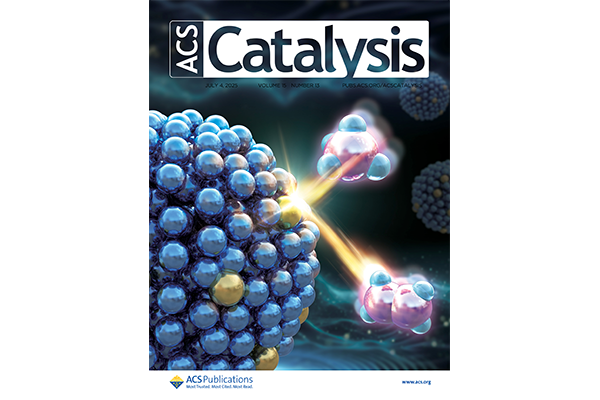
Sarah LaCroix, E’27, and Chengyu Zhou, PhD’28, co-authored a paper with ChE Assistant Professor Qing Zhao titled “Discovering Ni/Cu single-Atom Alloy as a Highly Active and Selective Catalyst for Direct Methane Conversion to Ethylene: A First-Principles Kinetic Study” that was featured in the Supplementary Journal Cover Art of ACS Catalysis. The research explored how to efficiently convert methane into liquid fuels or valuable chemicals without relying on petroleum. The team identified a promising catalyst—nickel atoms dispersed on a copper surface—that can break methane’s strong C–H bonds while avoiding carbon buildup, offering a cleaner and more sustainable approach to fuel production.
Abstract:
Direct methane conversion to liquid fuels or value-added chemicals is a promising technology to utilize natural resources without resorting to further petroleum extraction. However, discovering efficient catalysts for this reaction is challenging due to either coke formation or unfavorable C–H bond activation. Herein, we design single-atom alloy (SAA) catalysts to simultaneously eliminate the above two bottlenecks based on mechanism-guided strategies: (1) the active single atom enables favorable C–H bond breaking and (2) the less reactive host metal facilitates C–C coupling and thus avoids strong binding of carbonaceous species. Employing electronic structure theory calculations, we screened the stability of multiple SAAs with 3d-5d transition metals atomically dispersed on a copper surface in terms of avoiding dopant aggregation and segregation. We then evaluated reactivities of the stable SAAs as catalysts for direct methane conversion to C2 products, including methane dehydrogenation and C–C coupling mechanisms. Combining selectivity analysis with kinetic modeling, we predicted that nickel dispersed on copper, i.e., Ni/Cu SAA, is a highly active and selective catalyst that can efficiently transform methane to ethylene. This work designs efficient SAA catalysts for direct methane activation and provides chemical insights into engineering compositions of SAAs to tune their catalytic performances.