End of the Semester Brings Innovative Projects
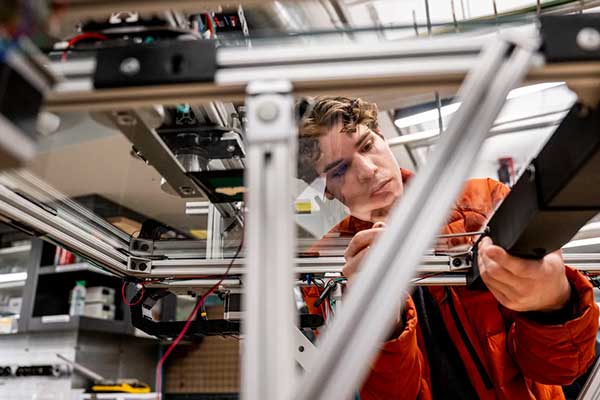
Fifth-year Northeastern mechanical engineering student Peter Reis was tinkering with his prototype device in the Capstone Lab this week. Photo by Matthew Modoono/Northeastern University
As the semester wraps up, Northeastern Global News explores a handful of interesting final projects from a variety of Northeastern students.
This article originally appeared on Northeastern Global News. It was published by Tanner Stening.
Finals, projects and presentations — this semester is a wrap
The final week of college classes is often a mixed bag. For some, the countdown to the last class comes with a winding down of work, but for others, the final week spells crunch time, especially for those putting the final touches on major projects.
From intricate, multi-semester engineering designs aimed at solving real-world problems to capstones that blend research, reporting and multimedia storytelling, the last push can often bring a sense of excitement and an opportunity for reflection.
That was certainly the case for fifth-year Northeastern mechanical engineering student Peter Reis, who was tinkering with his prototype device in the Capstone Lab in the Forsyth Building when he spoke to Northeastern Global News (NGN) on Wednesday. More than a year ago, he said, he began his capstone designing and building a new cleaning system for solar farm mirrors, which are large reflective panels used to concentrate sunlight in utility-scale solar fields.
These surfaces, which are also called heliostats, are prone to dust and grime buildup from being out in the open in wide, often hot, landscapes. And cleaning them currently involves blasting them with high-pressure water, but the problem with that is it uses large amounts of water and can be inefficient at scale.
So, Reis and four classmates came up with a “non-immersion ultrasonic system” — meaning it does not need to be submerged in water — to clean heliostats. Their design involves using ultrasonic vibrations to loosen and remove debris, and uses far less water than traditional methods.
“Efficiency and sustainability are the goals,” Reis said.
Their design involved months of planning and research, before moving into design, machining and testing in recent weeks. Now in the home stretch, he said the group has spent many long hours in the lab troubleshooting all the moving parts.
“It’s been a lot of work, but especially these past couple of days, when we pulled some all-nighters,” Reis said ahead of a final presentation on the finished design on Thursday. “But we got the thing working and did some testing, and it’s been a lot of fun.”
Read full story on Northeastern Global News