Following Curiosity: Discoveries Through Experience in Stem Cell Engineering
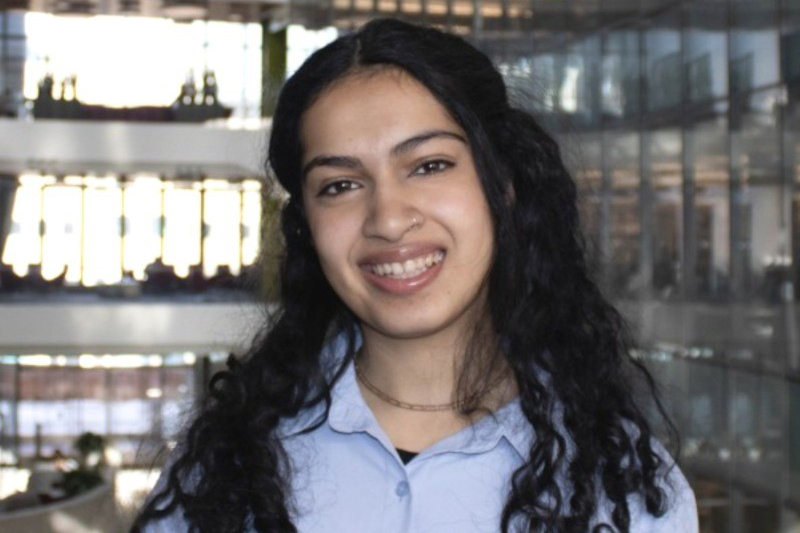
Ryana Sarcar, E’26, is a combined bioengineering and biochemistry graduate and currently researching at the Alice Stanton Lab. Looking to pursue a PhD after graduation, Sarcar is committed to furthering knowledge in neurodegenerative disease through bioengineering. Courtesy photo.
Ryana Sarcar has completed a bachelor’s degree in bioengineering and biochemistry at Northeastern University. Growing up, Sarcar was more interested in English and geography, and shares that “if you told me ten years ago that I would be a bioengineering major, I would have laughed.” Nevertheless, in high school she gained an interest in biology and neuroscience, but felt like something was missing, and started to explore engineering as well. Bioengineering blended her interests in biology, physics, and math. Sarcar also knew she could make an impact with engineering, using her skills for hands-on work. She decided to combine this with biochemistry, stating that she “wanted to make the most out of the program.”
As with the majority of Northeastern students, the Co-op Program is what put the school on Sarcar’s radar. She loved the idea of gaining both academic and industry experience, especially in one of the most prolific cities for bioengineering—Boston. In her words, “I was really drawn to the opportunity to be able to dedicate a couple months at a time to working somewhere in this amazing ecosystem and really understanding the landscape of research and engineering here.” She was also drawn to the strength of the bioengineering department, whether it be their resources or infrastructure.
Sarcar has been impressed with all of the bioengineering faculty she has interacted with during her studies, noting how approachable they were and how she always felt welcomed, even without having a robust engineering background. They have always been accessible when she needed help, ready to answer questions and help her develop new skills.
Co-op and research experiences
Sarcar completed two co-ops during her time at Northeastern. After developing an interest in neuroscience and helping out at a tissue engineering lab at Northeastern, she wanted a co-op where she could apply her knowledge as a bioengineer. Her first experience—a self-developed co-op—was an undergraduate research role at the Massachusetts Institute of Technology at the Li-Huei Tsai Lab. Her main work consisted of using computers to analyze images of lab-grown human brain tissue related to Alzheimer’s disease. She also learned how to grow stem cells to create brain tissue with different genetic makeups, in order to study how those differences might relate to Alzheimer’s. One of the most valuable things Sarcar took away from MIT was learning how to think and work independently while still being a strong team player.
After the introduction to stem cells in her first co-op, Sarcar was looking to further develop her knowledge in the subject and its engineering practices. This is how she came across Cellino, a biomanufacturing startup focused on scaling up stem cell generation, with the goal of making regenerative therapies more accessible to the general population. Sarcar’s role involved growing cells and capturing images to help build a machine learning model that allows scientists to automatically evaluate and improve how stem cells grow. She enjoyed the startup environment for being able to see decisions implemented in real time. Her experience made her adaptable, ready for change and any problems that may come her way.
Most recently, Sarcar was an undergraduate research intern at the Alice Stanton Lab at Harvard Medical School and Massachusetts General Hospital. Here, she worked with stem cells to generate multiple cell types for the synthesis of human brain tissue models. Similar to the work in her first co-op, these tissues can then be used to study various neurological diseases. From this experience she became even more confident in working independently as a researcher. She is grateful to Northeastern for being given the platform to self-develop her own co-op with her career interests in mind, and appreciates the help from her co-op advisor. Sarcar also had the opportunity to present the research she completed at MIT through Northeastern’s help with the PEAK Shout-It-Out Award, developing her network and presentation skills as a scientist.
Outside of the lab
As for extracurriculars, Sarcar was involved with Northeastern’s Mars Rover Team. Joining her first year she was able to start developing her engineering abilities, which at first was daunting, but soon found that this community was invested in helping new engineers succeed. Sarcar became the team lead for the life detection team, responsible for finding microbial life in the Utah soil during competition. Her biggest task was training new scientists and engineers, and found the experience to be “really rewarding to give back and teach a new group of engineers.” She originally thought that she was unqualified to lead her own team, but comments that “leadership is not something you need to come into being perfect, it is the leadership journey that shapes you.” Sarcar is continuously inspired by other teammates’ passion to pursue engineering outside of class.
Last semester she joined WREN—Women’s Research Engagement Network—at Northeastern. This club focuses on forming mentor-mentee relationships between students interested in research, as well as bringing in external mentors. She joined the program as a mentor, uncertain about her decision as she felt she did not have much advice to offer as an undergraduate student. Sarcar soon realized that her diverse experiences at university were helpful to those who are now going through the same thing, especially with challenges specific to STEM fields.
Advice and future plans
As a recent graduate, Sarcar’s biggest piece of advice is to “follow your curiosity wherever that takes you.” She encourages students not to fear crossing disciplinary boundaries—as a bioengineering major, she found that venturing outside her field helped round out her education. For Sarcar, refusing to box herself in and taking intellectual risks led to the most growth in her academic career. She also recommends that students go abroad while at Northeastern, noting that the university offers a wide range of opportunities that make it easy to do so. Sarcar went abroad to Oxford University in her second year, taking two courses on quantum computing and machine learning. Though neither was directly related to her major, she valued the chance to explore a new interest while immersing herself in a different culture.
Sarcar plans to continue her education after graduation, and is looking into PhD programs in neuroscience and cell and tissue engineering. She hopes to deepen our understanding of neurodegenerative disease, and while she hasn’t mapped out every step beyond graduate school, her goal is to end up somewhere she can make the greatest impact. Whatever path she takes, Sarcar’s drive for knowledge and discovery will leave a mark on the field of cell and tissue engineering.