Free and Fair Internet Access for All
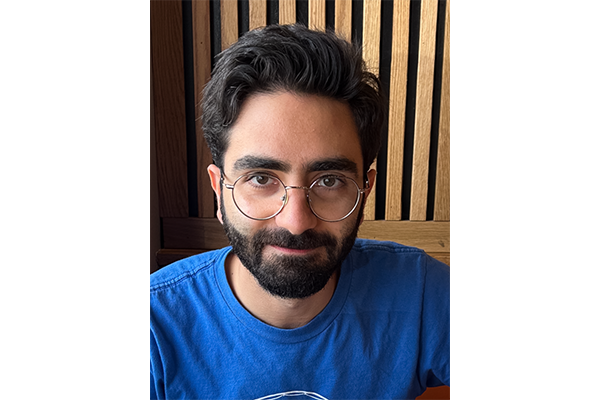
Portrait of Ali Saeizadeh. Photo sourced from LinkedIn.
Ali Saeizadeh, PhD’27, is a graduate research assistant in electrical and computer engineering at Northeastern’s Institute of Intelligent Networked Systems, where he builds “digital twin” simulations of 5G and 6G telecommunications networks. His work aims at something ambitious: making free and fair internet access a reality for people around the world. Before completing his degree, he plans to intern at Apple and a smaller tech firm to compare perspectives across an industry he hopes to shape.
Ali Saeizadeh is currently pursuing a PhD in electrical and computer engineering at Northeastern, after receiving a bachelor’s degree in electrical engineering from the University of Tehran. Saeizadeh has always had an interest in electrical engineering, but it was during his undergraduate studies when he became aware of how integral the telecommunications field is to the way we operate as a society. Wanting to be a part of that societal impact led him to pursue a Direct PhD after his bachelor’s.
Saeizadeh found Northeastern through the impressive work of his current advisor, Professor Tommaso Melodia, one of the leading figures in the telecommunications industry. Delving deeper, he learned about Professor Melodia’s impressive research with the group he founded, the Institute of Intelligent Networked Systems (INSI). Additionally, Saeizadeh was drawn to Northeastern because of how connected the university is, whether through the Co-op Program or the numerous industry partners it works with. He recognized the enormous value Northeastern provides, considering it “one of a kind”.
Research and academics
Saeizadeh is currently a graduate research assistant at INSI. His primary research topic focuses on the concept of “wireless digital twinning”, building a risk-free digital environment that people can train any agent or algorithm on, including AI. He develops buildings, streets, cars, and people, within a digital simulation. His goal is to create a realistic version of the world that is able to run accurately and efficiently. To do this, Saeizadeh must model the characteristics of radio frequency as realistically as possible to be able to test algorithms in a safe environment. The purpose of this simulation is to test the safety of certain algorithms or projects before they are deployed within the real world.
Northeastern’s support has been crucial to Saeizadeh’s research and the Institute’s broader mission. The university provides the infrastructure needed to run the powerful servers that the “digital twin” requires, housed at Northeastern’s Burlington campus. As Saeizadeh puts it, the partnership is foundational to everything the project makes possible.
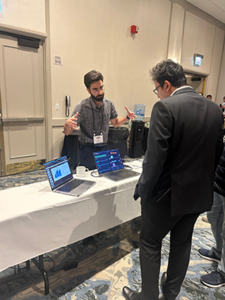
Saeizadeh presenting his research. Courtesy photo.
Beyond logistics, the work has deepened his expertise across virtually every dimension of 5G/6G and telecommunications systems. Because the digital twin demands true-to-life accurately, he must understand each component of a telecommunications network well enough to model it faithfully in simulation—a process that, in turn, sharpens his ability to identify opportunities for optimization. That combination of system-level thinking and hands-on modeling is precisely what employers in the field are looking for.
Among the faculty who have shaped Saeizadeh’s time at Northeastern, Professor Milica Stojanovic stands out. Teaching the Statistical Inferences course, she brought a rigor that Saeizadeh clearly respected—the exams were challenging, but he calls it “one of the best classes I’ve had in my life.” What he admires most is her ability to make deeply complex materials genuinely legible to her students, a quality he considers rare.
Equally influential, if in a different way, were Principal Research Scientist Pedram Johari and Assistant Research Professor Michele Polese, both colleagues in the lab. As more senior researchers, they offered Saeizadeh something harder to find in a classroom: direct mentorship. He describes them as approachable and generous with their time, noting that “they showed me where to go and without them, I could not have done as much.”
Saeizadeh also found value in stepping away from the lab. The “coffee hours” hosted by his department and the college of engineering gave him a space to decompress and connect with fellow graduate students navigating the same pressures. He found a sense of camaraderie there that the lab environment, for all its rewards, doesn’t always offer. For students earlier in their graduate journey, his recommendation is straightforward: show up to the social events, and don’t hesitate to reach out to peers in similar positions. The connections, he suggests, are worth more than they might seem.
Lessons, opportunities, and priorities
As he nears the final stretch of his program, with a 2027 graduation on the horizon, Saeizadeh’s advice to fellow graduate students centers on one thing: don’t stay in the lab. He encourages others to push past the feeling of not belonging—common in graduate programs—and engage with communities around them. Networking, he argues, isn’t just a professional strategy; it’s how you encounter new perspectives and stumble into opportunities you didn’t know to look for.
He’s equally direct about AI. Tools like large language models, he says, are no longer optional—students or faculty who don’t use them will fall behind. He points to his own experience as evidence: workflows that once took six months can now be completed in two weeks. But efficiency isn’t the whole story. Saeizadeh is careful to add that learning to use these tools well—ethically and critically—matters just as much as learning to use them at all, and he’d like to see more formal education reflect that.
After graduation, he plans to move into industry, drawn by the freedom it offers to explore across problems and sectors. He’s already looking ahead: internships at both a large tech company (Apple) and a smaller firm will let him compare those worlds before committing to a direction. For those opportunities, he credits Northeastern’s alumni network, which he sees as one of the university’s most tangible assets—a pipeline that consistently places skilled graduates into strong positions and connects current students to people already doing the work.
What unifies all of it, for Saeizadeh, is a goal he states plainly: “My main goal is to give everyone free and fair access to the internet.” He believes the technology to make that possible, whether through satellite systems or 5G infrastructure, is no longer a distant prospect but an active one. The internet, in his view, is fundamentally about human connection, and making it universally accessible is work worth devoting a career to internet for all.