How Climate Disasters Impact Local Government Funding
By analyzing the intersection of finance and engineering, CEE Distinguished Professor Auroop Ganguly and Aayushi Mishra, PhD’28, interdisciplinary engineering, illustrate how climate risks threaten local tax bases while offering innovative bond-based strategies to protect infrastructure.
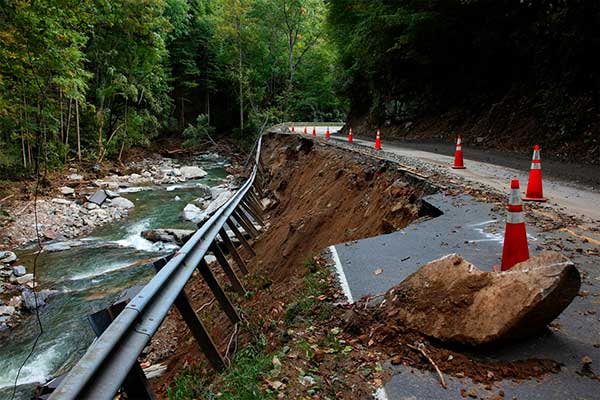
This article originally appeared on Northeastern Global News. It was published by Cynthia McCormick Hibbert. Main photo: Storm damage from Hurricane Helene is seen in Asheville, North Carolina on October 1, 2024. (Photo by Bryan Olin Dozier/NurPhoto via AP)
You’ve heard of climate change. What is the climate debt doom loop?
The low-cost way for municipalities to fund responses and preparedness for the floods, fires and other disasters.
Municipal bonds are a time-honored way to fund roads, schools, bridges and other public projects while paying investors interest, usually at tax-free rates.
But what happens when floods, hurricanes, wildfires and other climate events buckle roads, swamp public buildings and disrupt the municipal revenues that pay for the bond debt?
They can create what researchers from Northeastern University call a climate debt doom loop that makes it even harder for cities and towns to respond to and prepare for future disasters.
In a paper published in Nature Cities, a new journal from the prestigious science publication Nature focusing on resilient, greener environments, professor Auroop Ganguly and Ph.D. graduate student Aayushi Mishra worked with finance experts to describe how climate risk creates challenges as well as opportunities for municipalities to protect their infrastructure and their tax base.
“If more and more bridges and roads get affected by climate disasters, the financing aspect becomes a greater challenge,” said Mishra, who is working on her doctorate in interdisciplinary engineering. “This is especially the case for under-resourced communities, cities that don’t have a great tax base to rely on.”
But there are ways to disrupt the doom loop, she said.
The climate debt doom loop
Municipal bonds are debt securities issued by states, counties, cities and towns to cover costs such as capital projects, including the construction of schools, highways, water systems and sewers, according to the U.S. Securities and Exchange Commission.
Municipalities and states rely on their revenue base to repay investors when the bonds come due. For generations, investments in the bonds, which currently finance more than 70% of the country’s public projects, have been considered low risk.
Climate events, both sudden and slow-moving, are exposing vulnerabilities within the public finance system, Mishra said. Underpricing bonds means there are not enough funds to address catastrophic storms, fires and rising waters.
 |
 |
Professor Auroop Ganguly and Ph.D graduate student Aayushi Mishra’s paper says the municipal bond market offers a way to fund responses to and protection from climate events. Photo by Matthew Modoono/Northeastern University and Courtesy
The result is the “vicious cycle” known as the climate debt doom loop, according to the Nature Cities article. “Growing physical losses impact municipal public health, which limits adaptation efforts, thereby raising future climate exposure risks and subsequently increasing borrowing costs,” the research found.
The costs are high, the researchers said. In 2023 alone, the U.S. experienced 28 separate billion-dollar disasters.
Read full story at Northeastern Global News