Improving Lives by Exploring Urban Mobility and Transportation
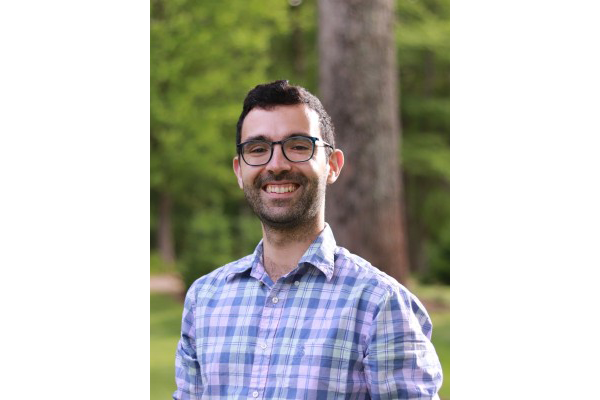
Portrait if Nail Bashan. Photo sourced from LinkedIn.
Nail Bashan, PhD’26, civil and environmental engineering, graduates this March ready to bring his transportation research expertise to industry, where he aims to translate complex data science into practical solutions that improve how people move through their communities.
Nail Bashan is completing his PhD in civil and environmental engineering at Northeastern. He received a bachelor’s degree in civil engineering at Boğaziçi University before coming to Northeastern to pursue a master’s degree in the same discipline. During his undergraduate studies, Bashan became interested in transportation, specifically the human experience of navigating daily life in urban environments. Even then, he knew he wanted to pursue a higher degree. Based on his experiences in both internships and research, he decided he preferred the research environment; he is particularly driven by curiosity and the exploration of uncharted areas in the field.
Bashan was drawn to Northeastern because of an interdisciplinary project called iSUPER. The project focuses on measuring air pollution in the field, and Bashan was brought on to explore the impact air pollution has on human mobility in the city. He was also interested in studying at Northeastern due to its CEE faculty, especially the professor who would become his advisor, Associate Professor Ryan Wang. Bashan realized quickly that his interdisciplinary background would allow him to integrate well with a team sharing that obviously shared that quality.
Current Research
Bashan’s current research at the Ryan Wang Lab also considers air pollution and is primarily focused on the urban dynamics of the problem. Their research seeks to produce quantifiable data on pollution effects related to human mobility. The data aims to reinforce the public benefits of using mass transit to reduce the number of cars on the road, thereby decreasing sources of pollution.
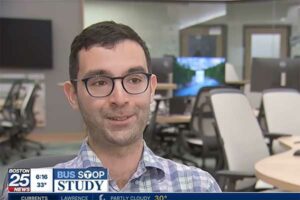
Bashan presenting his research to WFXT Boston 25 News. Screenshot sourced from LinkedIn.
A large part of their research focuses on mobility, in general. Specifically, Bashan studied how the wait time for buses may impact how many people use the system. It’s well known that waiting at a bus stop is often an uncomfortable experience, but their research discovered quantifiable data for how the condition of these bus stops corresponds to how many people use the buses. They found that bus stops equipped with more amenities, such as shelter or a bench, may encourage more people to use the bus. They hope that this data can be used by transportation agencies to improve customer experience.
Influence and inspiration
One particularly impactful course that Bashan cited was Urban Informatics, taught by Wang. He enjoyed this class because it bolstered his foundational knowledge with current resources alongside the standard texts for the field. Bashan enjoyed this class so much he became a teaching assistant for it, broadening his leadership skills, as well. Bashan credits both the curriculum and Professor Wang’s teaching style with enabling his growth as a student and a researcher. As Bashan notes, Wang, who serves as Vice Chair for Research, is able to adapt to the preferred working and communication style of each of his students, offering customized mentoring that he appreciated.
Bashan also cited his work with University Distinguished Professor Albert-László Barabási, a pioneer of network science, as impactful to his experience. In his words, “I took a class from him, and it was one of the most rewarding experiences I could ever imagine.” Being able to learn from experts and founders of his fields of study was a learning experience Bashan will always treasure.
Additionally, Bashan recognized the invaluable guidance provided by the LEADERs program, a professional development initiative for graduate students. He enjoyed this class because he was able to enhance his professional skills while interacting with people outside of his discipline. As he puts it, “It was a great class, you learn a lot, you have a lot of fun, and you meet great people”.
Reflection and new opportunities
Looking back, Bashan values the community he found in his department, not just through the usual holiday parties and end-of-semester get togethers, but through meaningful scientific exchange. Northeastern’s seminar series regularly brings scientists from around the world to present their research, and these weren’t just passive learning opportunities for Bashan. Several conversations sparked during these visits evolved into actual research collaborations and co-authored papers, turning what could have been routine academic events into career-defining connections.
After completing his PhD, Bashan will begin working with the Boston Region Metropolitan Planning Organization (MPO). As a data analyst for the Projects and Applications team, he will be responsible for long-term transportation planning with a focus on sustainability, efficiency, and cleanliness. The Boston MPO’s charge is to bring together stakeholders across the transportation field in the region to ensure they are running as efficiently and effectively as possible. Bashan is driven by a clear goal: making his research accessible and useful to the public. His work isn’t just about advancing transportation science—it’s about improving how people move through their communities every day. With the technical expertise he’s gained through his PhD and his commitment to translating research into real-world solutions, Bashan is ready to shape transportation systems that serve people better.