Industrial PhD Using AI to Optimize Healthcare Systems
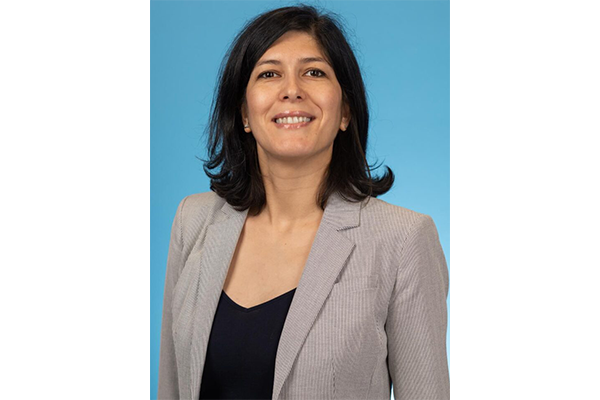
Photo credits: Souri Sasanfar
Souri Sasanfar, currently pursuing a PhD in industrial engineering, recently completed an internship at Apploi, who creates a healthcare hiring program. This placement was possible by the LEADERs program, and Sasanfar reflects on the valuable skills learned from the course and how they were applied during her internship.
This article was originally published by Enryka Christopher.
When Souri Sasanfar, PhD candidate in Industrial Engineering, heard about the LEADERs program from her fellow PhD students who had successfully landed internships through it, she was intrigued, “As PhD candidates, we’re too busy with research. The fact that we weren’t forced to find an internship ourselves, and they would offer us opportunities where we could just go and interview – it was a great opportunity.” After taking the first course, PHDL 7600 “Leading Self and Others,” Sasanfar took on a LEADERs placement with Apploi, a company that created a hiring platform specifically for healthcare jobs. After three rounds of interviews, it was clear that the company needed exactly what Sasanfar specialized in – applying Machine Learning (ML) and Natural Language Processing (NLP) to healthcare data. The company was venturing into AI for the first time, seeking to build a feature that would match existing candidates in their database with new job postings.
Working alongside another Northeastern PhD candidate, Sasanfar found herself in new and completely unknown circumstances. Apploi was still in the starting stages of determining what they needed, but Sasanfar was able to utilize her technical knowledge to help guide the project forward. This uncertainty became an unexpected opportunity for leadership, as Sasanfar took charge of coding an entire series of automations to collect, process, and transfer data from scratch in just 4 months. Sasanfar’s was proud of being able to deliver a working solution that was implemented before their internship ended. The experience proved informative for Sasanfar’s perspective on her PhD research, “We always work with data that may not be applicable in real life. I was doing lots of research and applying methods, but I never thought they could be applied in industry.” Seeing her academic knowledge create tangible results gave her newfound confidence that the skills she’s developing in her PhD program have direct, real-world applications.
One of Sasanfar’s PhD projects used NLP and ML to analyze clinical texts, specifically to identify falls that go uncoded in medical records. For example, a hip fracture caused by a fall is coded as “hip fracture” only by the doctor and medical system, missing the fact that the fall was the original reason for the injury. Properly coding all of the patients that have had injuries due to falls is only the start of developing predictive models that could warn at-risk patients before falls occur.
At Apploi, she was able to apply these same NLP techniques to analyze recruiter communications, using sentiment analysis to understand what characteristics make candidates attractive to healthcare employers. This parallel application of the research methods she had previously used proved the versatility of her academic work, “I used the same exact NLP techniques but with different libraries,” demonstrating how academic research skills can translate directly to meeting industry needs.
Translating Across Research Worlds
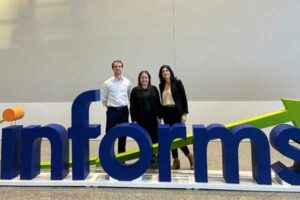
Sasanfar with colleagues at a conference hosted by the Institute for Operations Research and the Management Sciences (INFORMS), an international society for professionals in operations research, management science, and analytics.
Sasanfar emphasized how valuable the cross-disciplinary communication in the LEADERs Program introductory course, “Leading Self and Others,” was for her LEADERs placement. “When you’re in a major, you get deep and use words that only people in your area can understand” – she appreciated that the preparatory class brought together PhD students from various fields, forcing them to explain their research in more accessible ways. The practice she got in class proved useful at Apploi, where she had to explain complex AI and ML concepts to team members who did not have technical expertise. Beyond communication skills, the class taught Sasanfar practical leadership skills that she made use of right away when faced with multiple potential approaches and no clear direction. She stepped up to make decisions about which paths to explore, dividing workflow efficiently, and setting time-bound goals that kept the project on track.
She admitted her initial skepticism about exercises on simplifying communication in the PHDL 7600 “Leading Self and Others” course, but acknowledged how useful the practice has been, “At first, you think, ‘Why should I write everything in simple words? Why do I need to repeat over and over again? But when you go to an industry internship, you find all these things really helpful.” Her experience illustrates how the LEADERs program serves as more than just a pathway to placements; it provides PhD students with the confidence and skills to see their specialized academic knowledge create real-world impacts in industry. For Sasanfar, she is now sure that the complex algorithms and methods she has mastered aren’t only theoretical exercises, but rather they are tools that can transform how companies operate and create value in the real world.
More about Souri Sasanfar:
Souri Sasanfar completed her bachelor’s in mechanical engineering and master’s in industrial engineering back in her home country of Iran before starting her PhD here at Northeastern University. Check out her Google Scholar profile to read her publications!
Source: PhD Education