It’s Never Too Late to Pivot: Dani McLaughlin’s Computer Engineering Journey
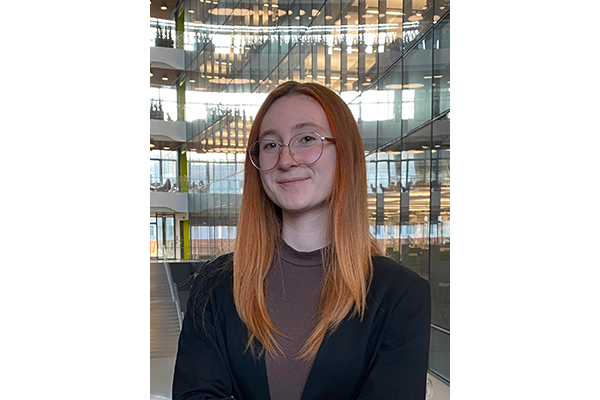
Danielle “Dani” McLaughlin, E’26, combined computer science and computer engineering, is entering the semiconductor industry following her recent graduation from Northeastern. With a diverse co-op and academic background, McLaughlin has built a skill set that will serve her well in any company she joins.
Dani McLaughlin recently completed her bachelor’s degree in computer engineering and computer science at Northeastern University. Her background is rooted in the arts—she attended a vocational high school specializing in art and graphic design—but a computer programming course in her senior year changed her trajectory. She found the subject engaging and recognized its applicability across a wide range of industries and roles. Engineering became a clear ambition once she understood how foundational it would be to a career in computer science, and she saw the breadth of the field as a way to keep her varied interests alive through the diversity of projects it offered.
When it came to choosing a university, McLaughlin was initially drawn to Northeastern for its location in Boston. Further research confirmed the fit: the university’s Co-op Program, its industry connections, and its combined major program all aligned with what she was looking for. Wanting to pursue multiple interests at once, she felt the combined degree would give her the most flexibility.
Hands-On Experience
McLaughlin completed two formal co-ops at Northeastern, both at Amazon’s Fulfillment Technologies and Robotics department as a sensor embedded software development engineer. Her work centered on programming the foundational software that allowed a computing module to receive and process a continuous stream of sensor data from robots operating in fulfillment centers.
That experience laid the groundwork for a summer internship with another multinational technology company where she worked on the software customers interact with directly when using their tech to run custom computing tasks. It was her introduction to the semiconductor industry, and she found that she genuinely enjoyed the work. Neither role came with prior professional experience in the field, but learning on the job gave her the confidence to keep stepping into unfamiliar territory. “I learned it’s possible to join any team and make an impact as long as you are willing to put in the work to teach yourself new concepts,” she says.
In her second co-op at Amazon, McLaughlin’s focus shifted to embedded software for the cameras and sensors used in robots that drive units and work in package cells. She deepened her knowledge of sensing hardware, gained experience in image processing, and developed exposure to a wide range of robotic sensing applications.
McLaughlin is grateful for the preparation Northeastern provided throughout the co-op process. Resume workshops, interview prep, and guidance on workplace norms made the transition to industry smoother—freeing her up to focus on the work itself rather than the logistics of getting started.
Impactful Spaces and People
One course McLaughlin particularly recommends is Operating Systems Implementation, taught by Assistant Professor Cheng Tan. With a strong interest in lower-level systems programming, she found the course a natural fit. Students are tasked with building their own operating systems from the ground up, going, as she puts it, “really in depth in all the concepts you learned in computer systems”—the prerequisite course. She also appreciated the flexibility of the final project, which allowed her to steer her work toward her own interests.
Outside the classroom, McLaughlin was deeply involved in Northeastern’s Mars Rover Team, working on the software side. From her first year onward, she contributed to a wide range of projects—robotic controls, firmware for the life detection team, and more—and traveled to Utah in her second year to operate the rover during competition. In her third year, she became software team lead for the fall semester, taking on onboarding and mentoring responsibilities for new members. The role was rewarding, but it also clarified something important: she wanted to move away from robotics. And it reshaped how she thinks about leadership. “I thought the most important thing about being a leader was technical skills, but you can always learn those,” she reflects. “I don’t think leadership is just about what you know—it’s about who you are, how you work with people, how you lift people up.”
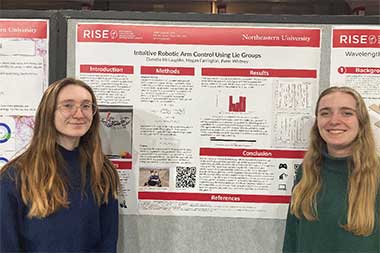
McLaughlin and peer presenting their research at RISE. Courtesy photo.
McLaughlin also received a PEAK Summit Award for a project she completed with the team, focused on improving the control and movement of the rover arm’s wrist. Using a mathematical framework to better represent the arm’s position and orientation, the team worked to stabilize the wrist during operation—exploring concepts well beyond their coursework. She came away with stronger presentation skills, including abstract writing, and encourages others to apply for similar opportunities. “If you have a professor you want to work with and a topic you want to learn, there’s no harm in filling out an application,” she says.
One mentor who made a meaningful impact was COE Distinguished Professor David Kaeli. Though her time working with him at NUCAR was brief, his guidance proved valuable at a pivotal moment—when McLaughlin was transitioning her focus from robotics and embedded software toward the semiconductor industry. Sitting down with Professor Kaeli to discuss the field, she came away with useful resources and a clearer sense of direction for her next steps.
Lessons and Future Plans
McLaughlin’s advice is direct: don’t be afraid to try new things or step outside your comfort zone. Clubs and research groups are excellent ways to explore new areas without changing your major, and she encourages students to reach out to faculty early and often. In her experience, the response has always been positive. “Figure out what you want to learn,” she says, “and people will help you out.”
Now that she has graduated, McLaughlin’s goals are equally clear: learn as much as she can about the semiconductor industry and work on technology that makes a real difference. “I have a lot of room to grow,” she says—and she means it as motivation, not a caveat. With the technical foundation, adaptability, and growth mindset she developed at Northeastern, McLaughlin is well positioned to make her mark in a field that sits at the center of modern innovation.