Light & Matter! Bringing Color-Changing Art to Life
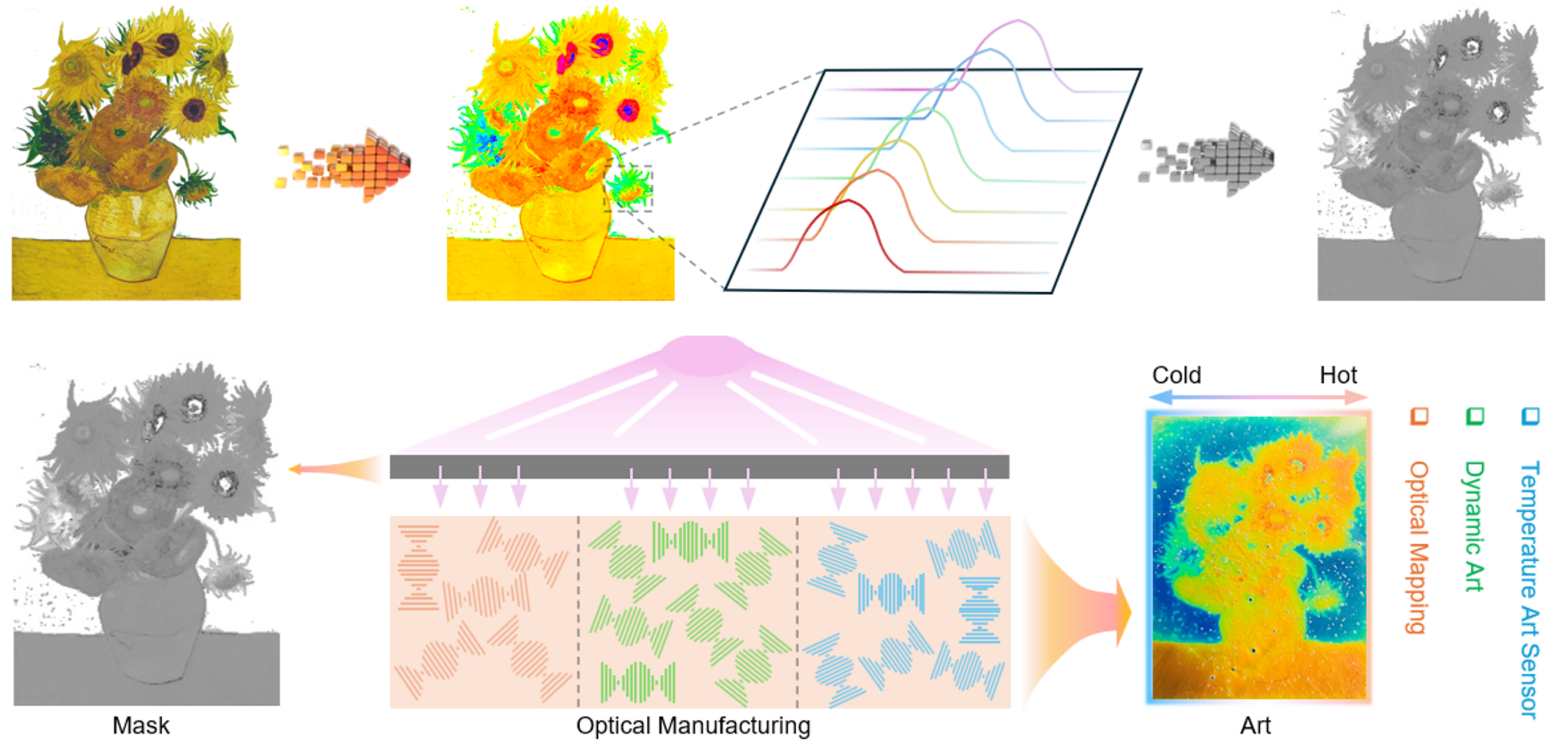
Researchers led by MIE Associate Professor Hongli Zhu have developed a method for writing multicolor images into cellulose-based photonic gels using light. Published in Advanced Functional Materials, the study on “Grayscale Photomasks Enable Noncontact Optical Patterning of Hydroxypropyl Cellulose Gels for Dynamic Art” combines machine-learning-guided calibration with grayscale photomasks to create images in a single 10-second ultraviolet exposure. The patterned gels retain their temperature-responsive colors, allowing the images to change appearance as their surroundings warm or cool.
Structural-color materials produce vivid colors through the interaction of light with organized microscopic structures. Depending on their design, temperature, pressure, humidity, ions, and light can influence their optical response-turning environmental changes into visible color signals.
Zhu’s group began this research in 2017, publishing its first study in Advanced Optical Materials in 2019, followed by work on color tuning in Advanced Materials Interfaces that same year. The research expanded to responsive photonic gels in ACS Nano in 2024, then to cellulose sensing in Advanced Optical Materials and computer-vision-guided camouflage fibers in ACS Nano in 2025.
The latest study adds the ability to program different colors across one continuous gel. By controlling the ultraviolet dose through a grayscale photomask, the team translates digital designs into responsive structural-color images. This proof of concept opens possibilities for dynamic artwork, interactive materials, and visual indicators.
Explore the group’s publications.
Abstract:
Hydroxypropyl cellulose (HPC) forms cholesteric photonic gels with dynamic structural color, but most HPC systems are tuned globally or patterned through serial fabrication. Here we report a mask-encoded parallel photonic manufacturing strategy that locally regulates the reflected wavelength of acrylamide-containing HPC (AM-HPC) photonic gels. UV-induced photopolymerization produces a dose-dependent blueshift consistent with cholesteric-pitch compression, yielding a 204 nm (662–458 nm) tuning window in 68 wt.% AM-HPC under time-controlled exposure and spatial features down to 50 µm. To translate this response into programmable manufacturing, we combine Gaussian-process active-learning calibration with an experimentally measured mask-opacity-to-UV transfer function. This workflow converts two-dimensional target wavelength fields into grayscale optical masks, enabling spatially varying UV doses to be delivered simultaneously across a continuous, unsegmented gel. A single 10 s exposure produced multilevel structural-color images with an 85 µm mask-pixel pitch (13 840 pixels cm−2) in a continuous gel. The patterned gels retain thermally responsive structural color, allowing dynamic modulation of encoded images. These results establish a proof-of-concept digital-to-material workflow for parallel, composition-specific programming of apparent structural color in continuous HPC photonic gels.