Making His Research Matter: From Lab to Practical Applications
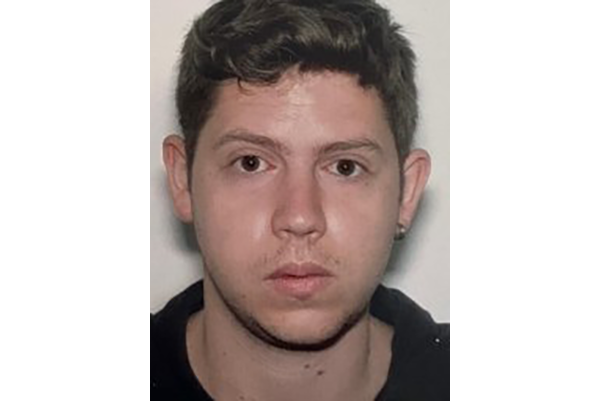
Portrait of Francesco Pessia. Photo sourced from LinkedIn.
Francesco Pessia, PhD’27, electrical engineering, develops machine learning systems for autonomous antenna calibration at the Mentis Lab in collaboration with the Institute of Intelligent Networked Systems. After graduation, he plans to transform his research into practical applications—either through industry or by launching his own startup in wireless communications technology.
Francesco Pessia is pursuing a PhD in electrical engineering at Northeastern, with a concentration in communications, control, and signal processing. While completing his bachelor’s and master’s degrees in electrical engineering at UC Irvine, he began developing relevant skills needed for the rapidly growing field of machine learning which now informs his work in the PhD program.
Connections to opportunities
With both of his parents in academia, Pessia has always felt inspired to pursue higher education. While at UC Irvine, he marveled at the plethora of research opportunities in America and began applying to PhD programs. His advisor had a connection to Northeastern, which is how he learned about the program as well as the university’s academic reputation. His advisor also spoke very highly of Northeastern’s assistant professor of electrical and computer engineering, Francesco Restuccia, who happened to be visiting Irvine at the time. Pessia connected with Restuccia and was invited to join him at Northeastern. As Pessia puts it, “He immediately understood my potential, gave me an offer, and I did not say no.”
Pessia has blunt advice for prospective PhD students: If you are pursuing the degree for prestige alone, don’t. As he puts it, “You need to put passion, dedication, your blood into it.” He’s learned firsthand that genuine interest in your research topic isn’t just helpful—it’s essential for surviving the long hours, failed experiments, and high-stakes deadlines that define doctoral work. Without that intrinsic motivation, he warns, the challenges will feel insurmountable rather than worthwhile.
Research
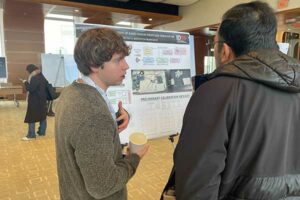
Pessia presenting his research at an expo. Courtesy Photo.
Pessia’s research, conducted in collaboration with the Mentis Lab and the Institute of Intelligent Networked Systems, focuses on using machine learning to calibrate antennas based on environmental conditions. His role centers on building the digital system that collects environmental data from sensors and processes it in real time.
The key challenge is developing an algorithm that can filter the incoming data stream—identifying and retaining only the information relevant to the machine learning model while discarding the rest. In essence, Pessia creates the intelligent data pipeline that trains the model to calibrate antennas autonomously.
He enjoys the lab environment and is especially pleased to work with capable lab mates who are willing to collaborate and share resources so generously with one another, as Pessia has not always found that to be the case. This research has equipped Pessia with highly marketable skills, and he is confident there is strong industry demand for his expertise in real-time data processing and machine learning systems.
Gratitude and future plans
One course that particularly influenced Pessia was High Performance Computing, taught by COE Distinguished Professor David Kaeli. What made the course fascinating, Pessia says, was how Professor Kaeli drew on his dual background in both industry and academia to contextualize the material. Learning from someone who had navigated both worlds gave Pessia valuable perspective on how the technical concepts translated to real-world applications.
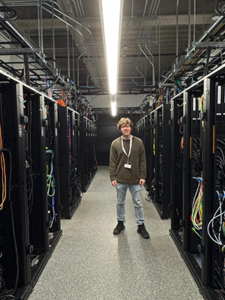
Pessia with the server infrastructure at Northeastern’s Burlington campus. Courtesy Photo.
Pessia is grateful for the vast resources provided during his PhD, stating that without Northeastern, “it would have been impossible for me to develop my research. You can have all the ideas, but if you do not have the actual objects to prototype and make your research practical, then it sort of ‘stays in the sky’.”
He believes the rigorous working environment of Northeastern produces highly motivated and dedicated students that Pessia appreciates collaborating with, and as he puts it, “finding a like-minded group of hard-working people is not that easy.” He recognizes that having access to the right resources and working with such equally driven people is what enables him to complete his work.
After completing his PhD, Pessia aims to transform his research into practical applications. He is weighing two paths: joining an industry research role closely aligned with his work, or taking the entrepreneurial route and launching a startup based on his antenna calibration technology.
What drives him, ultimately, is a desire to make his life meaningful through work that contributes to society. As he puts it, he wants to give “a contribution to mankind.” Whether through industry or entrepreneurship, Pessia’s dedication to solving real problems will advance machine learning applications in wireless communications—bringing smarter, more adaptive antenna systems into the world.