Non-Linear: How Matthew Fei Found His Passion in Chemical Engineering

Portrait of Matthew Fei. Courtesy photo.
Matthew Fei, BS’26, chemical engineering, has completed two co-ops and worked as a research assistant for two labs at Northeastern. With his passion for chemical engineering and creating an impact on the world, Fei is planning to pursue higher education before heading into industry, with ambitions to create his own company in the future.
Matthew Fei graduated with a bachelor’s degree in chemical engineering from Northeastern this spring, with an additional minor in materials science. However, looking back at his experiences in his undergraduate degree, his younger self would have never anticipated the path he would walk to get to where he is now.
Growing up, Fei had always been drawn to science. In high school, biology was his strongest subject, so when it came time to apply to college, he set his sights on that field with intentions of going into medicine. He ended up attending UMass Amherst as a chemistry major for his freshman year, which Fei half-jokingly calls “an accident,” given that he couldn’t recall why he chose chemistry over biology. He initially planned to transfer back to biology, until he took their chemistry department’s newly created advanced chemistry course. This course filled in gaps from his high school education and made him realize that chemistry intrigued him far more than biology ever did. As Fei was looking for ways to apply his chemistry knowledge to make an impact, he took an introductory chemical engineering class. Here, he found he was able to solve real problems using his passion for chemistry, and decided to fully commit to chemical engineering.
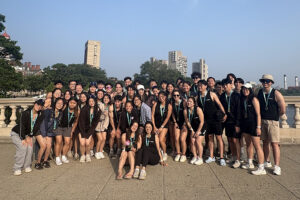
Fei with his dragon boat team on the Harvard Bridge. Courtesy photo.
UMass Amherst, however, wasn’t where Fei envisioned building his future. He planned to transfer from his first semester, as he found it was challenging to find experiential opportunities such as internships at UMass Amherst. Knowing he wanted the chance to gain valuable industry or research experience down the line, he admired Northeastern’s academic rigor and prime location in the city of Boston, as well as the support of the Co-op Program to secure internships in industry. He transferred at the start of his second year, officially declaring chemical engineering as his major.
Fei’s research journey
Fei’s research career has been a non-linear one. At UMass Amherst, he was only able to read through research papers, without gaining any wet lab experience. At Northeastern, he was determined to change that. Although the process of cold emailing and meeting with professors was long, Fei was able to secure his first project experience during his first year at Northeastern, helping the chemistry department’s Smotkin Lab design a small power generator and a circuit board model to teach community members about how power grids work. While he was glad to have been a part of the project, Fei hoped to find a lab that better aligned with his research interests.
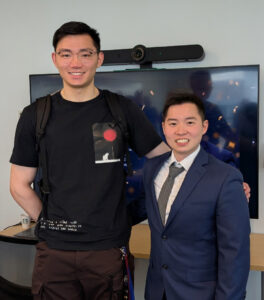
Fei (left) with his research mentor, Kevin Yang. Courtesy photo.
Juggling internships and student organizations made it hard to pursue research aggressively, and many of his leads went nowhere. Heading into his fourth year, Fei was anxious, as he knew that getting into graduate school would require meaningful research experience, and felt behind in his progress. Learning from this, Fei advised that “the best thing you can do for yourself is get back up and keep moving forward.” During the summer leading up to his fourth year, Fei was able to shadow two graduate students from different labs: the Zhao Research Group and the Center for Renewable Energy Technology (NUCRET), both at Northeastern. He joined both labs as an undergraduate researcher at the beginning of that year.
His work in each lab centered on carbon dioxide reduction—a way to capture and repurpose CO₂ emissions rather than letting them accumulate in the atmosphere. In Zhao’s lab, Fei mainly worked on computer simulations to predict how different materials can be used to drive and control chemical reactions. He analyzed different molecules attached to a catalyst—a substance that speeds up a chemical reaction—then mapped out the reaction pathway to model different energies and thermodynamic forces. At NUCRET, Fei did similar work but took a more hands-on approach, running lab experiments to test how tweaking a material’s chemical makeup affects how well it performs as a catalyst.
Fei recognizes the opportunities Northeastern provides to students working on research. He mentions that presenting at Northeastern’s RISE Expos allowed him to further practice his communication and presentation skills, building his confidence in talking about his complex research interests. He was also given the PEAK Summit Award for the spring semester of this year, providing funding for his research in NUCRET.
Co-op experiences
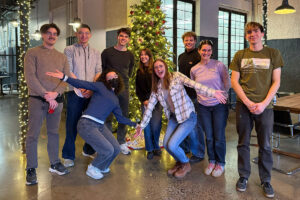
Fei (second from the left) with the Process R&D team at Sublime Systems. Courtesy photo.
Fei’s first co-op was at Kytopen, a cellular engineering company. As a Technology Innovation co-op, Fei’s main tasks involved conducting performance tests on Kytopen’s products, collecting data from these experiments, and using it to innovate their product’s performance. This experience strengthened his skills in data analysis, experimental design, and interpersonal communication—and he enjoyed being able to use his chemical engineering knowledge to make informed decisions about their experimental processes. He also found a mentor in his supervisor: a highly experienced engineer whose weekly check-ins became a highlight of the experience. Fei made a habit of asking for one life lesson per meeting, getting far more than just career advice in return.
His second co-op was at Sublime Systems, a startup focused on producing commercial zero-carbon cement. As cement manufacturing usually has negative environmental effects, their goal is to improve upon their novel process to create sustainable cement. As a process R&D co-op, Fei’s experience focused on working with reactor systems to expand and optimize their process. Beyond technical knowledge, he enjoyed developing his professional skills in a positive and inclusive environment with his co-op cohort.
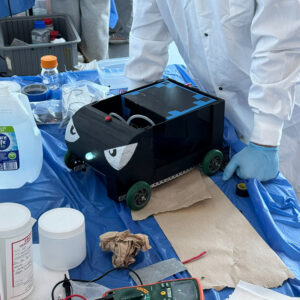
Fei’s Chem-E-Car, designed to look like Bullet Bill from the Mario Kart racing game. Courtesy photo.
Extracurriculars
Outside of academics and internships, Fei threw himself into campus life. One of his main commitments was his role as treasurer for the Society of Asian Scientists and Engineers (SASE). His duties included managing the club’s budget, fundraising, and events––even creating merchandise to raise additional funds. This club perfectly aligned with Fei’s interests, and was the environment where he developed his social life when he first arrived at Northeastern. He also gained helpful leadership experience from this role, as well as developing his organizational and time management skills.
Another club that Fei was heavily involved in was the Chem-E-Car team, a student group that designs and builds cars powered by chemical reactions. As a Power Reaction lead, it was Fei’s job to find a suitable chemical reaction to power the car. His team designed and built a zinc-air battery to power their car for that year, aligning with his goals in sustainability and R&D leadership.
Lessons and ambition
For engineering students deciding what path to pursue, Fei provides some guidance on why he chose his major. While chemical engineers are not as “flashy”—not building robots or rockets from scratch—he explains that they “have the most potential to tackle the world’s current challenges,” such as energy sustainability and biotechnology. Given that they work closely with raw materials and their conversion, Fei believes that chemical engineering has as much, if not more impact than the other engineering disciplines, even if they are not creating novel technologies.
He also encourages students to get involved in extracurricular activities, such as clubs, organizations, and research. As a transfer student, Fei found it difficult to make friends when he first came to Northeastern, and participating in clubs was how he met new people while also exploring his personal interests. Additionally, taking part in academic research can be intellectually rewarding and allows students to explore career options early. Fei shares that undergraduate students have more flexibility with their time, and “taking part in these extracurriculars is one of the better ways to make use of your time in college.”
After graduation, Fei will pursue a master’s degree, with plans to eventually pursue a PhD for the opportunities it can provide in industry. He wants to develop technologies that make a tangible difference in the world, and he’s open to eventually creating a startup—due to the positive experiences he had in that environment. Most of all, Fei hopes to use his chemical engineering knowledge to create positive impact in society, and due to his vast array of experiences at Northeastern, he feels equipped with the necessary skills to spark innovation in any professional setting.