Northeastern Co-Op Secures Cloud Infrastructure for United Nations
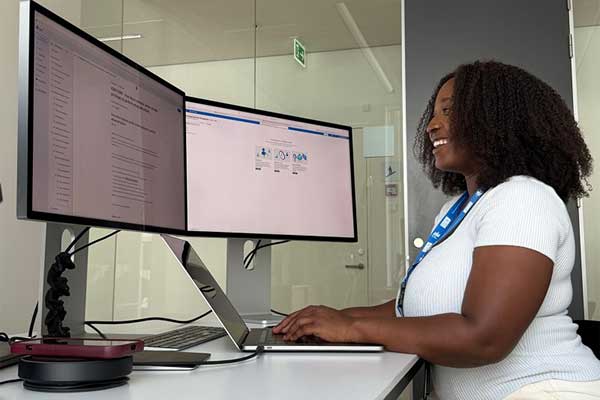
Northeastern software engineering systems graduate student Grace Awuma completed a global co-op with the United Nations Development Program in Copenhagen, Denmark, securing data and managing global access permissions for its cloud infrastructure services team.
This article originally appeared on Northeastern Global News. It was published by Cyrus Moulton. Main photo: A co-op working in cloud services helped Grace Awuma transition to a future in technology. Courtesy Photo
Grace Awuma worked in cloud security at the UN Development Program
This grad student completed a co-op with the cloud infrastructure services team for the United Nations Development Program in Copenhagen, Denmark.
The United Nations Development Program is on the ground in roughly 170 countries and territories helping to eradicate poverty, reduce inequalities and build resilience.
Its data and digital resources, meanwhile, are in the cloud – a global network of remote servers on the internet used to store, manage and process data – and Northeastern University co-op Grace Awuma is one of its gatekeepers.
“We are the center of the entire world when it comes to the (United Nations Development Program),” said Awuma, who is earning her master’s degree in software engineering systems at Northeastern. “We do the management, and we grant access to who should see what, which data you should be able to access so that data will not be leaked, and also we secure the data that every country office would want to secure.”
Awuma recently completed a co-op with the U.N. in Copenhagen, Denmark, where she worked on the cloud infrastructure services team.
It’s quite a different place and a different role for Awuma compared to four years ago.
Awuma is from Ghana and earned her undergraduate degree in communication studies from the Ghana Institute of Journalism (now the University of Media, Arts and Communication).
But while working as an administrative officer at the Presbyterian Church of Ghana following graduation, Awuma had to deal with a customer relationship management system, a database that managed the organization’s data and records. Unfortunately, the system made it very difficult to retrieve individual records, requiring that users export the entire database into Microsoft Excel or Word and manually search for what was needed.
“It was really tedious, especially when you were dealing with time-sensitive requests,” Awuma said.
When a team of engineers came in to fix the system, Awuma noticed a woman on the team.
“I was so impressed,” Awuma said. “In Ghana, it’s very rare for you to see a lady who is a software engineer.”
The woman encouraged Awuma to visit her office and then try a three-month certificate course in software engineering.
Awuma enjoyed the course. However, there was one problem. Awuma said it is very difficult in Ghana to go from a non-technical degree into a tech-related program at a university, especially if, like her, you didn’t study science or technology in high school.
Read full story at Northeastern Global News