Opportunities and Avenues: Colin Gallagher’s Path Through Chemical Engineering

Colin Gallagher is pursuing a PhD in chemical engineering at Northeastern. He completed his bachelor’s degree in chemical engineering at Pennsylvania State University, and through coursework, research, and internships gradually discovered where his true interests lay: electrochemical systems and sustainability-focused research. His parents, both of whom hold graduate degrees, inspired him to pursue a doctorate and continue to serve as a source of guidance throughout his academic and professional life.
Boston drew him to Northeastern initially—an exciting city with no shortage of opportunity. Further research confirmed the fit: a strong academic reputation, highly accomplished faculty in the chemical engineering department, and a wide range of research opportunities. When he found the Zhao Group, he recognized it as the right environment for the work he wanted to do.
Research at the Qing Zhao Group
As a member of the Zhao Group, Gallagher uses computational tools to build detailed models of how chemical reactions occur on the surfaces of solid materials—a field known as heterogeneous catalysis. By studying how small molecules interact with these surfaces, researchers can better understand why certain materials are able to convert one molecule into another more quickly or with less energy than others. One of the key advantages of this computational approach is that it allows researchers to evaluate and compare potential catalysts—substances that accelerate chemical reactions—before committing to physical experiments.
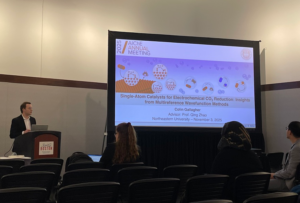
Colin Gallagher presents at AIChE Conference in San Diego.
Gallagher is also pushing at the limits of conventional modeling tools. While those tools offer a practical balance between computational cost and chemical accuracy, he notes that “the quantitative accuracy in many cases is still up for debate.” His work demonstrates that applying more advanced theoretical approaches can yield more reliably accurate predictions, particularly in cases where conventional methods fall short. “Quantitative accuracy is critical to unlocking the full potential of computational tools,” he says. By checking his results against real experimental data, he and his collaborators are developing a new method that could sharpen the predictive power of computational chemistry and open new directions for the field.
Since joining the Zhao Group, his primary focus has been using computational tools to study catalysts for converting CO₂ into other compounds through electrochemical reactions—work with direct implications for carbon capture and sustainability. The group has published across multiple scientific journals; Gallagher’s latest work was recently published in the Journal of Catalysis, a leading publication in the field.
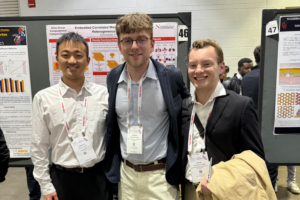
Gallagher stands with fellow researchers in front of their poster describing work done in the Zhao Lab.
Outside of research, Gallagher served as the first-year representative of the Chemical Engineering Graduate Student Council. “It was a unique opportunity to meet and connect with more senior graduate students that I may not have had otherwise,” he reflects. The experience gave him a sense of community among like-minded peers and taught him the value of being part of a larger team. He has also participated in LEADERs, a professional development program at Northeastern that has helped him reflect on his growth, sharpen his professional skills, and develop a clearer picture of the kind of career he wants to build.
Mentorship and Lessons
Throughout his time at Northeastern, Gallagher has been grateful for the guidance of his advisor, Assistant Professor Qing Zhao. As her first PhD student, he has been part of building the research group from the ground up—an experience he describes as genuinely rewarding. “Dr. Zhao strikes an incredible balance between providing insightful mentorship while also advising multiple students and postdocs, all while managing a research lab,” he says. She has consistently recognized his capabilities while pushing him to develop further—modeling, in his view, what a great advisor looks like. “Great advisors keep students at the edge of their comfort zone,” he reflects. “With time, the comfort zone expands as the student becomes more knowledgeable and confident and begins to unlock their full potential.”
Gallagher has also valued several electives in the Chemical Engineering department, singling out the Experimental Electrochemistry course taught by Associate Professor Josh Gallaway. Coming from a computational background, he appreciated the opportunity to connect course content to the methods and equations he regularly encountered in experimental literature. “Seeing where they come from, how they work, and why they are important gave me that full-circle moment that I would not have otherwise gotten without taking the course,” he says. He also appreciated that Professor Gallaway was genuinely engaged with student questions and cared not just about mastery of the material, but about students understanding its practical significance.

Outside of academics, Gallagher achieves work-life balance through his music pursuits, shown here as he performs in clubs around Greater Boston.
As he nears the end of his program, the most important lesson Gallagher has taken from Northeastern is the value of asking the right questions—specifically, asking “why”:
“In graduate school, the most effective problem-solving occurs when you start asking yourself ‘why?’ When faced with a challenge, the moment you start asking ‘why?’ is the moment you start to hypothesize, and then you start thinking of ways to test your hypotheses. While your first hypothesis may not always be correct, it brings you one step closer to solving the problem. Good graduate students can always find ways to circumnavigate a challenge, but great graduate students know how to address challenges head-on.”
Future Plans
Gallagher is optimistic about what comes next and open to a range of paths. An internship prior to Northeastern sparked an interest in working with companies committed to becoming more sustainable and energy efficient, and that interest has only deepened through his doctoral research. Equipped with a strong research background, he can see himself thriving in industry or academia, with particular interest in electrochemical systems research, catalytic process engineering, and sustainability consulting. He is not worried about finding the right opportunity—Boston and Northeastern’s networks, he notes, offer no shortage of them. Whatever direction he takes, his goals remain consistent: to advance the field of computational chemistry and use his expertise to make a meaningful contribution to sustainability.