Optimizing Energy Absorption in Lattice Structures via Intermediate Stochasticity
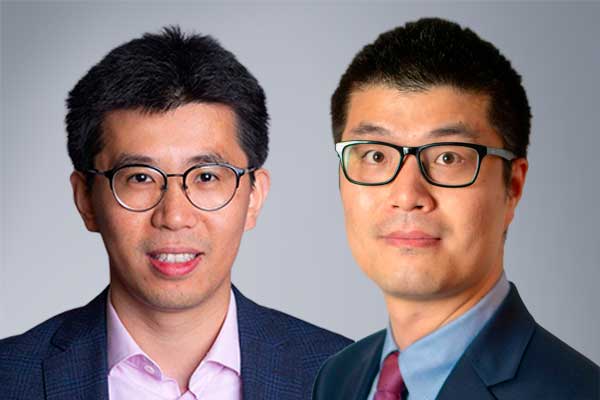
MIE Assistant Professors Juner Zhu and Ruobing Bai published their research on “Exploring the Role of Stochasticity in Lattice Structures for Crush Energy Absorption Capabilities” in Thin-Walled Structures.
Abstract:
This work presents a systematic study of the relationship between structural stochasticity and the crush energy absorption capability of lattice structures, with controlled stiffness and weight. We develop a Voronoi tessellation-based approach to generate multiple series of lattice structures with either equal weight or equal stiffness, smoothly transitioning from periodic to stochastic configurations for crush energy absorption analysis. The generated lattice series fall into two categories, originating from periodic honeycomb and diamond lattice structures. A new stochasticity metric is proposed for quantifying the structural stochasticity and is compared with the state-of-the-art stochasticity metrics to ensure a consistent measurement. The crush energy absorption properties are obtained using explicit finite element analysis and we observe similar stochasticity-property trends in simulations using both elastic-plastic and hyperelastic materials. We report a new observation that an intermediate level of stochasticity between periodic and high randomness leads to the best crush energy absorption performance. Our analysis reveals that this optimal performance arises from enhanced activation of deformation hinges, promoting efficient energy absorption.