Research, Industry, and Innovation with Haichao Zhang
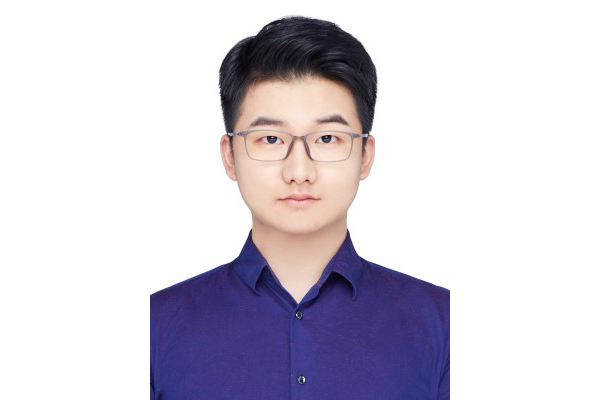
Portrait of Haichao Zhang. Photo sourced from LinkedIn.
Haichao Zhang, PhD ’27, computer engineering, is currently working at the SMILE Lab at Northeastern. Combining vast project experience and industry collaboration, Zhang continues to develop cutting-edge research in the ever-evolving field of AI.
Haichao Zhang is a PhD candidate in computer engineering at Northeastern University. Prior to Northeastern, he completed his master’s degree in computer science at Zhejiang University in 2021. His early work centered on computer vision and generative AI, with the goal of performing AI research as a faculty or scientist after getting his PhD—he has since expanded into video foundation models and their real-world applications.
SMILE and AI research
Zhang was drawn to Northeastern for its extensive research environment, including strong pathways for industry collaboration and research co-ops. While working within the SMILE Lab, Zhang saw that the collaborations across academia and industry expose students to diverse perspectives and real-world constraints, often shaping research questions around scalability, reliability, and deployment. Zhang, who admires Northeastern’s computing research strength, has been inspired by many lab alumni who have taken faculty positions in the U.S. and abroad. Zhang actively studies their trajectories and is mentored on how to build a durable, high-impact research agenda. He is advised by Distinguished Professor Yun Raymond Fu, an ACM Fellow, AAAI Fellow, and a member of Academia Europaea and the National Academy of Inventors.
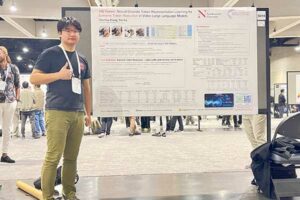
Zhang presenting his research at NeurIPS 2025. Courtesy Photo.
Zhang’s research at the SMILE Lab focuses on making video foundation models more practical and efficient. While modern video large language models show promise, they are computationally expensive and difficult to deploy in applications requiring large-scale retrieval or processing long sequences of user history.
His work develops compact video representations that preserve important semantic information while reducing computational bottlenecks. This allows models to leverage the power of large language models more efficiently for broader, real-world applications. More recently, Zhang has been exploring predictive “world models”—systems that learn the underlying dynamics from video data to forecast how scenes will evolve over time. This shifts the focus from simply understanding static video content to predicting and reasoning about future states.
Zhang gained valuable experience during a research internship at LinkedIn, where he worked on VideoLLM technology. The team initially questioned whether his research ideas would translate to their video recommendation platform, which required practical, scalable solutions. By focusing on scalable design and deployment constraints, Zhang proved his work could bridge the research-to-practice gap. He built LinkedOut, LinkedIn’s first video recommendation system using multimodal language learning models, which achieved state-of-the-art performance and significantly outperformed the existing commercial model in internal evaluations.
The experience strengthened Zhang’s expertise in video understanding, large-scale recommendation systems, and efficient deployment. Just as importantly, the team’s collaborative approach accelerated his research process and enhanced the experimental rigor in his subsequent publications at Northeastern.
One class that shaped Zhang’s approach to research communication was Professor Fu’s Information Visualization. It emphasized rigorous storytelling with data—how to design effective demonstrations, present evidence clearly, and explain complex research to both technical and non-technical audiences. As Zhang puts it, the course was where “it really clicked” for him.
Planning and Prioritization
Zhang has learned to attain ambitious goals by working step by step. He notes that research rarely follows a straight line. Zhang is motivated by the fast pace of AI innovations, and believes it is essential to adapt quickly, revise assumptions, and treat strong intermediate milestones as real progress, even when the intended target changes. He also emphasizes disciplined planning and prioritization as a way to sustain momentum under uncertainty.
As he approaches the conclusion of his PhD studies, Zhang aims to continue his research career as a faculty member or as a research scientist in an industrial AI lab. He credits Northeastern and the SMILE Lab’s research ecosystem, as well as internship opportunities, with giving him early exposure to real-world problems and production constraints. Looking ahead, Zhang hopes to work in an environment where research can be developed and evaluated against real industrial needs, supported by strong engineering infrastructure and broad dissemination channels. He plans to keep advancing video foundation models and their real-world applications as he moves into his next research role.