Sending Microchips to the Stars Through a Student Co-op
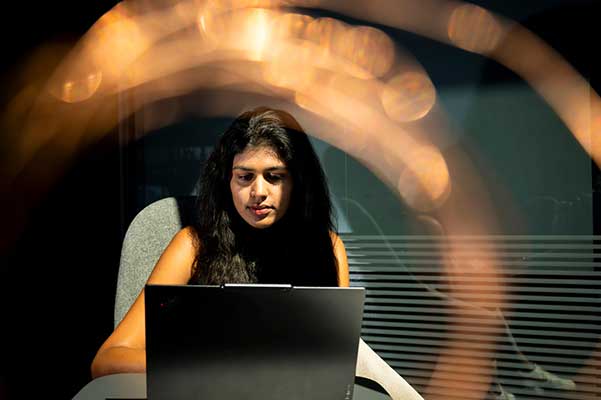
During her co-op at Besxar Space Industries, mechanical engineering and bioengineering student Rhea Dharia, E’27, helped design equipment to test semiconductor manufacturing in the vacuum of outer space.
This article originally appeared on Northeastern Global News. It was published by Rich McKay. Main photo: Rhea Dharia, a fourth year mechanical and bioengineering major, worked as a technician for D.C.-based BESXAR for her co-op. Photo by Alyssa Stone/Northeastern University
Northeastern student sent her co-op work on microchips up on a rocket
Microchip manufacturing’s future could be in outer space.
Rhea Dharia’s summer co-op assignment was to help send a capsule on the tail of a SpaceX Falcon 9 rocket and hope it didn’t break.
Dharia, 21, a Northeastern University senior from Jericho, New York, put aside her hobby of triathlon training and toiled for months earlier this year on a cargo-package for her co-op session as a payload specialist for the D.C.-based Besxar Space Industries. It’s a startup company that is testing technology to produce semiconductors in space.
Dharia’s work involved helping design a canister that would eventually be able to carry a device into space that can cook up a stew of silica sand, primarily made of quartz, and electrically conductive elements. The canister needs to be out of the Earth’s atmosphere so the vacuum of space can suck out any impurities left in the air inside. Then the stew can be heated into the material needed to make microchips.

Rhea Dharia, a fourth year mechanical and bioengineering major, sent her co-op work into outer space. Photo by Alyssa Stone/Northeastern University
The equipment in the capsule had to survive the shocks and vibrations of rocket-travel without breaking. Dharia also helped write test plans and together with a team of five engineers assisted with getting the company’s fabships ready to launch.
The re-usable canisters were called “fabships” which would hold the actual equipment to make the semiconductor material.
Industrial-grade vacuums are expensive to achieve on Earth, but needed to keep impurities from the air getting in the raw materials, said Sabrina Atkin, a mechanical engineer at Besxar, who served as Dharia’s boss.
“We were working at a pretty fast pace and we were a small team [and] she was super eager to learn,” Atkin said of Dharia, who is working toward a bachelor’s of science degree with dual majors in mechanical engineering and bioengineering at Northeastern.
Besxar’s exact process to make the semiconductor material is a company secret. But in general, semiconductors are made from a molten stew of quartz sand and trace elements including boron and arsenic which are superheated in forges, according to the American Chemical Society, a non-profit scientific organization.
Read full story at Northeastern Global News