Student Startup Creates Hands On STEM Toy to Inspire Young Engineers

Mechanical engineering students Nicolas Bejar and Mason Kim co-founded NextTile, a patent-pending student startup supported by the IDEA venture accelerator that creates modular, magnetic building block toys to provide hands-on STEM education for elementary students.
This article originally appeared on Northeastern Global News. It was published by Peter Rubinstein. Main photo: NextTile is now a patent-pending startup that has the backing of Northeastern’s IDEA venture accelerator. Photo by Matthew Modoono/Northeastern University
Student startup develops hands-on learning toy for future engineers
The magnetic squares powered by batteries and filled with circuitry could encourage the next generation of students to pursue STEM.
Nicolas Bejar’s earliest engineering memories date back to his third-grade classroom in San Diego, where he built robots with LEGO Mindstorms.
But Bejar, who is now a third-year mechanical engineering student at Northeastern University, said that his nascent passion for robotics – sparked by the LEGO Mindstorms – was interrupted when he reached middle school. Not because his interest in circuitry and hardware went away, he said, but because there wasn’t a similar, widely available STEM teaching tool for students of that age.
“In middle school, unless you take an active interest and join a robotics club or take advanced physics classes, you’re not truly introduced to circuitry in any way,” he said.
Now at Northeastern University, Bejar and fellow mechanical engineering student Mason Kim have created a product that could fill this hole in the education technology market.
Using the Makerspaces on Northeastern’s Oakland and Boston campuses, the pair came up with a prototype of a modular STEM toy called NextTile. The battery-powered toy, made up of magnetic squares that can be connected in dozens of orientations to produce different visual results, are a hands-on alternative to the theory-based curriculum typical in grade school, the students said.
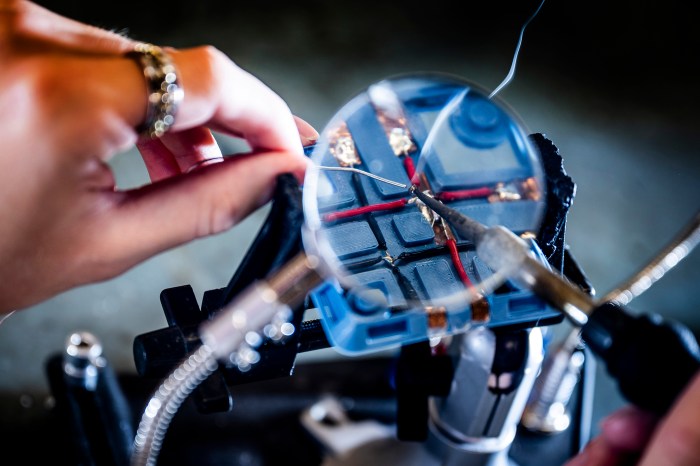
STEM toys represent only about 6% of the global toy market by retail sales, but they are growing about twice as fast as the overall toy industry. Photo by Matthew Modoono/Northeastern University
Tomás Galguera, professor of education at Northeastern University, said children actively construct knowledge while engaging in play, testing theories while developing valuable cognitive skills.
“We know that playing with toys and games can help students feel more comfortable with technical domains, spatial skills, computational thinking and design,” he said. “Preserving ample time and space for children to tinker … is one of the best things we can do to maximize the probability of future scientists.”
Read full story at Northeastern Global News