Sustainable Development Through Engineering Experience
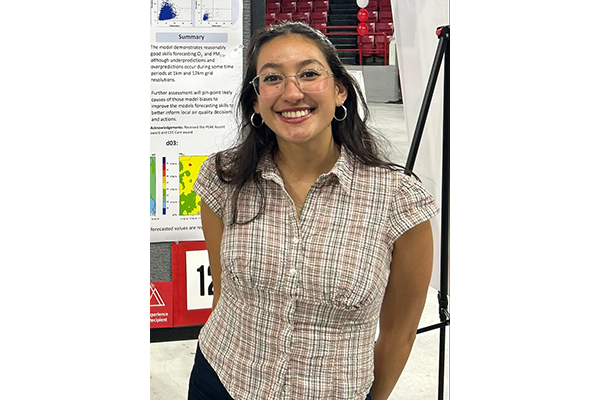
Portrait of Olivia Ciaravino. Courtesy photo.
Olivia Ciaravino, E ’25, environmental engineering, currently works full-time at Bohler. Through classes, co-ops, research, and Dialogues of Civilizations, she has built the skills and experience to pursue a career centered on sustainability and community development.

Ciaravino and peers with their graduation plaques. Courtesy photo.
Olivia Ciaravino graduated from Northeastern last year with a bachelor’s degree in environmental engineering. Before college, she had broad interests in science and the environment, but her passion for sustainability didn’t fully crystallize until the end of high school—and she never expected to study engineering. She started college as an environmental studies major. When researching universities, location and academic opportunity were her primary criteria. Northeastern’s Boston campus appealed to her for its urban energy while still offering the enclosed, campus-like feel she was looking for. The university’s academic reputation, its research opportunities, and its options for undergraduate study abroad convinced her that Northeastern would give her the “true college experience” she was after.
That first year as an environmental studies major, however, didn’t quite fit. After exploring related fields and talking with peers in the civil and environmental engineering department, she made the switch to environmental engineering—a change she describes as simply “more aligned with what I wanted to do.”
Co-ops and Research
Ciaravino’s first co-op was at VHB, an engineering consulting firm, where she worked as a land development intern. Day-to-day work involved using CAD and other design software to review plans for potential development sites. As her first professional experience, it taught her how to draw on available resources and push through the challenge of picking up new skills on the job. Her second co-op took her to BlueWave, a solar energy development company, where she evaluated land plots for solar potential and reached out to landowners about possible development deals. She also built skills in mapping software and gained an understanding of how the energy industry operates.
Ciaravino also worked as a research assistant in the Cascade Lab at Northeastern, where her main project involved running an air quality forecasting model and comparing its outputs to readings from government sensors to evaluate accuracy. She sees the work as increasingly urgent as climate change drives more frequent wildfire events and pollution episodes. She also noticed an equity dimension: poor air quality disproportionately affects low-income neighborhoods, yet government monitoring stations are often too sparsely distributed to capture localized spikes. The forecasting model helps fill those gaps, giving decision-makers better information to protect the communities most at risk. Being the only undergraduate in the lab required her to work independently and manage her own time—skills, she notes, that matter to future employers. She received the PEAK Ascent Spring 2025 Award for this research, a program she discovered later in her experience than she would have liked. She found the application process straightforward and credits her professors and teaching assistants for guiding her through it—and she encourages other students not to wait as long as she did to apply.
Her Engineering Capstone project rounded out her applied experience. Her team developed a master plan to increase renewable energy use on Northeastern’s Oakland campus, examining how solar panels, battery storage, and electric vehicles could be integrated into existing infrastructure—along with the financial implications and projected carbon savings. The team connected directly with Oakland campus stakeholders who could realistically implement the plan, bringing a practical dimension to what might otherwise have been a theoretical exercise. Like her Cascade Lab research, the project gave her practice setting her own deadlines and taking ownership of work she genuinely cared about.
Important Experiences, Advice, and Future Plans
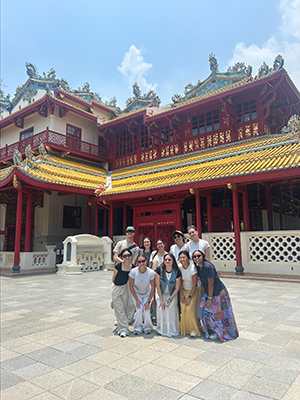
Ciaravino on her second DOC. Courtesy photo.
Two Dialogues of Civilizations stood out as highlights of Ciaravino’s time at Northeastern. The first took her to Sardinia, Italy, with a focus on waste treatment—visiting paper and compost recycling facilities and studying a region recognized as a leader in waste processing. Comparing Italian and American practices gave her a sharper picture of where the U.S. has room to improve. The second Dialogue, centered on climate change and emerging economies, brought her to Thailand and Indonesia, where she worked alongside students from a range of backgrounds to discuss sustainable development in smaller, growing economies. Her favorite part was the final project, in which each student represented a different country to debate solutions and strategies for addressing climate change. Beyond the academics, both trips gave her lasting friendships and prompted meaningful personal reflection—including a clearer sense of how much she values new experiences and the people she meets through them. She recommends these programs without reservation, counting them among her best memories at Northeastern.
Reflecting on her path, Ciaravino’s advice to current students is simple: “You’re going to figure it out eventually.” She spent time early in her degree worrying that she was switching majors too late. Looking back, she is certain it was the right call. “It’s better to switch later than never—it’s worth it to take more classes if you’re doing something you enjoy.”
Ciaravino currently works full-time as a staff engineer at Bohler, a land development consulting firm. Over the past year she has developed a clear passion for sustainable, community-focused infrastructure, and hopes eventually to move into the world of landscape architecture—a field that would let her blend her engineering foundation with the creative dimension she wants to develop further, in service of both the environment and the people who live in it. The skills and the space to explore that Northeastern gave her will continue to shape her career, guided throughout by a commitment to sustainability.