The Family Blueprint: Three Siblings’ Journeys with Mechanical Engineering
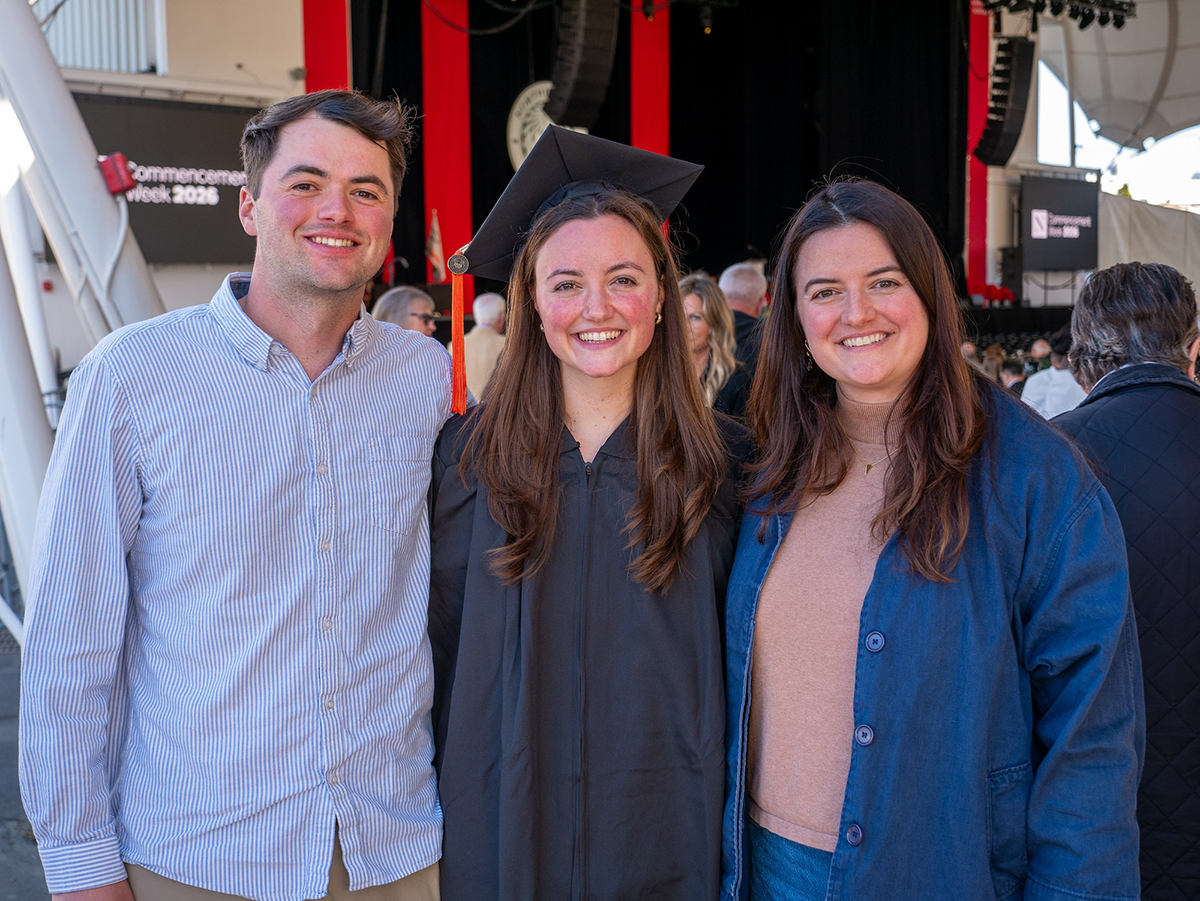
Portrait of Kevin, Kayla, and Carly (in order) at Kayla’s commencement this April. Photo by Bella Martinez/Northeastern University.
Carly, E’18, Kevin, E’21, and Kayla Parlato, E’26, have all graduated from Northeastern with mechanical engineering degrees. Inspired by their engineering father, they were all drawn to the same discipline, yet carved their own paths using the opportunities and resources Northeastern provided.
Origins and inspiration
Carly, Kevin, and Kayla Parlato all graduated with bachelor’s degrees in mechanical engineering from Northeastern University, and although they share the same degree, their career paths vary widely. Their story begins with their father, who is also a mechanical engineer, and the first of his family to become one. A graduate of Brooklyn Polytechnic University (now part of NYU), he made sure his children were aware of the opportunities before them, especially in engineering. Carly, the oldest, always had a hands-on mindset with a passion for creating things, so engineering was a natural direction. In high school, she and her sister were deeply involved with their school’s FIRST Robotics team, which further encouraged her ambitions. Kevin, the brother between them, had a strong interest in physics and entrepreneurship, and knew from his father that engineering was the best way to combine those passions while building a foundation toward product development.
Their father was especially influential to Kayla, the youngest, who spent much of her childhood building projects with him in their home workshop. While he sparked her passion for engineering, tracking her older siblings’ coursework and co-ops fueled her fascination. Her siblings were also pillars of support, always willing to answer any questions she had about an engineering career.
Not all of the Parlato siblings took the engineering path—Kristin, the second oldest, followed a different path, citing her mother’s creative spirit as inspiration. She graduated from the University of Pittsburgh in 2018 with a degree in marketing and now works as a sales and marketing operations specialist for Infectious Disease Connect.
Decisions and specialization
When Carly began her college search, she knew she wanted a school in a city with a strong engineering program. That narrowed the field somewhat, but once she toured Northeastern’s Boston campus, it became her first choice. In her own words, “the quality of the students” was what stood out––recalling that students approached her when she was lost to ask if she needed help. That maturity and confidence was the biggest draw, as she wanted to be among like-minded, ambitious peers. She was also drawn to Boston’s energy as a college town with strong industry ties.
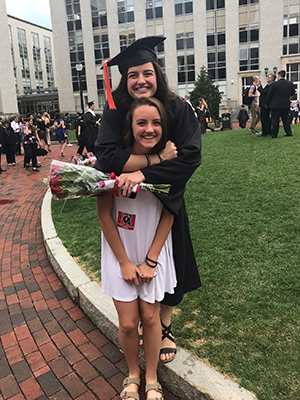
Carly and Kayla at Carly’s graduation in 2018. Courtesy photo.
While attending that same tour, Kevin also saw the school’s resources and accomplished student body firsthand. Like his sister, he appreciated Northeastern’s Boston location, especially how well it blends into city life, offering both a campus feel and access to urban opportunities. The co-op program was one of his biggest deciding factors, as he valued the chance for hands-on experience before graduation, stating “I know Northeastern is probably the best school out there for that.”
Based on her older siblings’ experience, Northeastern was also Kayla’s top choice, with their successes in the co-op program being a significant factor. She was drawn to how well it prepares students for industry, noting, “Northeastern creates students that are really serious about being good workers.” A family friend who works at an engineering firm reinforced this: he noticed that Northeastern co-ops were consistently mature and self-driven, initially thinking he had gotten lucky with the student assignments. As the pattern continued, he realized the university itself was producing great workers—and now he only hires candidates from Northeastern.
Each of the three siblings embraced mechanical engineering in their own way. From Carly’s perspective, mechanical engineering offers the strongest foundational skills while remaining versatile enough to apply across industries. Kevin recognized that mechanical engineering let him apply physics in fascinating ways while learning the entire process of product manufacturing. For Kayla, it was the obvious fit for her love of building—the most hands-on branch of engineering. While they all studied the same degree, they each carved out their own individual niches within the field. Carly gravitated towards aerospace, with a focus on manufacturing. Kayla also entered aerospace manufacturing but was drawn more to the design and innovation side. Kevin pursued a double major with physics, applying it to product design while exploring the startup and entrepreneurial space.
Extracurriculars and mentorship

Carly and her Hyperloop team. Courtesy photo.
Carly tried many clubs at Northeastern, including joining the founding team of Generate, a product development club on campus, and competing in SpaceX’s Hyperloop Pod competition to develop high-speed vacuum transportation systems. The club worked closely with SpaceX, using their testing sites and meeting employees—an experience Carly credits with helping her land a job there after graduation. Kevin was also a member of Generate, most notably developing a custom insole for people with nerve damage and a VR headset that aids doctors in diagnosing neurological conditions. In her first year, Kayla joined AerospaceNU’s propulsion team, where she worked on testing liquid rocket engines, gaining mentorship from senior peers, and building a network of connections that helped her land her first internship and launch her aerospace career.
Both Carly and Kayla highlight Professor Andrew Gouldstone and Associate Teaching Professor Mehdi Abedi as important mentors. Both sisters had Professor Gouldstone in class, and credit his supportive teaching style for their success—Carly noted that he “was very in-tune with the students, he knew who you were and what your goals were.” Professor Gouldstone also advised AerospaceNU’s propulsion team, where Kayla benefited from his direct mentorship, saying, “he enabled us to do so much”—even arranging for students to safely test their engines at a private airport.
Professor Abedi advised both Hyperloop and the propulsion teams and served as Kayla’s Engineering Capstone project advisor. He guided students through complex topics while emphasizing a key lesson: do not be afraid to fail. As young engineers, he reminded them, they were in an environment designed for learning from mistakes––a mindset Kayla carried into her co-op search and beyond. Carly recalls a computational fluid dynamics elective with him fondly, noting that his passion made the material genuinely engaging.
Learning through co-op experiences
All three siblings completed three co-ops during their time at Northeastern. Carly began at Medtronic, working on the Hugo System, a robotic surgical device. She contributed to the finger trap—the component worn by surgeons to control the robotic arms—and without being asked, independently designed a tapered helix shape that accommodated varying grip styles. She 3D-printed and tested her design, then presented it to her supervisors, who liked it enough to incorporate it into the final product. Her second experience was at the NASA Jet Propulsion Laboratory, where she worked on the Mars 2020 rover, improving the ball-lock design for the robot’s drill. At Google, her third co-op, she tested different materials to manage the heat generated by microchips in wearable devices.
Carly loved her co-ops and is immensely grateful for the program, not only for gaining technical experience, but also teaching her how to adapt to change. Relocating for a job became routine, and co-op trained her to thrive in new environments with a growth mindset. She also credits Northeastern with teaching her to be proactive, which led to richer, more varied experiences. Most importantly, co-op showed her that engineering extends far beyond mathematics, developing her project management and critical thinking skills along the way.
Kevin started at Instron, where he helped design and test the Transverse Strain Measuring Unit (TSMU), a machine that measures metal strain, improving its design to reduce manufacturing costs and errors. His second co-op was located at Fractyl Health, where he supported the development of a device that burns the upper layer of the intestine to treat diabetes by resetting its relationship to insulin. Kevin worked on animal testing, helped advance the company’s FDA approval process, and assisted with early-stage cell research. His last co-op was with a startup called Cuberg, who made lithium-metal batteries, where he focused on safety testing and studying the thermal characteristics of lithium-metal pouch cells. Across all three experiences, Kevin is most thankful for the direct, hands-on experience while learning to approach problems creatively—skills the classroom alone couldn’t provide. He also discovered a preference for startup environments, recognizing them as the right training ground for his entrepreneurial ambitions.
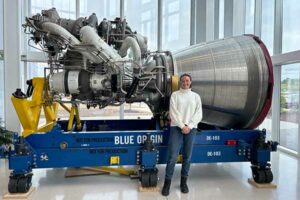
Kayla next to an engine at her Blue Origins co-op. Courtesy photo.
Kayla’s first co-op took place at HRL Laboratories, an aerospace and defense research center. She worked as a prototyping engineer, designing large space structures and learning resistance welding techniques. Her supervisor was a Northeastern alumnus whose mentorship helped guide her through her first industry experience. Her second co-op was at Blue Origin, a human spaceflight and aerospace manufacturing company, where she helped develop and test automated welding procedures for the New Glenn rocket. Working primarily on the manufacturing floor alongside technicians gave her knowledge she would apply directly at her final co-op with SpaceX, where she served on the build team for Starship’s boosters and the design team for Ship V3. Throughout her experiences, Kayla gained clarity on what she needed to know to do the work she loves. This focus helped her tailor her education and stay engaged in coursework, knowing she would apply it directly on the job.
Clearing the path
For Kayla, growing up in an environment that encouraged exploration was fundamental to her development—she always had space to create. She is equally grateful for her siblings, whose guidance as engineers in the workforce created a community of mentorship around her. Their constant support reinforced her own identity as an engineer, stating, “it makes me feel more like a mechanical engineer because I am always surrounded by it all of the time.”
Their support also helped break barriers. As the oldest daughter, Carly entered the industry seven years before Kayla and learned firsthand about the competitiveness and challenges of mechanical engineering. She describes it plainly: “I ran into a lot of hard walls, broke some down, learned some hard lessons, all with the intention of clearing an easier path for [Kayla].” Her younger sister was a motivating force in those difficult moments, and everything Carly learned she shared to help Kayla navigate her own challenges.
Future perspective
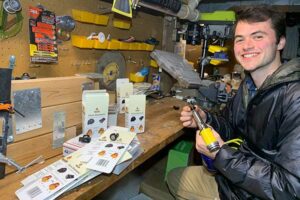
Kevin working on his product for Spud’s Adventure Gear. Courtesy photo.
Carly currently works as a manager of factory development engineering for Hadrian, a company that specializes in aerospace and defense manufacturing, which is quickly becoming a key player in the industry. She sees herself there for the long term, energized by the company’s growth. Kevin founded his own company in 2022, Spuds Adventure Gear, centered on his invention, “Stick Stashers” ––a magnet that clips to hiking sticks and backpacks for hands-free storage. While looking to return to industry to gain more experience, he hopes to launch another company again in the future. Kayla, through her hard work during her co-op, received a return offer from SpaceX and will join the same team full-time after graduation. For now, she plans to dive into the workforce and gain as much experience as possible.
When asked if the three engineers will ever work together in the same company, the answer was a humorous and lighthearted “definitely not.” Beyond sibling competitiveness, they have each carved out distinct niches and are content to forge their own paths. Kayla, in particular, is determined to build her career independently—so determined that, despite Carly’s five years on the Crew Dragon program, Kayla didn’t tell anyone she had applied to SpaceX until she was accepted. While they have no desire to work at the same company, they are not opposed to starting a family business in the future, entering as equals. Through all their varied experiences, one thing remains constant: the drive and dedication each sibling brings to their work and to one another. Each carved out a distinct path—from factory floors to rocket boosters to startup ventures—yet all three trace that foundation back to the same place: a Northeastern education, a supportive family, and the belief that engineering could take them anywhere. These three siblings are already forces of change, and they are only just getting started.
