Trial and Error: Using the Co-op Program to Find Your Path
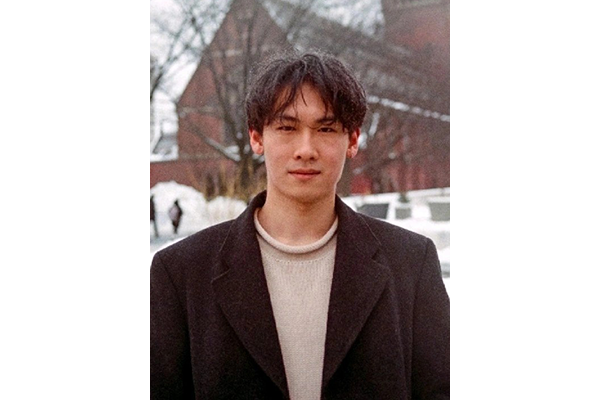
Mark Yang portrait. Courtesy photo.
Mark Yang, E’26, electrical and computer engineering, is planning to pursue a PhD in bioelectronics after graduation. Through a series of research experiences during his undergraduate years, Yang hopes to eventually translate his work into a startup that makes advanced technologies accessible to the general public.
Mark Yang just completed his bachelor’s degree in electrical and computer engineering at Northeastern. Throughout secondary school he was involved in robotics, and always assumed engineering would be in his future. Growing up in the Bay Area also gave him an entrepreneurial outlook—a drive toward building something of his own. He knew he wanted to pursue higher education in part to find more like-minded, ambitious peers. With a background in robotics, electrical and computer engineering felt like the natural starting point, and his search led him to Northeastern—drawn by its location in Boston and its Co-op Program, even though he ended up spending his first year at the university’s London campus.
Research and Co-op Experiences
Yang’s first college research experience was at Northeastern’s eSOIL Lab, run by Associate Professor Canek Fuentes Hernandez. The connection grew out of a high school project in which Yang had designed low-resolution infrared cameras to track human movement. Eager to take that work further, he brought the idea to Professor Fuentes, who welcomed him into a related project involving organic photodiodes—thin, flexible sensors that can be attached to nearly any surface to detect motion. Yang pushed the concept further in scale and complexity, and together they developed a “smart wallpaper” made from the diodes that could not only detect motion but also determine its direction and path. The experience introduced him to how a research lab operates and to the rhythms of the experimentation process—and he was quickly captivated.
His second research opportunity, and first formal co-op, took him to MIT’s Lab for Translational Engineering (L4TE), which develops ingestible devices small enough to swallow that can remain in the digestive system for sensing, tracking, or drug delivery. As a research assistant on the electrical engineering team, Yang’s primary role was building the hardware and software that power these devices. One project he found particularly compelling involved the DARPA Adapter—a smart pill designed for soldiers that would sit in the stomach, continuously monitor the body, and autonomously release antidotes for specific field ailments such as radiation sickness, internal bleeding, or fatigue. Yang designed the circuit boards and wrote the internal software that allow the pill to operate independently. He came into the co-op without a clear sense of what he wanted to pursue—and left with a passion for bioelectronic devices that he plans to build his career around. He credits the co-op structure itself for making that discovery possible: the ability to commit to a project full-time accelerated both his technical mastery and his professional connections in the field.
His second co-op was at Amazon Fulfillment Technologies and Robotics, chosen deliberately to broaden his experience. As a robotics systems engineer on the deployment team, he helped Amazon warehouses implement their robotic technology effectively. He describes deployment engineering as “a mix of software, hardware, and project management”—work that involved defining clear operational instructions for the technology and building out software components. Working within a large company proved invaluable in a different way: he developed his ability to communicate across teams, present his work clearly, and operate with independence in a corporate environment.
Student Involvement
Yang has been active in student organizations throughout his time at Northeastern. During his year in London, he co-founded two clubs: the Northeastern London Robotics Club and Northeastern Young Entrepreneurs. The robotics club gave him a space to keep his skills sharp, and founding it from scratch turned out to be a formative experience in its own right. With Young Entrepreneurs, he helped build a speaker series and a consulting component, motivated by a desire to find a community of people who shared his entrepreneurial instincts. He is grateful for Northeastern’s institutional support in getting both organizations off the ground.
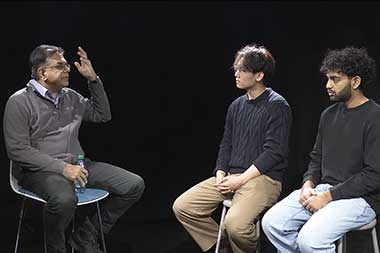
Yang and his peer on their podcast. Courtesy photo.
Yang also co-hosts a podcast with several peers called The Talkin’ Science Podcast, which features interviews with Northeastern professors working across science-adjacent fields. The premise is simple but meaningful: research and cutting-edge technology can feel distant and abstract to students, and the podcast aims to “bridge the distance between students and professors” by making that work feel accessible. Episodes cover professors’ career paths, current research, and advice for students—along with their own college stories. Across all of these ventures, Yang has internalized a key lesson: “putting yourself out there—you can make mistakes,” and nothing moves forward until you take the first step.
Mentorship, Advice, and Ambitions
The most influential figure in Yang’s time at Northeastern has been Professor Gregory Abowd, Dean of the College of Engineering. Over all four years of his degree, Dean Abowd has been a consistent and accessible mentor, particularly when it comes to navigating the research world. He has served as a sounding board for Yang’s ideas and a guide for his longer-term planning, engaging in multiple substantive conversations about Yang’s future and how to get there. That ongoing dialogue has shaped Yang’s academic and professional trajectory in ways he considers invaluable.
Yang’s advice to other students is direct: use the Co-op Program as much as possible—whether in industry or research settings. He has experience in both, and each helped him arrive at a clearer sense of what he actually wants to pursue—something quite different from what he imagined when he started. While large companies are understandably appealing, he cautions against overlooking research positions and startups, all of which can build a portfolio in distinctive ways. Real growth, he believes, happens through that kind of hands-on exploration—experience that simply cannot be replicated in a classroom.
Since graduation, Yang plans to pursue a PhD in electrical engineering and computer science at UC Berkeley, with a focus on bioelectronics. His co-op at MIT and his conversations with Dean Abowd both helped him recognize that full-time research is the environment where he will thrive. Further down the road, he hopes to spin his research into a company—building commercial products that make the benefits of advanced technology available to everyone. That commitment to accessibility, combined with the technical foundation and entrepreneurial drive he has developed at Northeastern, positions Yang to make an impact in both research and industry.