Why Rechargeable Batteries Break Down Over Time
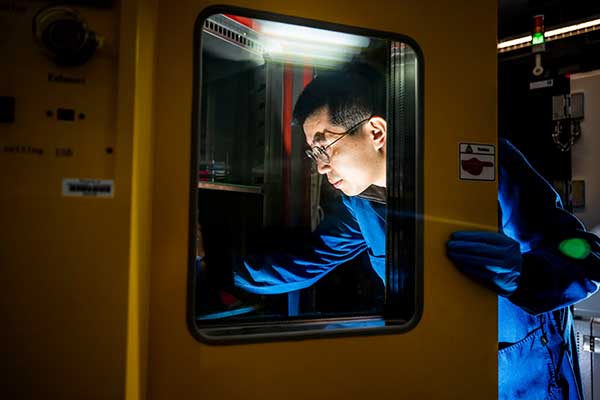
Juner Zhu, assistant professor, mechanical and industrial engineering, works inside The Kostas Research Institute. Photo by Matthew Modoono/Northeastern University
MIE Assistant Professor Juner Zhu’s research on “Electrode strain dynamics in layered intercalation battery cathodes” was published in Science.
This article originally appeared on Northeastern Global News. It was published by Cesareo Contreras.
Research lays the groundwork for longer lasting batteries
Inside nearly every battery you use is a collection of electrode particles arranged similarly to the stars that make up our galaxy.
For years, researchers have understood those particles, particularly in lithium-ion batteries, to be fixed and remain relatively stable throughout a battery’s life.
Yet new research published in “Science” overturns that long held assumption, showing that many of these particles move more like shooting stars or meteors, adding a new dimension to our understanding of battery degradation, explained Juner Zhu, a Northeastern University professor of mechanical and industrial engineering and one of the authors of the research.
The findings could help lay the groundwork for longer-lasting and more reliable batteries by providing documentation and analysis on the chemical reactions and mechanical properties that cause those particles to move the way they do, the researchers said.
Using motion tracking mapping and advanced X-ray imaging of three-dimensional objects, the team, which included experts from the University of Texas at Austin, observed that those electrode particles can move quite dynamically and far while a battery is in use.
These movements are caused primarily by evolving and ever-changing chemical reactions inside the battery, causing the particles to move at different rates throughout the battery’s life, Zhu and his team theorized. In this way, batteries could be understood almost as “living systems” changing over time,” he said.
Read full article at Northeastern Global News