Navigating the Risks of Self Driving Tech
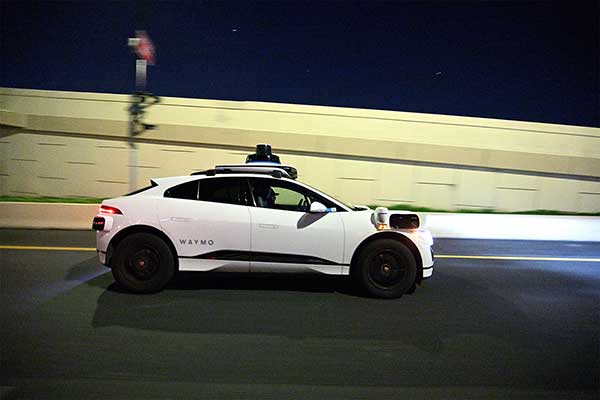
ECE Professor Taskin Padir and other experts suggest that while autonomous vehicles offer significant safety advantages over human drivers, they are not yet perfect and require transparent, responsible oversight to navigate complex real-world scenarios.
This article originally appeared on Northeastern Global News. It was published by Cesareo Contreras. Main photo: A Waymo autonomous ride-hailing electric Jaguar vehicle makes its way along a roadway, Friday, Nov. 14, 2025, in Orlando, Fla. (Phelan M. Ebenhack via AP)
How safe are self-driving cars really? Experts weigh in
Autonomous systems are a net good and in many aspects have the capacity to outperform human drivers, but they are not perfect, according to experts.
How safe are autonomous vehicles?
It’s a question on the mind of many as robotaxis continue to take on the road, with some of them malfunctioning and violating traffic laws.
Waymo, the self-driving car company that spun out of Google in 2016, announced this month that it was recalling 3,067 robotaxis after multiple reports of them driving around stopped school buses in Austin, Texas.
This is just the latest in a series of small controversies the self-driving car company has found itself in over the past decade. For years, there have been reports of Waymo vehicles making illegal turns, stopping at intersections when they shouldn’t, and even striking bicyclists.

Taskin Padir, professor of electrical and computer engineering and Amazon Scholar, said autonomous vehicles offer many advantages but are not immune to issues. Photo by Matthew Modoono/Northeastern University
At the same time, however, Waymo continues to tout how much safer its autonomous vehicles are when put up against human operators.
On its website, Waymo states that “compared to an average human driver over the same distance in our operating cities,” its autonomous vehicles have 90% “fewer serious injuries or worse crashes;” 82% “fewer airbag deployment crashes,” and 81% “fewer injury-causing crashes.”
So, if these vehicles are safe, why do we continue to see incidents as Waymo’s robotaxi service continues to expand into more cities?
Taskin Padir, an electrical and computer engineering professor at Northeastern University and an autonomous vehicle researcher, said while he believes autonomous systems are a net good and in many aspects have the capacity to outperform human drivers, they are not perfect.
Like humans, these vehicles will invariably make mistakes, especially in challenging “edge cases.”
“We have not achieved a level of autonomy that accounts for all the scenarios in the world,” he said.
Therefore, one of the key takeaways here is for these companies to operate responsibly and transparently and work with the proper authorities and local governmental officials to address any issues that could arise, he said.
It’s ultimately up to those regulators to determine whether a particular autonomous vehicle is safe enough to be on the road in the first place, explained Mark MacCarthy, a nonresident senior fellow at the Brookings Institution, an American think tank in Washington, D.C., that does nonpartisan research, including in the development of safety standards around autonomous vehicles.
Read full story at Northeastern Global News