Sustainability at the Heart of Chemical Engineering Research
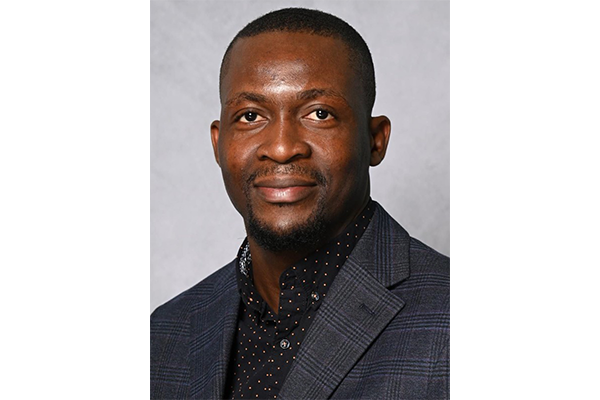
Portrait of Lawrence Ajayi. Photo sourced from LinkedIn.
Lawrence Ajayi, PhD ’27, chemical engineering, is a doctoral researcher at the REPRODUCE Lab. Currently on co-op at Found Energy, Ajayi is gaining fast-paced industry experience that is expanding how he thinks and sharpening his adaptability.
Lawrence Ajayi is completing a PhD in chemical engineering at Northeastern University. He earned his bachelor’s degree in chemical engineering from Ladoke Akintola University of Technology in Nigeria and his master’s in the same discipline from Ohio University. Growing up in Nigeria, where the oil and gas industry has long been a dominant economic force, he was drawn to chemical engineering as a path to meaningful work in a thriving field. He began his research career in the final year of his undergraduate degree, studying the removal of pharmaceutical contaminants from wastewater using methods such as activated carbon adsorption. The research environment suited him, and he continued into his master’s program—shifting his focus toward enhancing sustainability through electrochemical processes. In that work, he found a way to contribute to scientific progress while also making a positive impact on the environment.
A master’s degree, it turned out, wasn’t enough to satisfy his curiosity. As he began exploring PhD programs, Northeastern stood out for its research reputation and the quality of work its faculty were doing. The Co-op Program was a decisive factor: planning to move into industry after graduation, Ajayi wanted hands-on experience that would make him competitive in the workforce. Northeastern offered both.
Current Research
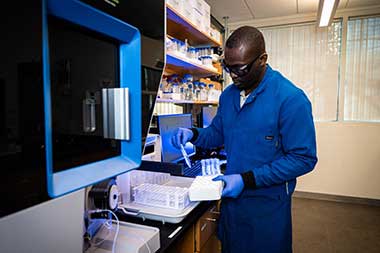
Ajayi in the lab. Photo by Alyssa Stone/Northeastern University,
Ajayi is a doctoral researcher at the REPRODUCE Lab at Northeastern, which focuses on reversing human impact on Earth’s natural cycles—water, carbon, nitrogen, and phosphorus among them. His specific project addresses how to extract rare earth elements like neodymium—used in magnets, wind turbines, and electric vehicles—from coal mining waste. The United States currently underproduces these elements domestically, and Ajayi’s goal is to develop extraction techniques that are both scalable and sustainable. When coal is mined, it generates a residue that is typically left behind in the mines, where it often leaches into the surrounding environment. Ajayi is developing electrochemical techniques—methods that use electrical energy to drive chemical reactions—to recover valuable elements from that waste efficiently and with minimal environmental impact.
Much of his work so far has focused on understanding and optimizing the liquid solution used to pre-treat coal waste, making it more effective at drawing out rare earth elements. He is now moving to the next phase of the process: selectively extracting different metals from the solution that has absorbed those elements. His contributions have been recognized with the Ramboll Flourish Scholarship through the National Society of Black Engineers, and he was named a 2025 Graduate Student Awardee in Environmental Chemistry by the ACS Environmental Chemistry Division.
Beyond individual recognition, Ajayi values the collaborative environment Northeastern fosters. His most recent publication involved contributions from students and faculty across multiple science and engineering departments, and he appreciated the diversity of perspectives they brought to the analysis. “Northeastern is always open to helping you,” he says—a sentiment that reflects his experience of the university’s resources and community as genuine assets to his research.
Co-op and AGSA
This semester, Ajayi is on co-op at Found Energy, a company developing rechargeable aluminum-based power systems, where he works as an electrochemical engineering co-op focused on developing and optimizing the electrochemical processes within the project pipeline. Though only four months in, the experience is already reshaping how he approaches research—pushing him toward a more industry-oriented perspective and teaching him to adapt and learn quickly in an environment where priorities can shift rapidly.
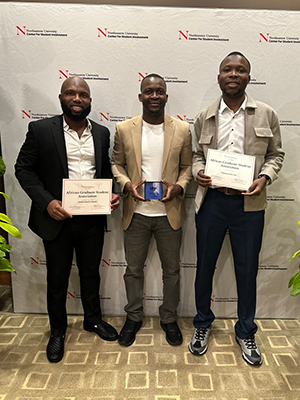
Ajayi accepting the Program of the Year award. Courtesy photo.
Outside the lab, Ajayi serves as president of the African Graduate Student Association (AGSA), an organization dedicated to building community and supporting professional development among graduate students from Africa. One of his primary goals this year has been to “make people feel at home”—which has meant organizing everything from soccer games to professional development workshops. He also helps connect students with the organization’s network of financial resources. A parallel priority has been showcasing African culture to the broader Northeastern community, which he pursued through two flagship events: “African Heroes Night” and “African Day.” The first celebrated members of the Northeastern community from the African diaspora who have made a meaningful difference for African students on campus—honoring ten students and Richard O’Bryant, Director of the John D. O’Bryant African American Institute. “African Day” brought African culture to campus through food, dance, and fashion. Under Ajayi’s leadership, AGSA won the 2026 NU Student Life Program Of The Year award for organizing the first-ever African Heroes Night.
Leading these initiatives has sharpened Ajayi’s understanding of what effective leadership requires. Knowing your team—their strengths and limitations—makes delegation more precise and work more efficient. He has also built strong communication and networking skills through the steady outreach to staff and faculty that event organizing demands. Having a passion outside the lab, he has found, produces a more well-rounded skill set—and one that will serve him well beyond graduate school.
Mentorship and Advice
Throughout both his master’s and doctoral degrees, the most influential mentor in Ajayi’s development has been his advisor, Assistant Professor Damilola Daramola, who has guided him from the beginning and shown him firsthand what it takes to build a research lab from the ground up. He also highlights Professor Richard Wamai, faculty advisor for AGSA, whose close support throughout his term as president—offering guidance on event planning and club management—has been invaluable.
For anyone considering a PhD, Ajayi’s most important advice is to choose both your advisor and your research topic with care. The degree is demanding, and genuine passion for the subject is what makes it possible to push through the inevitable obstacles. An advisor you work well with is equally essential—and while it can be hard to gauge that fit through the application process alone, he encourages prospective students to reach out to current lab members for candid insight into the advisor’s mentorship style and the lab environment. Once enrolled, he recommends doing a thorough literature review before setting foot in the lab: understanding the history, current state, major breakthroughs, and open challenges of your topic will give your research direction and save you from unnecessary trial and error.
Future Plans
After completing his PhD, Ajayi plans to spend several years in industry, building experience across sustainability and energy sectors. He thrives in research environments and hopes to find a role where he can develop sustainable processes with real potential for scale. Academia remains an option as well—he is open to eventually starting his own lab, with the long-term goal of combining the depth of academic research with the pace and relevance of industry. Wherever he lands, his commitment to the circular economy and environmental sustainability will be the thread running through his work, driving innovation in whatever field he calls home.