Empowered by Service: Teaching Boston’s Kids to Think Like Engineers

Portrait of Catherine Connolly. Courtesy photo.
Catherine Connolly, E’28, chemical engineering, serves as the president of Roxbury Robotics, an engineering service-learning club. As she navigates structural and logistic changes to the club, she highlights their recent successes, and the reasons why she is devoted to the cause.
Catherine Connolly is a third-year chemical engineering major at Northeastern and the president of Roxbury Robotics, an engineering service-learning club on campus. Connolly was always sure that she wanted to be an engineer. She was drawn to Northeastern due to its place in the city and the Co-op Program, allowing her to “try out” different careers before she commits to them. That same engineering drive is what pulled her into Roxbury Robotics, an engineering service-learning club she now leads as president.
Discovery and interest
Connolly first discovered the club through her introductory engineering course, Cornerstone of Engineering, where she opted into a service-learning section. Every week, the class visited the community groups that the club partners with, teaching kids the fundamentals of Lego Robotics. The course ended with students building a museum exhibition for the kids to explore—an event that gives students a chance to receive feedback on their work from the kids themselves.
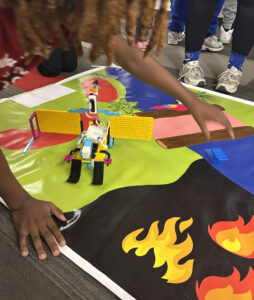
Young students utilizing the club’s rainforest mat for robotics activity development. Courtesy photo.
Over the semester, Connolly had a great time connecting with the kids, and decided to continue the work by officially joining the club once the course ended. The club meets with several groups each week—the Yawkey Boys and Girls Club of Roxbury on Monday, Paige Academy on Tuesday, Parent University on Wednesday, and United South End Settlements on Thursday––with a mission to serve community groups across the Boston area.
The kids range from six to thirteen, so mentors adapt a single foundational lesson plan to fit different levels of involvement. This lesson plan centers around a challenge; last semester’s was relating rain forests and forest fires. The core initiative is not just teaching robotics, but instilling an engineering mindset––encouraging kids to try things on their own and figure out what works and what doesn’t. Connolly has found this part especially rewarding, noting that “the kids often come up with much simpler solutions than me.” The program culminates with the end-of-semester showcase, during which the club members, kids, families, and community partners come to campus. The main event is the robotics competition where the kids receive scores based on how well their robot completes the challenge. The event is a memorable way to end each semester, often drawing over 100 people.
Leadership and exciting changes
As president this past year, Connolly took on far more responsibility. In her first semester as president, her duties centered on organizing documents for her executive members and handling new legal paperwork. The team’s main goal for the term was to bring Parent University onto campus rather than sending students out to meet them—a shift that increases mentor availability and lets the club support even more kids. This year they worked with about 80 kids, and hope to raise that to 100 in the future. The move to campus brought a lot of paperwork, and one of Connolly’s largest tasks was making sure every student mentor completed their training and background checks, a tedious process since every group has their own background-check system.
The E-board has been essential here, with the four other executives splitting tasks among themselves and pitching in wherever needed. The vice president is in charge of site placements, working to match each mentor with a site they prefer and smoothing out any scheduling conflicts. The secretary manages mass communication and keeps the team organized, making sure members have what they need to do the work they love. The club also elects a Showcase chair, in charge of all logistics and organization of their biggest event of the semester, as well as any legal issues that may arise. Finally, the social chair is in charge of any creative endeavor—from managing social media to designing emblems and apparel.
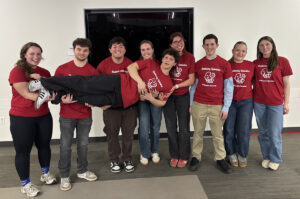
The Spring 2026 E-Board and Site Leaders. Courtesy photo.
Throughout her time in the club, Connolly has surprised herself with her own devotion: “If it’s something I really care about, I will stop at nothing to get it done.” She isn’t alone in that, and points to a time when the club struggled to get a Showcase approved under the sheer volume of paperwork required. It became so dire that they believed they would have to cancel the event. But they refused to give up on the kids, sending mass communications and meeting with whoever they needed to, and finally got the event approved twenty-four hours before it was scheduled. She offers this story as proof of the devotion within the club and the strength of its perseverance.
Even with deadlines and finals bearing down, this club runs on its members’ passion for the kids, who pour themselves into the logistics and paperwork so that the kids can have a good time. Connolly finds hope in seeing her passion mirrored in the rest of the club, who give up their time to teach topics these kids might not encounter at such a young age otherwise.
The support that makes it possible
The club had a very successful Giving Day last April, raising over $2,500 and even unlocking a $1,000 challenge match from Gregory Abowd, former engineering dean and electrical and computer engineering professor. This support is essential as it increases the amount that they can invest in the kids, allowing them to purchase extra LEGO kits to expand the curriculum, club T-shirts, and prizes for the aspiring young engineers to remember the program by. Connolly was struck by the response, even receiving donations from complete strangers, some of whom had never heard of the club before that day. She was grateful that the Northeastern community cared about these kids just as much as they do, and Giving Day reaffirmed her confidence in their mission while giving the club the means to carry it out.
The club’s advisor, Associate Teaching Professor Brian O’Connell, is another pillar of support. He consistently goes above and beyond his duties as club advisor, and his involvement and guidance have been crucial to the club’s progress. O’Connell is deeply invested in the cause and shows it through how available he makes himself to Connolly and the E-board, ready to answer a question or walk them through a complicated process.
The club has also found support within the institution itself, especially from Northeastern’s Risk Services, which has helped enormously as the club navigates moving Parent University to campus. They have been grateful for how accessible Risk Services has been, walking them through complicated background-check procedures and helping them untangle confusing logistics. Although Connolly herself had no experience with the legal forms involved, Risk Services became a steady source of knowledge and support, giving her the information she needed.
She also wants to thank the club’s community partners, whose involvement makes the whole thing possible. These organizations already run their own programs, and they fold Roxbury Robotics seamlessly into the mix. Organizing logistics and scheduling is made immeasurably easier with their commitment to open and responsive communication. Beyond logistics, these organizations also go above and beyond to make student mentors feel welcome in their spaces, a large factor in why so many students return to this club.
Closing thoughts
For Connolly, the reward of the club is twofold: watching her students grow and gain confidence, and the camaraderie she’s found among the student mentors and community partners. Many students first arrive in the course not knowing what to expect yet stay because they want to—and as she puts it, “there’s a certain aspect to someone who is willing to give up two and a half hours of their week to help the kids.” She returns, too, to her gratitude for the community partners, without whom the club simply couldn’t function. In the end, both rewards come back to the same conviction: her core belief about service learning, that “you’re learning from them as much as they are learning from you.”