New Project Combines Biology, Music, and Math to Display Limb Regeneration
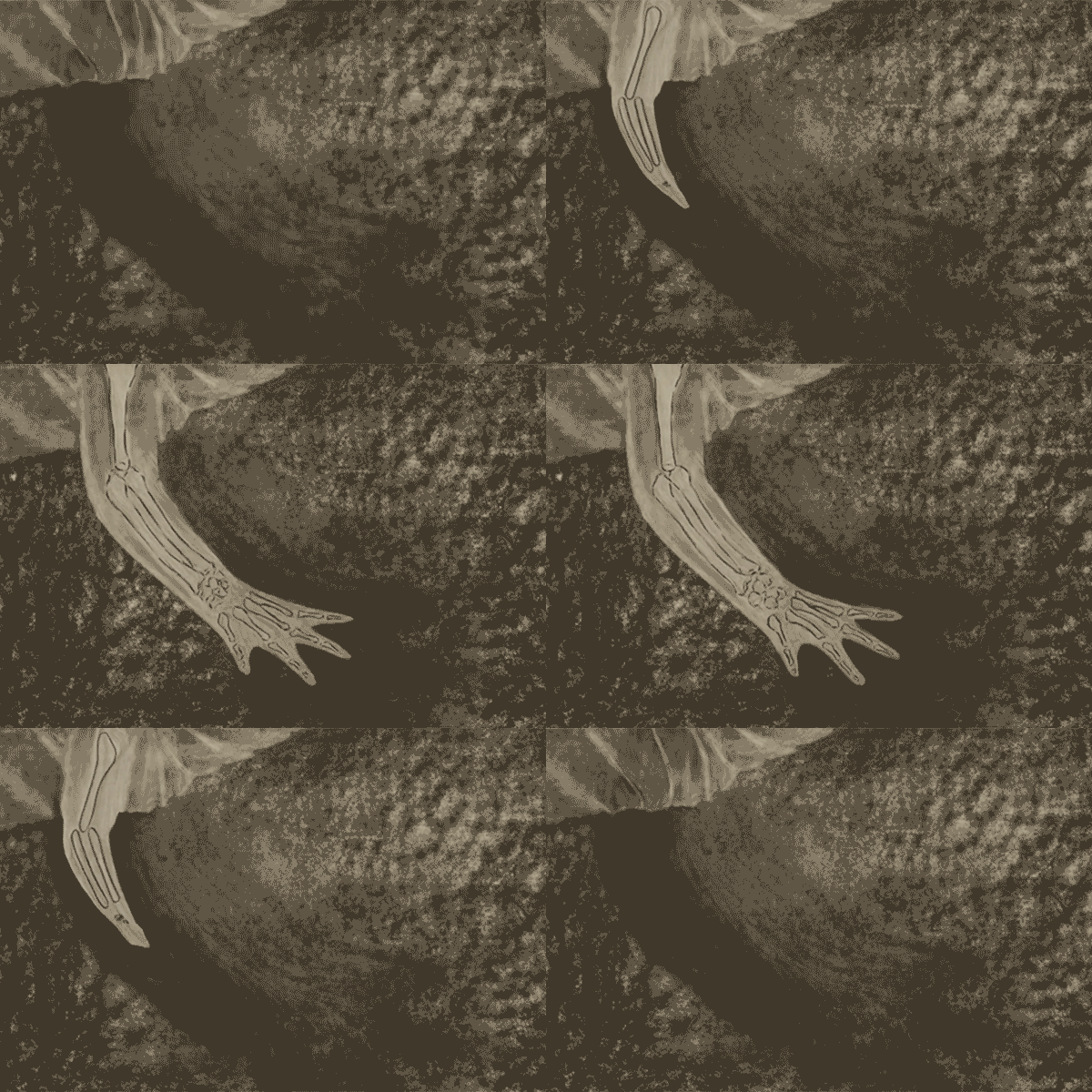
Courtesy of Sandra Shefelbine
A project named “Morphogenesis,” led by Garret Compston and MIE/BioE Professor Sandra Shefelbine, uses Alan Turing’s pattern work with musical representation to portray the biological process behind how individual cells, tissues and organs develop their specific shapes and structures when the embryo is still developing.
This article originally appeared on Northeastern Global News. It was published by Cody Mello-Klein.
What if you could hear how a limb grows? With this project, you can
Sometimes inspiration comes from the most unlikely of places. For musician Garrett Compston, it came in the form of a skeleton.
Alongside scientists, engineers and illustrators, Compston, a musical technology student at Northeastern University, transformed the mathematical equations and biological concepts behind how limbs grow into a nearly six-minute piece of music.
Titled “Morphogenesis,” after the biological process behind how individual cells, tissues and organs develop their specific shapes and structures when the embryo is still developing, the project, helmed by faculty and students at Northeastern, blends math, biology and music. Although it started as a fun exercise for the academics involved, this interdisciplinary project gradually became an exercise in something scientists can struggle with: translating complex, important ideas to the public.
“If we’re trying to convey what we’re doing … we can’t just sit in our ivory tower and do our thing,” said Sandra Shefelbine, a professor of bioengineering and mechanical and industrial engineering at Northeastern who helped lead the project.
“Using a different medium helps us to translate pretty technical things into something an audience can get a conceptual grasp on. In this case, “Most people don’t think in math,” Shefelbine added. “But they can hear it [represented in music].”
The work it took to make music out of math didn’t come easily, but the team developed “Morphogenesis” with joy and genuine curiosity.
Math and music have a long, tangled history, as do math and biology. The ancient Greek mathematician Pythagoras discovered that musical harmonies were made possible by simple mathematical ratios. A few centuries later, building on the work of those who came before him, Renaissance man Leonardo da Vinci utilized mathematical modeling to comprehend human anatomy and physiology, dissecting the human body’s appearance and functions into distinct patterns.
But the Northeastern team took inspiration for their project from a more recent historical figure: The 20th century mathematician and computer scientist Alan Turing.
Among his many contributions, Turing is credited with a concept that helps explain how natural, asymmetric patterns, like the spots on a leopard or even how different parts of our body, develop from a symmetrical embryo. Turing surmised that these repeating patterns come about when a chemical system — in the case of development, hormones or genes — that would otherwise have a stabilizing effect on the body causes instability. Laws of physics dictate that all systems tend to want to return to a state of stability, which is where patterning — like on fish skin or how limbs develop — takes root. This concept is now known as a Turing pattern.
This process helps explain limb growth across the animal kingdom, Shefelbine explained. Humans, bats, whales and even axolotls — the pink, smiling salamanders that Shefelbine studies due to their regenerative ability — all have the same limb structure: a single bone connected at the shoulder, two bones in the middle and many bones where the digits, or fingers, form.
“We think that the way that these develop is a Turing pattern, and it’s a Turing pattern in all species,” Shefelbine said.
That understanding served as the foundation for Compston’s music, which focused on representing the biological process behind limb development.
When a limb first starts to grow, it’s a homogenous “bag of cells,” Shefelbine explained. But as the limb develops, those cells take on unique functions and help to form different parts of the limb. Their role is established from the beginning of the process, a concept known as cell destiny, but they don’t step on stage until they’re ready to play their part.
“The whole project is about fate, how cells decide that they are going to build this very complex structure even though the structure is way bigger than they are,” mechanical engineering Ph.D. candidate Soha Ben Tahar said.
Read full story on Northeastern Global News