Becoming Intentional at Dennis Lab with Warisha Tahir
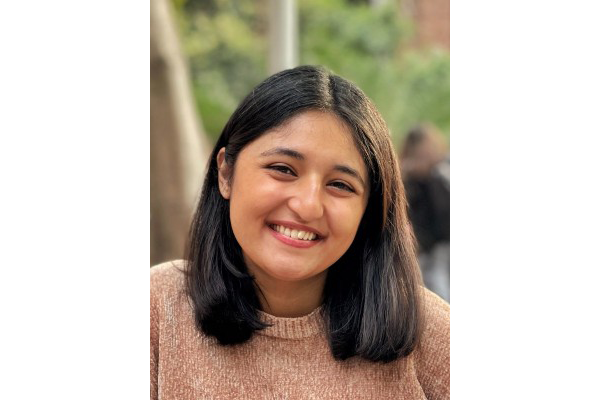
Warisha Tahir portrait. Photo sourced from LinkedIn.
Warisha Tahir, PhD’27, chemical engineering, currently works at Dennis Lab under Professor Alison Dennis. With a focus on positive human impact, Tahir will use her skills and experience to develop new innovations in the public health realm.
Warisha Tahir is currently pursuing a PhD in chemical engineering at Northeastern University. She graduated with her bachelor’s degree in chemical engineering from Lahore University of Management Services in 2022 in Pakistan, where she gained a wide variety of research experience like fabricating piezoelectric polymers for cardiovascular sensing, nanoparticle synthesis for microplastic removal, and chemical testing to identify milk adulteration. During the pandemic, she was able to use ‘wet-lab downtime’ to model sustainable mixed acid production, and researched sustainable alternatives to fossil-based raw materials like CO2 capture-utilization pathways within her internships.
Chemical engineering appealed to her because of its interdisciplinary nature. She went straight from undergraduate studies to a PhD program, and chose Northeastern primarily for its co-op program. Unlike most doctoral programs, which focus heavily on academic research, Northeastern offers co-ops even to PhD students—a rarity in graduate education. Tahir was drawn to this because she plans to work in industry rather than academia, and she knew the hands-on project experience would be valuable for that career path.
Research at Dennis Lab
At Northeastern’s Dennis Lab, Tahir is developing a biosensing platform for environmental and health monitoring purposes. She studies how proteins recognize and bind to DNA—like understanding how a lock recognizes its key. By creating large libraries of DNA variants, Tahir maps out how to control binding strength between proteins and their DNA targets. The goal is to fine-tune biological sensors that detect molecules important for health or environmental monitoring—essentially adjusting their sensitivity similar to dialing up or down a radio signal. Her work combines experimental design with computational analysis to help create better tools for detecting diseases and environmental contaminants.
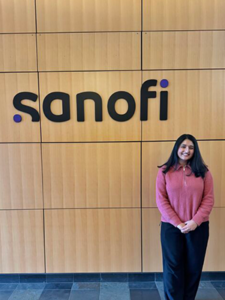
Tahir in front of Sanofi logo. Photo sourced from LinkedIn.
Tahir has found strong support for her research goals at Northeastern, particularly through the PhD Network. The network’s LEADERS program connected her to a co-op at Sanofi, a pharmaceutical company, where she gained firsthand experience applying her research skills in an industry setting. The PhD Network also provides travel funds for conferences and seminars, helping her build connections in her field.
Beyond her research pursuits, Tahir joined the Chemical Engineering Graduate Student Council, and found it to be a good way to connect with the rest of her cohort. They plan community activities, like formals and team building exercises, as well as support professional development opportunities among graduate students.
Additionally, Tahir is a director of Project SHORT, a mentorship program that pairs current doctoral students with prospective graduate school applicants. Tahir facilitates mentor-mentee matches based on demographics, research interests, and career aspirations, while tracking program effectiveness through data-driven feedback. She believes this role allows her to advocate for equity in higher education, as well as stay connected to the broader community beyond the lab, and as she puts it, “We are always looking for more mentors.”
Appreciation and support
Tahir credits an undergraduate class, Experimental Systems and Synthetic Biology, taken in her PhD studies, as an unexpected resource with her research. While she did not appreciate the biology courses taught in her bachelor’s degree, she valued this class’s focus on practical application and deeper understanding. The foundational concepts covered proved directly useful in her dissertation project.
In addition to PhD network, Tahir is grateful for her involvement with Northeastern Employer Engagement and Career Design. Through their monthly Career Development workshops, she has learned both technical and communication skills that will be useful when she graduates. She believes the comprehensiveness of the program gives students a clear path to their career once they graduate.
Tahir finds the College of Engineering faculty to be very supportive. She really values her advisor, Associate Professor Allison Dennis, especially as an advocate of Tahir’s experiential learning ambitions. Tahir also cites Professor Behrooz Satvat, who taught her graduate level mathematics for chemical engineering. She admires his hard work behind so many entrepreneurial endeavors and the fact that “he is so passionate about teaching,” describing him as kind and very encouraging.
What comes next
As she nears the end of her PhD program, Tahir has learned to be more selective about where she invests her energy. Early on, she “wanted to dabble in everything” Northeastern offered. But the focused, iterative work of her dissertation taught her the value of depth over breadth—a lesson she now applies to managing her time and projects. The experience has also reconnected her with what drew her to start a PhD in the first place: her fascination with what science can accomplish.
Through her co-op at Sanofi, Tahir discovered what excites her most-seeing how her work directly affects patients and their families. That realization has shaped her post––PhD plans. She’s looking for industry or consulting roles in public health and policy—places where she can apply her research training to real-world problems with tangible human impact.