Bioengineering Leader in the Making: Dylan Lasky’s Story at Northeastern
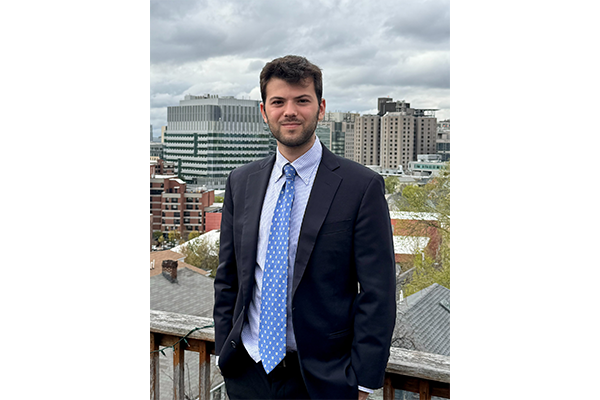
Dylan Lasky, MS ’26, bioengineering and engineering leadership, works full-time at Jana Care while completing his master’s degree. Planning to remain in industry, Lasky will bring the knowledge and leadership skills he has gained at Northeastern to the medical device field.
Dylan Lasky completed his bachelor’s degree in bioengineering last spring and just earned a master’s in bioengineering through the PlusOne Program at Northeastern, alongside a graduate certificate in engineering leadership through the Gordon Institute of Engineering Leadership. He has always had an analytical mind and a natural inclination toward building and problem-solving, which drew him to engineering early. When choosing a major, he wavered between mechanical engineering and bioengineering before his fascination with cellular systems and interest in medical biotechnology made the decision for him. Every bioengineering course since has only deepened that conviction—he emphasizes that he “picked the right choice.”
Northeastern came onto his radar through its location in Boston, a city he saw as both a great environment for college students and a hub for the biotechnology industry. The summer before applying, he took an engineering-focused campus tour that opened his eyes to the resources available, and the kinds of projects students work on. He remembers that day as “really special,” and when his acceptance came through, “it just felt right.”
Classroom Influences
Lasky’s interest in pursuing a master’s degree was planted early—during his first co-op, a colleague advised him to get the degree before spending years in industry rather than after. Already familiar with the PlusOne Program, he saw it as an efficient path. The decision to add the Gordon certificate came later, when a professor approached him after his Capstone presentation—a project called “Glaucoma-on-a-Chip,” a miniature device that mimics the part of the eye involved in glaucoma to aid in developing better treatments—and encouraged him to apply for the program. He researched it, decided to go for it, and has not looked back. The team-oriented pedagogy of the Gordon program has broadened how he thinks as an engineer, and he values the ability to work full-time while completing his master’s, building technical and interpersonal skills in parallel.
Two courses and the people who taught them stand out as particularly formative. The first is Dynamics, Chaos, and Fractals, taught by Associate Professor Evan Dummit. The material was inherently engaging, but it was Professor Dummit’s teaching style that made it genuinely eye-opening—bringing an authenticity to the classroom that deepened Lasky’s interest in fractal dynamics in a way he hadn’t expected. The second is his time in the lab of Former Associate Professor Erel Levine, Director of the Levine Quantitative Biology Lab, where Lasky conducted undergraduate research. He describes Levine as a rigorous thinker and a committed advocate for understanding how climate change affects ecosystems—a mentor who left a clear mark on how he approaches scientific questions.
In the Lab

Lasky in the lab. Courtesy photo.
In the Levine Lab, Lasky contributed to a PhD project studying microbiome dynamics—specifically, how nutrition and bacterial composition affect host organisms. The team fed fluorescently labeled bacteria to C. elegans, a tiny roundworm, and tracked the bacteria’s behavior inside the worm’s gut using a specialized microscope. Lasky led the fabrication of small custom devices used to hold the worms in place during imaging, working with a rubber-like material to create precise miniature chambers. He also learned to grow, process, and prepare bacterial samples and measure their concentration to ensure experimental consistency. The experience built both his technical capabilities and his confidence as a scientist, and he considers it one of the highlights of his undergraduate years. He encourages every student to get involved in research they are genuinely curious about.
Lasky currently works full-time as a research and development associate at Jana Care, a diagnostics company developing an at-home blood plasma biomarker monitoring system for chronic illness management. The system detects elevated biomarker concentrations associated with chronic kidney disease and heart disease: a small blood sample applied to a test strip is analyzed using LED sensors that measure the reflectance or fluorescence of the sample, with results transmitted directly to the patient’s physician. Lasky’s role is to improve the accuracy of those results—running repeated experiments and adjusting variables such as the chemistry of the test strip and the volume of blood used—as well as leading the calibration process to ensure consistent performance across devices. While most of his time is spent in the lab, he also handles data analysis and device calibration using Python automation.
Alongside his full-time work, Lasky is completing his Gordon Institute thesis project at Jana Care. The project focuses on optimizing the calibration process that all newly manufactured devices must undergo before experimental or clinical use. His goal is to transform what is currently a manual process into an efficient, digitally automated system ready for production scale. The work involves standardizing data collection and recordkeeping, building automated software to compile calibration results and log them into the company’s quality tracking system, and creating clearer documentation and training materials so that new operators can get up to speed quickly and calibrate devices correctly. He has felt genuinely supported throughout by the three advisors the Gordon program assigned to the project, whose weekly and monthly check-ins have kept the work structured and on track.
Extracurriculars and Reflection
Outside the lab, Lasky was involved in two clubs during his undergraduate years. As a Husky Ambassador and campus tour guide, he pushed himself to become comfortable with public speaking in front of large groups—an experience that made him more outgoing and noticeably more confident in co-op and job interviews. He also hosted a show at WRBB Radio for five semesters, a creative outlet he treasured amid the demands of engineering coursework. The show became a small community of its own, with friends regularly appearing as guests to talk through music and artists together. “The radio show was a cool club to be part of,” he says, “and I got to spend time with like-minded friends.”
Reflecting on his time at Northeastern, Lasky sees college as fundamentally a process of self-discovery. “College is all about understanding yourself—learning how you learn, how you interact with others, and how to be a team member.” The university and the city offer more opportunities than any one student can pursue, and he urges younger students to take ownership of seeking them out. “Experiences will not just be handed to you,” he says—but in his experience, the work of finding them was the best part of the undergraduate journey.
Future Perspective
After graduation, Lasky plans to stay in the biotech industry, building his skills and career from within a company rather than jumping between them. What drives him is straightforward: he wants to do work that is both engaging and meaningful, and bioengineering delivers on both counts. “The main goal is treating patients,” he says—and that focus keeps the work grounded. He has come to believe that “bioengineering is reshaping the world; we are doing things that no other scientists have done before,” and he wants to be part of that progress. With the technical foundation, leadership training, and professional experience he has built at Northeastern, Lasky is well positioned to be exactly that kind of force in the medical device industry.