Driven by Curiosity: Rohith Poola’s Journey in Autonomous Robotics
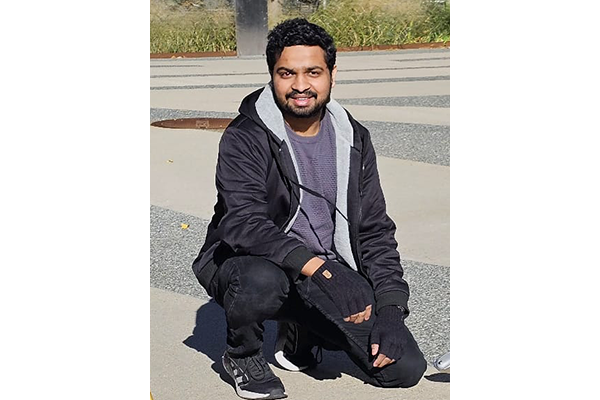
Rohith Poola portrait. Courtesy Photo.
Rohith Poola, MS’26, is a robotics student in the Autonomy and Intelligence Lab at Northeastern, where he works on projects in autonomous navigation and off-road traversability estimation. Guided by a deep curiosity and strong mentorship, he plans to pursue a PhD and eventually establish his own research in autonomy and planning.
Rohith Poola is on track to complete his master’s degree in robotics at Northeastern in just a few short months. Prior to beginning his pursuit at Northeastern, Poola received his bachelor’s degree in mechanical engineering at the National Institute of Technology in Calicut. It was Poola’s interest in robotics that led to him choosing mechanical engineering as a major. By the end of the first year of his undergraduate studies, he joined a robotics research lab at the institute, where he remained an undergraduate researcher until he graduated.
Driven to learn more—Poola was intent on pursuing a master’s degree and eventually a PhD—he first wanted to gain industry experience. Fortunately, he had the opportunity to work with IIIT-Hyderabad, a prestigious research group in India where Poola explored and developed bionic hand technology. It was the research aspect of that job that cemented his ambition for a robotics master’s degree.
While considering programs, Poola was drawn to Northeastern’s robotics labs for their emphasis on developing robust algorithms and their practical implementation. When he connected with other students in the labs and heard glowing accounts of their work, he knew this was the research that resonated with him most. He decided to apply to Assistant Professor of Electrical and Computer Engineering Michael Everett’s Autonomy and Intelligence Lab, drawn by a particular interest in perception and control systems.
Research
One research project Poola is working on involves BranchMPPI, an algorithm developed by members of the Autonomy and Intelligence lab. The goal is for the robot to navigate toward a destination while staying close to designated “safe zones”—predefined regions that minimize risk throughout the trajectory. If an unexpected event occurs, the robot can then autonomously reach one of these safe zones within a set time. One of the main challenges is running this algorithm within the broader autonomy pipeline in real time, given its significant computational demands.
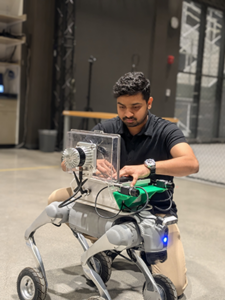
Poola working on a robot in the lab. Courtesy Photo.
As part of another collaborative project in the lab, Poola is developing a traversability estimation algorithm for autonomous off-road driving. The goal is to analyze environmental maps and assess a vehicle’s ability to traverse rugged terrain, specifically modeling how approach angles and varying speeds impact maneuverability and safety.
Poola appreciates both the infrastructure and the resources Northeastern provides for research. This access allows him to not only develop but also deploy robotic algorithms in the real world, necessary skills for any robotics engineer. He mentions that “[he] never needs to think of alternatives due to the lack of resources because whatever we need is provided in the lab.” If he requires resources from another robotics lab, the collaborative environment makes it easy for him to coordinate with other students or professors in separate labs.
Influential faculty
Poola emphasizes that having approachable faculty has made a meaningful difference in his research experience. He points to Professor Everett as a particularly strong mentor—one who is readily available to give feedback and help think through new ideas. Even when certain directions did not pan out, Professor Everett helped him reframe the problem and explore new approaches. That openness extends to the classroom as well: Poola notes that “the foundations of robotics are very well taught,” reflecting the care Professor Everett puts into his coursework.
He also highlights the guidance and support he received in his early classes at Northeastern from Professor Hanumant Singh, director of the MS in Robotics program. As Poola puts it, “[he] is very responsive, regardless of what questions you have, [he] always has time for you.” He describes Singh as accessible, willing to offer academic and research guidance or administrative help, stating, “he was always there.” Poola notes that Professor Singh is consistently willing to provide guidance and resources, even outside the scope of his own research. He appreciates that this kind of collaborative support extends beyond his immediate lab environment.
Among those early classes, Poola highlights Autonomous Field Robotics. He notes that the course was very effective at integrating theoretical knowledge and practical applications of robotics. Given this, as well as his access to cutting-edge research in the curriculum, Poola adds that this class “gave [him] so much confidence in that domain.”
Reflection and what comes next
As he nears the completion of his master’s, Poola credits the vast experience he gained in the lab by giving him the skills needed to excel in his future career. Through class projects and building robots from scratch, he knows Northeastern has provided the tools he needs to reach his ambitions.
Driven by a genuine commitment to learning, Poola acknowledges that while his master’s has given him a great deal of experience and knowledge, he desires “to know even more.” That curiosity is what draws him toward a PhD—a path he sees as giving him the time and space to pursue deeper questions in autonomy and planning. Ultimately, he hopes to carry that expertise into an industry role, where he can put his research into practice.