Engineering a Greener Future, One Protein at a Time
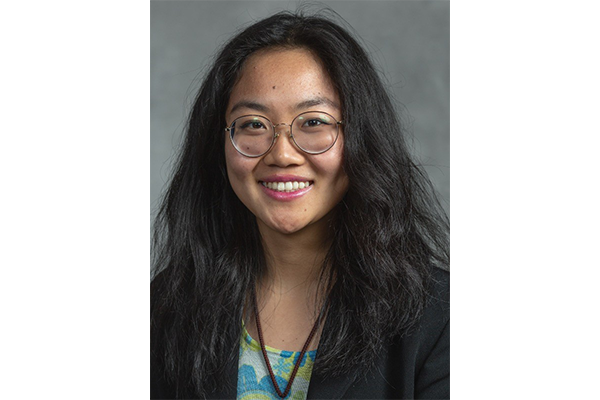
Portrait of JiaJia Fu. Courtesy photo.
JiaJia Fu, E’26, is a bioengineering student whose research spans modeling the HIV glycan shield at Northeastern’s SymBioSys Lab to engineering plastic-degrading enzymes as a research co-op at the Harvard Wyss Institute. After graduation, she plans to pursue a PhD at the intersection of sustainability and biotechnology, bringing a rare blend of computational and wet lab expertise—and a deep conviction that bioengineering can help solve the planet’s most pressing ecological problems.
JiaJia Fu just completed her bachelor’s degree in bioengineering at Northeastern University. Growing up, she spent a lot of time in nature and developed a fondness for animals, so she was adamant about pursuing a degree in the natural science realm. When she was introduced to biotechnology during a summer camp, Fu realized that she could have a bigger impact on the natural world through engineering. Then, she joined a robotics team and enjoyed the applied aspect of building robots. Fu ultimately chose bioengineering because she admired how the field “leverages tools that nature has already optimized.” In high school she discovered an interest in independent research after completing a project about plastic eating enzymes and decided that she wanted to pursue higher education.
Fu was initially drawn to Northeastern based on its location in Boston—a hub for bio-related research. She also admired the Co-op Program and how students are encouraged to get as much experience as possible. With a collaborative environment and a variety of lab spaces at Northeastern, Fu knew she that this was the school for her.
SymBioSys and extracurriculars
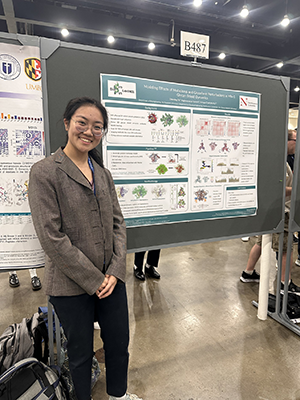
Fu presenting her research. Courtesy photo.
Her main project at the SymBioSys Lab is to use computer modeling to understand how the HIV virus escapes patients’ immune systems. Specifically, she is modeling the glycan shield—the sugar molecules that protect the surface of the protein—to better understand how the disease works and help the development of more effective vaccines.
Guiding her through this work is Assistant Professor Srirupa Chakraborty, head of the SymBioSys Lab, whose mentorship has been foundational to Fu’s growth as a researcher. Because SymBioSys was Fu’s first research experience, Professor Chakraborty built her skills from the ground up, teaching her how to approach complex problems and see a project through from start to finish. Fu credits her mentor’s “infinite patience” and depth of knowledge for giving her a solid foundation to carry into future endeavors.
Beyond the lab, Fu channels that same curiosity and collaborative spirit into several extracurricular pursuits. As head of the life detection team on the Northeastern Mars Rover Team, she helps design onboard instruments and biochemical assays to search for signs of life in soil samples. Each summer, the team competes in the international University Rover Challenge at the Mars Desert Research Station in remote Utah, where the terrain mimics a Martian surface. Fu’s recent work with the club—developing a UV-visible spectrometer that identifies biomolecules in soil by analyzing how light reflects through a sample—earned her the PEAK Summit Spring award for both the 2025 and 2026 school years.
Leading the life detection team has also sharpened Fu’s communication skills. Coordinating across teams building different parts of the rover taught her to be consistent and efficient in how she shares information, and to connect with people from a wide range of backgrounds and technical skill sets— something she has found equally valuable in her professional life.
Fu also brings her creative side to campus as head of photography for NU Sci, Northeastern’s student science magazine. She creates cover photos for each issue and runs workshops and field trips to teach fellow students digital photography. It’s a natural extension of her favorite hobby. “I’ve enjoyed turning my creative outlet into something other people can enjoy,” she says.
Co-op and gratitude
Fu currently works as a research co-op at the Wyss Institute at Harvard University, a hub of cutting-edge academic research labs with a shared mission: turning scientific discoveries into real-world startups. Her lab’s current project is engineering bacteria that produce enzymes capable of breaking down plastic. Fu’s role sits at the intersection of computation and biology—she builds machine learning pipelines to design new protein structures in 3D space at the atomic level. Because these models are trained on existing protein data, they can generate entirely novel structures from scientific inputs, allowing her team to redesign plastic-eating enzymes that break down plastic into non-toxic components at room temperature. From there, colleagues in the lab synthesize the genes and engineer them into bacteria to physically produce the proteins Fu designs. Working with technology that did not exist a decade ago, she says the experience has fundamentally shaped her vision for her future career.
Her path to Wyss was itself a product of Northeastern’s co-op network. During her first co-op, she worked at a startup whose founder had conducted the original research at the Wyss Institute—a connection that eventually opened the door to her current position. It’s the kind of through-line that Fu sees as emblematic of what Northeastern has offered her more broadly. She is grateful for the university’s emphasis on hands-on experience, which gave her not only the technical skills to work in a research lab, but also the ability to communicate complex science clearly—making her work accessible to audiences well beyond the lab.
Lessons learned and the future
As Fu graduated this spring, she reflects on one of the harder lessons her time at Northeastern taught her: more is not always more. Juggling multiple clubs, research positions, and a full course load left her burnt out, and she watched her productivity suffer as a result. The experience taught her the importance of knowing her own limits. “Learning to say no is quite difficult,” she says, “but sometimes you just have to establish a boundary for yourself and know your own limits.”
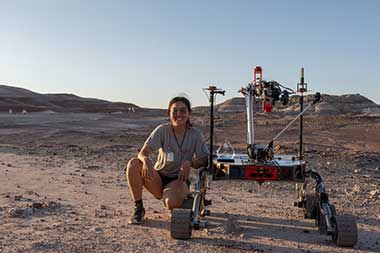
Fu next to the NEU rover in Utah. Courtesy photo.
Equally important to managing her workload, she says, is having a deeper reason to keep going when the work gets hard. “Even if I am stuck on a project for months at a time, I remember why this is important and worth struggling over.” For Fu, that motivation is rooted in something larger than any single experiment—a drive to help the planet by solving ecological problems through bioengineering. That sense of purpose, she believes, is what carries researchers through the inevitable frustrations of lab work.
It’s also what’s shaping her next steps. Fu plans to pursue a PhD in bioengineering, with an eye toward building a career at the intersection of sustainability and biotechnology—whether in academia or the startup world. Protein design, like the work she’s doing at Wyss, is the area she hopes to stay close to. Whatever path she takes, she leaves Northeastern with a rare combination of computational expertise, hands-on lab experience, and the kind of perspective that comes from doing the work—and learning, sometimes the hard way, how to do it well.