Improving Telecommunications for a Better Future
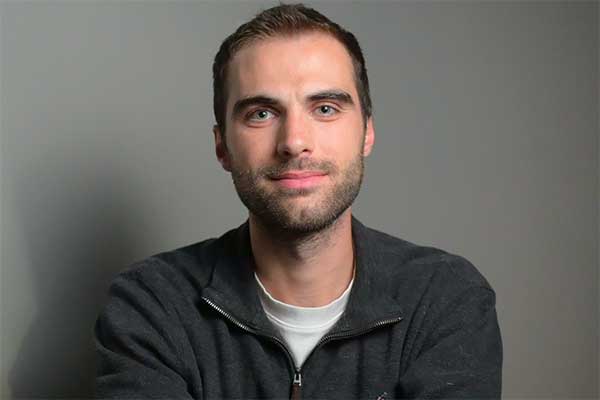
For his master’s thesis, Matteo Bordin, PhD’27, computer engineering, researched telecommunications and 5G networks. Closer examination within this field inspired Bordin to pursue a PhD, as well, where he hopes to develop inventive and impactful research projects that offer promise for a better future.
Matteo Bordin studied computer science in both his undergraduate and master’s studies. During his master’s thesis process, Bordin got to work with Northeastern University through his collaboration with Assistant Research Professor Michele Polese. Bordin’s thesis focused on using a network simulator where he had to model drones equipped with 5G radio to study the extension of the perception of autonomous vehicles. He modelled a drone to wirelessly communicate with autonomous cars. Bordin was evaluating whether it is more efficient to have the drone process all the sensor data or for the drone to send the data directly to the vehicle.
Bordin says that his thesis process introduced him to research in telecommunications, as well as sparked his interest in 5G and 6G networks. Now, in his PhD program in computer engineering, Bordin is conducting research at the Wireless Networks and Embedded Systems (WiNES) Lab with William Lincoln Smith Professor Tommaso Melodia. The WiNES Lab is a part of the Institute for the Wireless Internet of Things at Northeastern. Since researching at this lab, Bordin has worked on various projects from unmanned aerial vehicles (UAVs) to artificial intelligence for network optimization.
Research at the WiNES Lab
Bordin collaborated with Professor Stefano Basagni on one of his UAV projects, working on low-power sensors that can be used in emergency cases. This project—called “UAV-assisted Data Collection for Wake-Up Radio Networks”—helped Professor Basagni implement and use a real-world UAV to aerially scan these low-power sensors and gather data. This research project was Bordin’s first experience in the field with UAVs.
Next, Bordin began research involving UAVs that ultimately led to a published patent. The research involved a framework that allowed UAVs to fly easily on public 5G networks. This research was submitted to the IEEE Advanced Air Mobility Challenge and won the first-place prize.
Presenting at the IEEE International Symposium
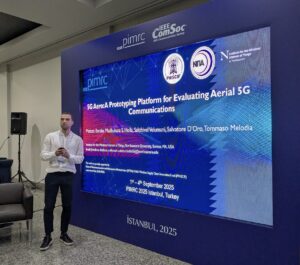
Bordin presenting his research paper at the IEEE International Symposium on Personal, Indoor and Radio Communications.
Recently, Bordin was able to present one of his research papers at the IEEE International Symposium. In the paper on Personal, Indoor and Mobile Radio Communications, Bordin and his team explored how 5G can empower smaller drones. The goal was to see if small drones equipped with commercial 5G radios could manage the demand of real-time data, video streaming and remote monitoring. The research tests whether the communications infrastructure can support these use cases in real-world conditions, not just in controlled laboratory settings.
For this project, Bordin started by building a compact platform named “5G Aero” from scratch. “5G Aero” is a drone, the smallest of its kind, with a 5G radio that is 3rd Generation Partnership Project (3GPP) compliant. This UAV connects to the 5G network as a smartphone would and can be used as a research platform to measure real-world performance. Upon completing the construction of the drone, Bordin assessed to see if it was 3GPP compliant. To test this, there are two types of scenarios he used to assess the drone. The first scenario is called a line-of-sight condition. In this scenario, there is a base station that provides the 5G connection, and the drone requires a clear, unobstructed path to the base station. In the second scenario, they put obstacles in the middle of the path and studied how the drone behaves in non-line-of-sight conditions.
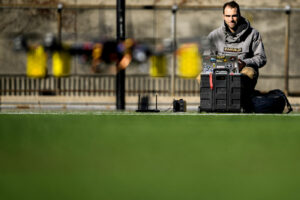
Bordin testing the UAV device.
Bordin and his team were able to maintain all 3GPP requirements in both test scenarios. Additionally, Bordin and his team studied how the battery in the drone performs with access to 5G versus without. The overall battery life and flight time were reduced by 1% when using 5G compared to when 5G was not being used, suggesting that the higher data speeds and complex processing required when using the more advanced signal, as well as the struggle to simply maintain a signal, demands more power and energy.
Impactful Research and Future Perspectives
After working extensively with real UAV platforms, Bordin moved into improving the realism and performance of simulation tools. He began contributing to two major open-source tools (ns-o-ran and SioLena), which provide realistic simulations of 5G systems. These modules let researchers emulate real networks, test new algorithms at scale and reproduce complex scenarios safely and quickly. By integrating insights gained from field UAV experiments, Bordin helped make these simulators more accurate and practical, enabling the broader community to evaluate wireless systems long before they are deployed in the real world.
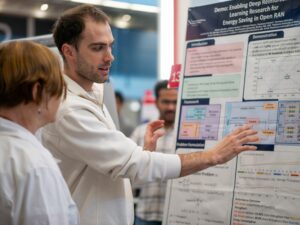
Bordin explaining his demo.
Bordin’s latest project, a collaboration with Mavenir Systems, tackles energy efficiency in 5G networks through machine learning. He developed a model that intelligently decides which antennas to activate and deactivate based on real-time network demand, significantly reducing energy consumption without compromising service quality. At the IEEE Consumer Communications and Networking Conference 2025, Bordin presented both a paper and a live demonstration of the system in action—work that earned him “Best Demo Award Runner-Up” recognition.
Bordin’s other recent project emerged from a summer internship with AT&T. He developed a machine learning model that predicts system failures before they occur in AT&T’s 5G network. By forecasting alarms ahead of time, the tool enables operators to address issues proactively—preventing service disruptions for customers and saving technicians valuable time they would otherwise spend troubleshooting unexpected outages.
Throughout his PhD program at Northeastern, Bordin has focused on research that delivers real-world impact. His machine learning models aim to benefit both sides of the telecommunications ecosystem: helping providers reduce operational costs and energy consumption while ensuring consumers experience reliable, high-quality service.
When asked what he enjoys most about his research, Bordin said, “Providing some impactful research solution and something that can have an impact on other people. That’s for sure the main reason why I like doing this.” Bordin says that after completing his PhD program, he wants to continue working on projects that will have a significant impact on the telecommunications industry and make products better for individuals to enhance user experience. He is also interested in launching his own venture to bring novel telecom technologies to market.