It’s Never Too Late to Pivot: How Lucia Marquez Made Her Own Path
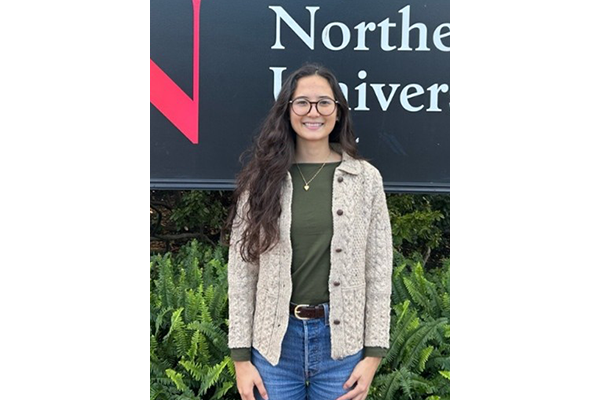
Lucia Marquez portrait. Courtesy photo.
Lucia Marquez, MS ’26, is completing a master’s degree in mechanical engineering through the PlusOne Program. With diverse co-op experience behind her, Marquez is entering industry with a focus on the two things that drive her most: innovation and sustainability.
Lucia Marquez just completed a master’s degree in mechanical engineering with a concentration in thermofluids at Northeastern. As a child she gravitated toward STEM, and attending a technical high school gave her an early grounding in engineering fundamentals. Midway through high school, she participated in the Exploring Career Options in Engineering and Science (ECOES) program at Stevens Institute of Technology, which introduced her to the full range of engineering disciplines—and helped her identify mechanical engineering as the one that suited her best. When it came time to apply to college, Marquez applied to just two schools, with Northeastern as her clear first choice. She had toured the campus a couple of years earlier and been drawn immediately to the Co-op Program. Having watched older peers struggle to find work after graduation due to limited experience, she felt the program was “really prepping you for the real world.”
She had known she wanted a master’s degree since high school, so the PlusOne Program—which adds only one additional year—was a natural fit. She also appreciated being able to use elective slots for advanced technical coursework, where she consistently excelled. Thermofluids was the obvious concentration: a subject she had thrived in as an undergraduate and one she expected to be directly applicable in her career. In addition to her master’s, Marquez is earning a graduate certificate in engineering leadership through The Gordon Institute of Engineering Leadership (GIEL), which has reshaped her courseload to include leadership and product development classes alongside a capstone challenge project in place of some technical electives.
Co-op Experiences
Marquez’s first co-op was at EZ ICE Rinks Inc., where she worked as a mechanical engineering intern. The experience introduced her to start-up culture and to the world of product development. It was insightful—and it clarified something important: product development was not the direction she wanted to pursue. She left with a clearer sense of what she was looking for and a willingness to pivot.

Marquez on site during her RDH co-op. Courtesy photo.
Her most formative experience came during her second co-op at RDH Building Science, an engineering consulting firm specializing in building design, construction, maintenance, and energy and climate services. Though her team was composed mostly of civil, structural, and architectural engineers, the office culture was warm and supportive, and Marquez found herself welcomed into a corner of engineering she hadn’t previously considered. As an engineering assistant, she accompanied supervisors on job site visits to inspect building envelopes—the foundations, walls, doors, windows, and roofing systems—ensuring proper installation and identifying deficiencies. She also explored using drone technology to develop 3D building models where issues could be flagged and shared efficiently with clients. One project she led stood out in particular: designing a new system for calculating how effectively a building retains or releases heat based on its architectural plans.
The co-op confirmed her direction. She left with a conviction that thermofluids was the right path—and with a broader lesson she carries with her: “as long as you have a passion and experience you can transfer, you can become an asset in a new career path.” Even without direct overlap between her first and second co-ops, she found enough common ground to break into a new sector with confidence. She currently works part-time at RDH as a building enclosure consultant while completing her final research project for the Gordon Institute.
Extracurriculars and Mentorship
During her undergraduate years, Marquez was a member of Northeastern’s chapter of the American Society of Mechanical Engineers (ASME). The club was a valuable resource throughout her co-op search, regularly bringing in company representatives to talk about their work—giving her both a wider view of career paths in mechanical engineering and direct access to the companies she was most interested in.
She also highlights her involvement with Pi Tau Sigma, the mechanical engineering honors society, where she served as president for a year. A highlight of that role was a national convention that brought mechanical engineers together from across the country—an excellent networking opportunity that also exposed her to research and perspectives from outside Northeastern. Leading the organization gave her a new appreciation for the behind-the-scenes work that keeps a club running, and sharpened her project management and delegation skills in the process.
Marquez has found consistent support from Northeastern’s thermofluids faculty—not only as professors but as career advisors. Having worked in industry themselves, they offered a kind of reflection she found especially valuable: honest perspective on what they might have done differently, which helped shape her own thinking about her path. She highlights Associate Professor Carlos Hidrovo, Director of Global Programs, as a particularly meaningful mentor in her final year. His demanding and distinctive teaching style pushed her to develop a more rigorous approach to critical problem-solving. She also credits Professor Hameed Metghalchi and Associate Teaching Professor Mehdi Abedi—her GIEL and Capstone advisors, respectively—for their guidance through both her undergraduate and graduate coursework.
Reflection and Looking Forward
Looking back, the one thing Marquez wishes she had done differently is reach out for help sooner. Early in her studies, she felt pressure to “go with the flow” and follow the same path as everyone around her. It wasn’t until she began building real relationships with advisors and professors that she discovered interests and opportunities she would never have found on her own. Her advice to younger students reflects that experience: connect with faculty early, because they have knowledge and networks that extend well beyond the classroom. Co-op supervisors and colleagues, she adds, can be equally valuable—offering career perspectives the university may not surface. “Find a different path and make it your own,” she says—and even if Northeastern doesn’t chart that route explicitly, there are always resources available to help students navigate it.

Marquez completing a team building exercise with her Gordon peers. Courtesy photo.
Marquez has accepted a full-time position at a mechanical, electrical, and plumbing (MEP) firm specializing in mechanical design and energy systems, beginning after graduation. She had no prior experience in the MEP sector, but her co-ops gave her a platform to translate her skills and passion convincingly—and, she credits Northeastern’s commitment to experiential learning as what ultimately made it possible. In the near term, she plans to keep building her technical expertise in industry. Her driving motivation is simple and concrete: “to make buildings better”—improving existing processes, making that knowledge more accessible, and reducing the environmental strain that buildings place on the planet. With the range of experience and clarity of purpose she has developed at Northeastern, Marquez is well positioned to pursue exactly that.