New Discovery in Human Cells
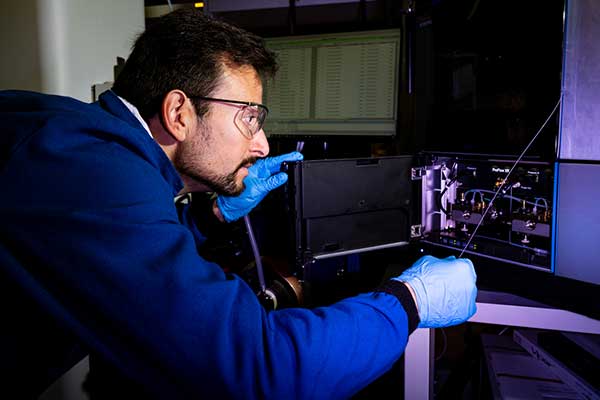
BioE Professor Nikolai Slavov and his team at the Single-Cell Proteomics Center made a discovery in early human cell differences. The findings of this discovery could have a huge impact on regenerative medicine.
This article originally appeared on Northeastern Global News. It was published by Kate Rix. Main photo: Nikolai Slavov, Northeastern professor of bioengineering, has found molecular differences that predict the developmental potential of human embryos. Photo by Alyssa Stone/Northeastern University.
Discovery in early human cell differences could rewrite stem cell therapy
Mammal embryos show differences between individual cells from the very first division — a finding that could transform stem cell therapy, Northeastern University researchers have discovered.
Individual cells are distinct from one another in mammal embryos from almost the very beginning of life — the first division of cells — overturning a long-held belief that human embryos are a blank slate until later in development, Northeastern researchers report.
“People assume that in those early stages, the two cells are much more similar to each other,” says Nikolai Slavov, bioengineering professor and director of Northeastern’s Single-Cell Proteomics Center. “It wasn’t known how they’re different, and we have found molecular differences that can predict their developmental potential.”
The findings may guide future research in regenerative medicine, Slavov says. The cells more likely to develop into a viable embryo contain certain proteins that could “become targets to improve reprogramming efficiency or embryo-like formation from stem cells,” he says, to make them more medically effective.
The findings were published today in the journal Cell.
Using a powerful machine learning-enhanced technique called single-cell proteomics by mass-spectrometry to measure proteins in individual cells, researchers in Slavov’s lab identified proteins in a two-celled embryo that varied abundantly from one cell to the other and that those differences related to the organism’s future success.
The differentiation of initially identical cells, says Slavov, is driven by proteins. It happens earlier than was previously understood, but one of the cells is more likely to develop into a viable embryo.
The proteins are key to the discovery, Slavov says. The proteins in our cells are complex molecules that orchestrate complex chemical reactions, from growing tissue to fighting disease. Our bodies house thousands of different types of cells, which contain tens of thousands of different proteins, he says.
Read full story at Northeastern Global News