New Research Discovers Sensor That Can Detect Single Cancer Cells
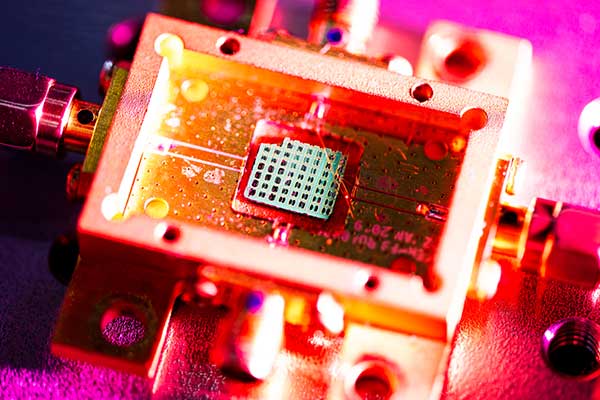
ECE Associate Professor Cristian Cassella, Assistant Professors Marco Colangelo, and Siddhartha Ghosh have made a breakthrough in their research on sensors. They have been working on a sensor that can detect objects as small as single cancer cells, which will be incredibly beneficial to the future of medical technology.
This article originally appeared on Northeastern Global News. It was published by Noah Lloyd. Main photo: Researchers have made a breakthrough sensor discovery that could detect objects as small as individual proteins or single cancer cells. Photo by Alyssa Stone/Northeastern University.
Breakthrough research revolutionizes imaging at the smallest scales
At the heart of every camera is a sensor, whether that sensor is a collection of light-detecting pixels or a strip of 35-millimeter film. But what happens when you want to take a picture of something so small that the sensor itself has to shrink down to sizes that cause the sensor’s performance to crater?
Now, Northeastern University researchers have made a breakthrough discovery in sensing technologies that allows them to detect objects as small as individual proteins or single cancer cells, without the additional need to scale down the sensor. Their breakthrough uses guided acoustic waves and specialized states of matter to achieve great precision within very small parameters.
The device, which is about the size of a belt buckle, opens up possibilities for sensing at both the nano and quantum scales, with repercussions for everything from quantum computing to precision medicine.
Shrinking cameras
Previously, when a scientist wanted to train a camera on something very small, the camera itself had to reduce in size, too. As camera systems shrink, however, the technology comes up against greater and greater barriers, according to Cristian Cassella, an associate professor of electrical and computer engineering at Northeastern.
A specialist in microelectromechanical technology, that is, electrical and mechanical systems that operate on scales often smaller than the width of a human hair, Cassella says that as the size of the pixels in the camera sensor decreases, performance and sensitivity both degrade. So how, Cassella wondered, “can you get an equivalent reduction of the pixel size without reducing the pixel size?”
While this might seem like a contradiction in terms, it forced Cassella to think outside the box, eventually approaching collaborator Marco Colangelo, an assistant professor of electrical and computer engineering at Northeastern. Colangelo, Cassella and Siddhartha Ghosh, an assistant professor of electrical and computer engineering who also contributed to the project, all share laboratory space in Northeastern’s EXP building.
Read full story at Northeastern Global News