Service, Sustainability, and a Human-Centered Engineering Mindset
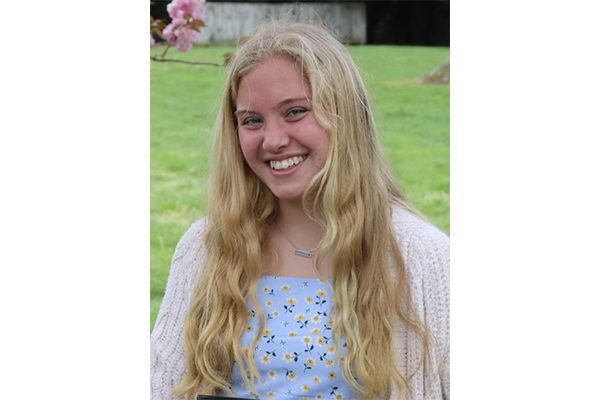
Annie Shea portrait. Courtesy photo.
Annie Shea, E’26, combined chemical and environmental engineering, completed three co-ops and multiple research projects at Northeastern. Driven by a passion for sustainability and service, she is now applying to climate tech positions aimed at bringing relief to communities facing environmental challenges.
Annie Shea graduated from Northeastern this spring with a bachelor’s degree in combined chemical and environmental engineering. An avid learner who has always loved school, she gravitated naturally toward math and chemistry—and from an early age toward taking things apart to see how they worked, building Legos, and solving problems creatively. Sustainability became a deepening passion, and engineering felt like the right field to bring all of those interests together. In high school, Shea was active in multiple service organizations, and she came to college fully intending to continue that work.
Family ties to the Boston area first introduced her to Northeastern. Her brother had benefited from a co-op-style internship at another school, so Northeastern’s own Co-op Program was an immediate draw—she liked the idea of gaining real professional experience while still a student. A campus tour and further research confirmed the fit. She connected with the university’s ambitious atmosphere and found a community of students who, like her, wanted to be involved and make an impact. That sense of common purpose sealed her decision.
A Service-Learning Journey
The course that reshaped the entire arc of Shea’s academic career was Cornerstones of Engineering, the required first-year course for engineering students. She was placed in a service-learning section without quite realizing it—and ended up loving the experience. That section partnered with an after-school elementary STEAM club, with engineering students facilitating weekly lessons for younger students and working toward a final project: a museum exhibit designed for the kids. The course introduced Shea to the idea of human-centered engineering and to the communication skills that come with putting people at the center of technical work.
The course was taught by Teaching Professor Kathryn Grahame, Director of First Year Engineering. In addition to being an “excellent professor,” Grahame became a lasting mentor—she invited Shea to serve as a teaching assistant for the course every semester since, a role Shea embraced enthusiastically. Together they worked to strengthen service-learning at Northeastern, with Grahame consistently encouraging Shea to follow her interests, pursue research, and seek funding to present their work at conferences. “She has always encouraged me to pursue what I am interested in,” Shea says. Working alongside Professor Grahame deepened Shea’s confidence in her own abilities, and she is grateful for the continued guidance.
Research Projects
One of the most meaningful projects of Shea’s college career was her work with Community-Engaged Teaching and Research (CETR). She and Professor Grahame collaborated with a community partner—an elementary school teacher—to develop a framework for teaching STEAM through service learning. The resulting paper, which Shea describes as a “culmination” of their work together, highlights best practices for service learning in STEAM environments and explores how those practices can be implemented at the high school or university level. At its core, the work makes the case for human-centered engineering: encouraging engineers to think beyond technical solutions and consider the people and communities they are serving—while also breaking down biases on both sides, helping engineering students connect with communities and showing kids what engineers actually do. The paper was presented at the American Society for Engineering Education (ASEE) Conference in 2023.
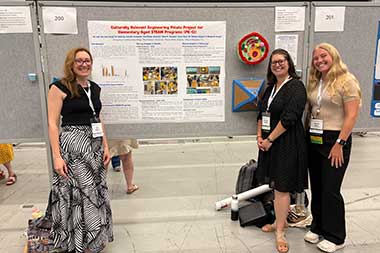
Shea presenting at the 2025 ASEE Conference. Courtesy photo.
At that conference, Shea and her team connected with researchers from the University of California San Diego, who run a summer camp teaching engineering activities to students. The collaboration that followed produced a second paper, centered on one of the camp’s signature activities: a piñata-building exercise that serves as a culturally responsive way to teach fundamental engineering concepts such as spatial visualization, with creative elements woven in through decoration. The paper also addressed how to adapt the activity for Northeastern’s own community partners, with a scaffolded framework accommodating different levels of learning. The team presented this work at the ASEE Conference in 2025.
Beyond the research itself, Shea valued the professional development dimension of CETR. “It’s been helpful to have a community to bounce ideas off of in terms of trainings, reflection, and cultural competency—which are important when working in service-learning,” she says. As service-learning team manager, she oversaw a group of teaching assistants from a range of majors, making time to learn what other service courses were doing and sharing ideas across programs.
The role also shaped her as a leader. She learned that leading from within a group—facilitating discussion rather than directing from above—is more effective and more meaningful. Before taking on these responsibilities, Shea describes herself as not particularly outgoing; the experience changed that. Though her CETR work sits outside the technical core of chemical and environmental engineering, it built skills—research, communication, organization, and empathy—that translate directly to any professional setting.
Co-op Experiences
Shea completed three co-ops during her undergraduate degree. The first was at Advent Technologies Holdings, a hydrogen fuel cell company, where she worked as a fuel cell testing and analysis co-op. Her responsibilities included assembling and testing fuel cell technology and writing code for data analysis—including teaching herself Python to build an analysis application. The experience sharpened her ability to work independently on professional-scale projects.
Her second co-op was at Lithios, a company that uses electrochemical processes to extract lithium from concentrated brine solutions for use in electric vehicle batteries. As an electrochemical engineer intern, she worked with the R&D team on experiments to optimize the purity of the extracted lithium. She describes it as a rewarding experience—fast-paced, hands-on, and skill-building.
Her most recent co-op was at Sora Fuel, which develops carbon-neutral aviation fuel. There she deepened her knowledge of material properties and worked on refining the electrochemical processes used to capture and store carbon. Once again working with significant independence, she honed her experimental troubleshooting skills and came away with a clearer sense of the kind of work she wanted to do next.
Clubs, Advice, and the Future
Outside of research and co-ops, Shea was a committed member of the Alliance of Civically Engaged Students (ACES)—a community she joined before she even arrived on campus. ACES offers its own welcome week, pairing first-year students with a community partner for weekly service and hosting workshops, discussions, and presentations on civic engagement in Boston. For Shea, it was an ideal way to orient herself in a new city while continuing the service work she had valued in high school. She eventually became a team leader and peer mentor, then moved into the role of education coordinator, developing the club’s curriculum around the most pressing challenges facing Boston’s communities.
She was also a member of Club Running, where she served as vice president for a period. The team met nearly every day, and Shea came to treasure those gatherings. “They are my family on campus,” she says. The club was both a vital outlet and another space where her confidence and leadership continued to grow.
As she looks back on her time at Northeastern, Shea’s advice to current students is to build a solid support system early—professors, classmates, lab mates, whoever shows up for you. “Engineering is not a major that should be done alone; it’s very collaborative,” she says. That network is also, she notes, how opportunities find you. Many of the research experiences that shaped her college career grew out of conversations within the community she had built.
Shea is currently applying to roles in the climate tech industry, looking to bring together her chemical and environmental engineering skills through a shared focus on sustainability. Her co-ops gave her an appreciation for the start-up environment in particular. “It’s exciting to see startups scale up and grow into something bigger,” she says. Her deeper motivation is the impact of environmental risks—pollution, climate change, degraded ecosystems—on communities least equipped to absorb them. She wants to be part of developing sustainable solutions that offer real relief. With her breadth of technical experience, her grounding in service, and her commitment to human-centered work, Shea is well positioned to be a meaningful force in the sustainability and climate tech space.