Deep Dive into the Success of Emmanual Amoako
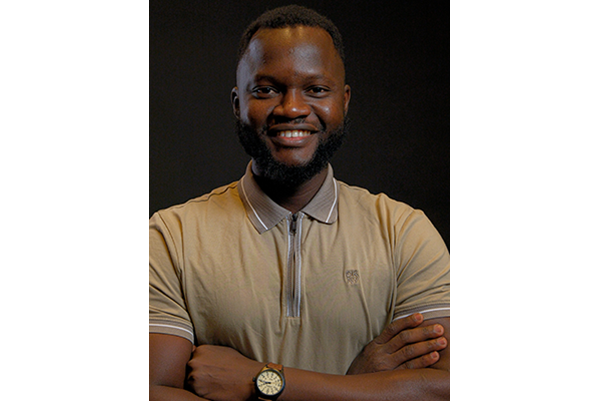
Portrait of Emmanual Amoako. Courtesy Photo.
Emmanual Amoako, MS’25, bioengineering, has recently defended his master’s thesis and graduated from Northeastern University. With a passion for service and extensive laboratory research, Amoako will help usher in a new age for accessible medical instruments.
Emmanual Amoako recently graduated with his master’s in bioengineering from Northeastern University, after completing his bachelor’s in biomedical engineering in 2022 at the University of Ghana. Amoako originally wanted to become a doctor but two experiences during his youth shifted his path. When his brother needed an MRI after an accident, his family had to travel two hours to reach a clinic with the necessary equipment. Later, visiting a family member in the intensive care unit after a premature birth, he was struck by the sight of three babies sharing a single incubator. These moments revealed a critical need—not just for more doctors, but for better access to medical technology. That realization led him to pursue medical engineering and focus on the medical device sector.
Collaborations and opportunities
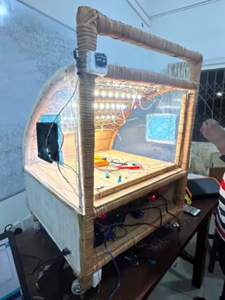
Incubator made by Amoako and his team. Photo sourced from LinkedIn.
As an undergraduate at the University of Ghana, Amoako completed an internship in his hometown hospital, where he designed a heating system for newborns. The system used a lightbulb as a heat source that automatically shut off when it reached a safe temperature for infants. This project’s success inspired him to do more. When Northeastern partnered with the University of Ghana on capstone projects, Amoako eagerly joined, helping to build a low-cost infant incubator using locally accessible materials like bamboo.
It was this project that led Amoako to consider Northeastern for his master’s. After meeting Professor Lee Makowski, affiliated professor Mark Fuller, and some students, his interest grew. Discovering the enormous benefits of the co-op program solidified his commitment and he became determined to see “how [his] classroom experience can be transferred or applied in the industry.”
Makowski and Niedre’s lab and influence
Amoako is grateful for the support he has received throughout his master’s. Specifically, he mentions that, “Northeastern gave me some of the best professors that I have ever met in my life”, referring to Professor Makowski and Associate Dean of PhD Education and Distinguished Professor Mark Niedre. Coming from Ghana’s education system, Amoako was uncertain how his experience would translate to American universities. Professor Makowski immediately saw his potential and brought him onto his research team. For his first project, Amoako was tasked with converting chunks of data into images—something he had no prior experience with. He recalls, “This really challenged me to read more, to learn more, to do these conversions, and that was good.”
After taking Niedre’s medical imaging class, which offered Amoako practical coding skills that are useful in the medical device field, he sought an opportunity to work in Niedre’s lab, the Biomedical Optics Research group. Impressed with Amoako’s undergraduate research, Niedre admitted Amoako into the lab.
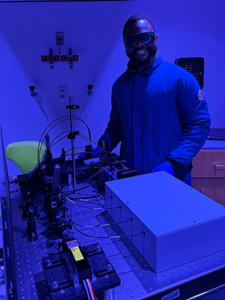
Amoako in Niedre’s lab. Courtesy Photo.
Amoako’s project with Niedre’s lab focuses on detecting and studying cancer cells in the blood non-invasively. Specifically, he examines the differences between ordinary melanoma cells and a more dangerous subtype: tumor-repopulating cells. These cells are stem-like, highly-aggressive, and have enhanced metastatic potential—meaning they are more likely to spread cancer throughout the body.
Previous research has shown that these resistant cells are unusually flexible and deformable. Building on this knowledge, Amoako investigates how these mechanical properties might influence how the cells circulate through the bloodstream and their ability to metastasize. He uses a specialized tool called Diffuse In Vivo Flow Cytometry— a system designed by Professor Niedre’s group that can detect fluorescently labeled cancer cells in live animals without invasive procedures. Amoako developed the algorithms for the In Vivo tool using Python and MATLAB for signal detections.
Amoako says these experiences helped him bridge the gap between his education in Ghana and the more competitive academic environment he found in Boston.
Learning and the future
Amoako credits the work he completed in both Professor Makowski’s and Professor Niedre’s labs with preparing him for his 2024 co-op at Glaukos. The diverse skills he acquired—including developing Python algorithms to convert X-ray microdiffraction data into 2D brain images, growing tumor cells, analyzing bio signals, operating fabrication equipment like 3D printers and laser cutters in the Bioengineering Capstone lab, and conducting data analysis—gave him the technical versatility Glaukos was seeking.
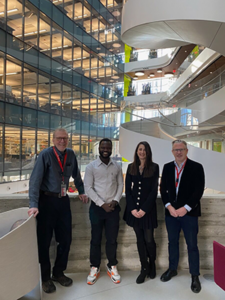
Amoako after defending his master’s thesis. Photo sourced from LinkedIn.
Amoako reflects that his time in the program has brought his once confusing career ambitions into sharp focus. The skills he acquired at Northeastern have clarified his path: designing medical devices, therapies, and diagnostics for patients in low-resource areas. He is particularly interested in improving obstetric devices and developing solutions for glaucoma patients—populations that often lack access to quality care. At the heart of it all is Amoako’s fundamental desire to help people through his work. Armed with the skills and support he’s gained from Northeastern, he’s ready to pursue his passion for medical devices and use it to make healthcare more accessible for underserved patients worldwide.