Helping Others Through Innovations in Bioengineering
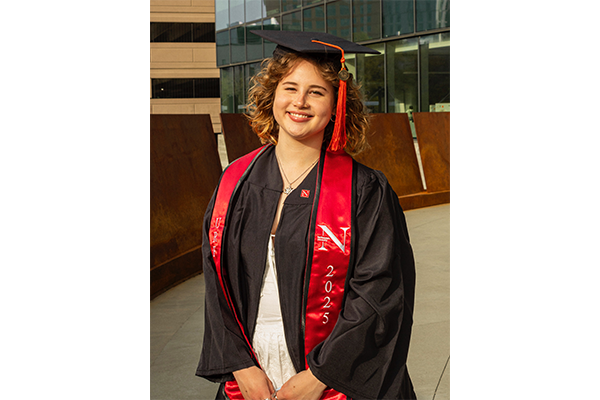
Portrait of Hannah Carter. Courtesy photo.
Hannah Carter, MS ’26, bioengineering, is deeply involved in research at Northeastern with a focus on the causes of neurodegenerative disease. After graduating, she plans to gain several years of research experience before applying to PhD programs.
Hannah Carter completed her bachelor’s degree in bioengineering last spring and has rounded it out with a master’s in bioengineering through the PlusOne Program at Northeastern. Music has been a lifelong passion—she became president of her school choir and led an a cappella group—and early in her education she considered pursuing business, inspired by watching her parents run their own venture. That changed when her grandmother was diagnosed with Parkinson’s disease. Wanting to understand the illness, Carter began researching how it worked and what treatments existed. As she moved through high school and into more advanced math and science courses, her curiosity deepened. A conversation with a family friend introduced her to bioengineering, where she learned the field offered broader career options than biology alone—and she was drawn to how rapidly it was expanding.
Carter attended an International Baccalaureate high school, an experience that reinforced her intention to continue her education. When her college search brought her to Boston, Northeastern stood out immediately—the Co-op Program aligned with her hands-on learning style, and the PlusOne Program appealed to her given her early interest in eventually pursuing a PhD. She was also drawn to the diversity of the student body and the range of extracurriculars, appreciating that she could pursue her passions in both science and music without having to choose between them.
Research and Co-op Experiences
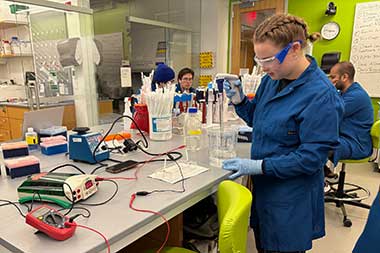
Carter in the lab. Courtesy photo.
Carter entered the research world early, joining the Advanced Biosystems for Neuroengineering Lab (ABNEL) in her first year. At the time, the lab focused on “organ-on-a-chip” systems—small devices embedded with human cells that mimic the functions of organs. She began by shadowing PhD students, learning proper lab technique and getting a feel for the research environment. Once she found her footing, she launched her own project and received the PEAK Ascent Spring 2023 Award for her efforts. The work examined how intestinal cells from one of the lab’s organ-on-a-chip devices responded to stress and temperature changes—testing how well the chip could model the behavior of a real intestine. The project built her confidence and introduced her to techniques like fluorescent staining and live microscopy imaging.
Her first industry experience was at uniQure, a genetic therapeutics company focused primarily on Huntington’s disease. On the upstream process and manufacturing science team, she helped build an information tracking system for manufacturing operations—reorganizing and cataloguing data and fine-tuning an automated control system, while lending a hand on a range of other projects as needed. Though the role didn’t develop many technical skills, it taught her how to adapt in a fast-paced environment where things frequently don’t go as planned. She became more proactive about seeking out work, learning to advocate for herself by asking her supervisor for additional projects—a mindset she has carried forward: finding value in any position, even one that isn’t a perfect fit.
Her second co-op took her to the ZHAW School of Engineering in Switzerland, where she worked as a research assistant contributing to the development of various medical devices through design work and 3D printing. A project she found particularly engaging involved testing algae-like samples with a heat-sensing device—work that culminated in a co-authored paper on which she and a fellow co-op shared first authorship. Beyond that project, she rotated through others as needed, building a versatile dry lab skill set that included coding, validation, and machine design. The experience was rewarding, but it also clarified something important: she thrives in a wet lab setting, which aligns more naturally with her research interests.
Carter returned to the ABNEL Lab to complete her master’s thesis. Using an organ-on-a-chip that mimics intestinal cells for a PhD student’s project, she is investigating how a specific gut cell type—one that sends signals directly to the brain—responds to a combination of Parkinson’s-linked proteins and glyphosate-based herbicides. The research has a personal dimension: her grandmother believes that her own exposure to herbicide contributed to her Parkinson’s diagnosis. Throughout the project, Carter has felt supported both by her lab colleagues and by the university through funding initiatives like PEAK. “Although the thesis is mainly an independent project,” she says, “there is always help when I need it.” The experience has deepened her technical skills and her confidence as she looks toward whatever comes next.
Passions and Influences
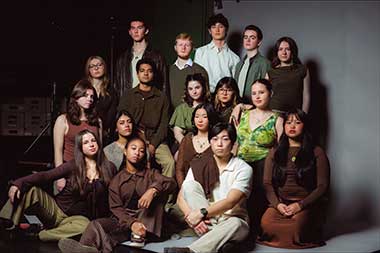
Team photo of Downbeats Acapella. Courtesy photo.
Determined to keep music in her life, Carter joined Downbeats Acapella in her first semester and became music director in her sophomore year. The club is entirely student-run, and her role involved teaching arrangements to her peers and leading rehearsals—a responsibility that developed her communication skills in concrete ways, including how to give constructive feedback and how to receive it. The most valuable lesson from leading a group of peers, she says, is that “there is a fine line between friendship and professionalism—you don’t want to hurt others’ feelings, but you still need to maintain a structured setting.” It has been challenging at times, but the confidence she has built in the role—and the sense of community the group has given her—have made it one of the most formative parts of her time at Northeastern.
Several faculty members have shaped Carter’s path in meaningful ways. She is especially grateful to Associate Professor Abigail Koppes, her principal investigator at ABNEL, who has been a steady mentor since her undergraduate years. The foundational research skills she gained from Professor Koppes and the lab’s PhD students are, in Carter’s view, “one of the biggest reasons I got the Technical Research Assistant II position at McLean Hospital.” She also highlights Professor Lee Makowski, her Capstone project sponsor, for his honesty and accessibility as a career and thesis advisor—qualities she credits with giving her clarity at several key decision points. And she is inspired by Assistant Professor Mona Minkara, whose course she took and whose office hours she attended. Professor Minkara’s enthusiasm for a subject she has spent decades studying, and her dedication to her students, have left a clear impression on Carter.
Lessons and Looking Ahead
The most important thing Carter has learned at Northeastern is that independence, taken too far, becomes unsustainable. She came in with a strong self-reliant streak and an instinct to figure things out on her own. A few difficult bioengineering courses showed her that using available resources—tutoring, office hours, study groups—doesn’t diminish that independence; it makes it more durable. She now advises students not to be afraid to ask for help, and to invest in relationships with both professors and peers. She also recommends getting to know Boston beyond campus, through volunteering or other community involvement—connections that made her own college experience richer and more varied.
Carter has accepted a full-time position at a Harvard Medical School lab at McLean Hospital, beginning after she completes her master’s degree. She plans to work for several years to build her experience and sharpen her sense of where she wants to focus before applying to doctoral programs. She has come to love the research environment and is drawn less to pharmaceutical development than to understanding disease pathology—how conditions arise and how they might be prevented rather than merely managed. Inspired by her grandmother and by others living with neurodegenerative disease, Carter hopes to use science responsibly and collaboratively to one day help eliminate these conditions altogether.