Northeastern Launches Physical AI Research Initiative, Unveils NU-WORLD Platform
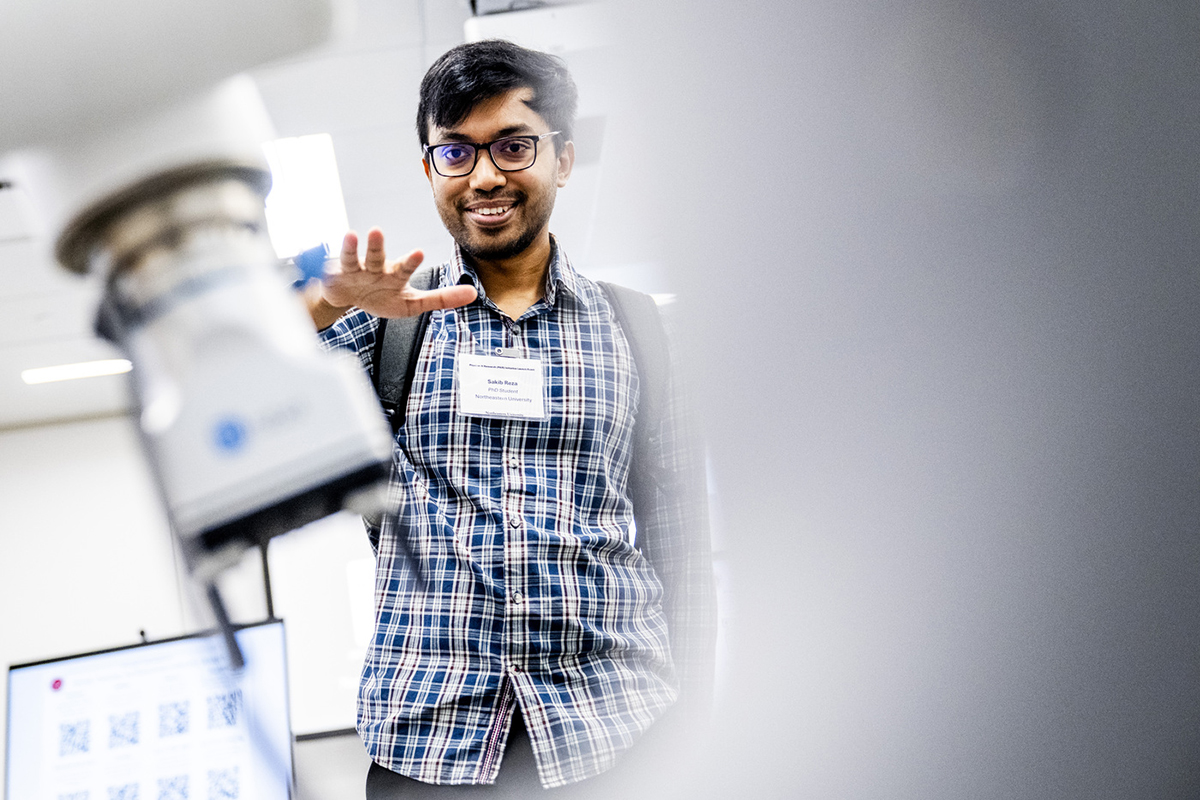
More than 200 researchers, students, industry leaders, entrepreneurs, and government representatives gathered at Northeastern University’s Interdisciplinary Science and Engineering Complex (ISEC) on May 21–22 for the launch of the Physical AI Research (PAIR) Initiative, positioning Northeastern at the forefront of one of the next major frontiers of artificial intelligence.
The two-day event featured plenary talks by Leslie Kaelbling of MIT and Peter Stone of UT Austin, the public debut of NU-WORLD, Northeastern’s open world-model platform, technical presentations, three parallel breakout sessions, poster and demonstration sessions, panel discussions, and networking opportunities.
A Critical Moment for Physical AI
PAIR leaders argue that recent advances in foundation models, multimodal AI, robotics, simulation, digital twins, edge AI, and AI for science are converging to create a unique moment for Physical AI.
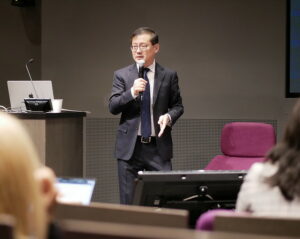
Edmund Yeh offers opening remarks at PAIR Launch in ISEC auditorium.
“We are at a critical moment in the evolution of AI,” said Edmund Yeh, founding director of PAIR and chair of electrical and computer engineering (ECE). “Over the last several years, AI has transformed our ability to process information and reason in digital environments. But the next major frontier lies beyond purely digital systems, toward intelligent systems that can learn from, reason about, and act effectively in the physical world.”
Unlike purely digital AI systems, Physical AI systems must operate in environments governed by physical laws, real-world constraints, uncertainty, and human interaction. As a result, safety, reliability, robustness, and human collaboration become central challenges.
A central theme of the launch event was that Physical AI extends far beyond robotics alone. PAIR encompasses intelligent systems operating across advanced manufacturing, assisted living and assisted health, intelligent infrastructure, energy systems, sustainability, digital twins, material discovery, AI for science, robotics, and autonomous systems.
Jennifer Dy describes three core pillars of AI research.
“PAIR pioneers the next frontier of AI through three core research pillars: learning from the world, reasoning in the world, and acting responsibly in the world,” said College of Engineering Distinguished Professor of Electrical and Computer Engineering and Professor of Computer Science Jennifer Dy. “Future intelligent systems must be able to learn from rich multimodal data, build physics-consistent models of the world, reason effectively under uncertainty, and act in ways that are trustworthy, verifiable, and resilient. These capabilities will be foundational to AI systems that operate safely and effectively in collaboration with people in complex real-world environments.”
Northeastern’s Leadership Position
The initiative has been more than a year in development and emerged from Northeastern Engineering and ECE strengths in AI, systems, sensing, robotics, and intelligent infrastructure. Today, PAIR includes 33 primary faculty members spanning the College of Engineering (COE), the Khoury College of Computer Sciences, the Bouvé College of Health Sciences, the College of Science, and the College of Social Sciences and Humanities, and has rapidly grown into a broad interdisciplinary effort with strong industry and government engagement.
“We believe Northeastern is uniquely positioned to help lead the development of Physical AI through the combination of AI, systems, infrastructure, interdisciplinary collaboration, and strong engagement with industry,” said Yeh. “Our goal is not only to advance research, but to help build the broader ecosystem around this emerging field.”
The launch event reflected broad university support, opening with remarks from the provost, Dean of COE Gregory Abowd, and Dean of the Khoury College of Computer Sciences Beth Mynatt.
Debut of NU-WORLD
A centerpiece of the launch event was the public debut of NU-WORLD, Northeastern’s open world-model platform. World models are AI systems that learn representations of how the world works, enabling intelligent systems to understand their environment, predict future outcomes, reason about possible actions, and make decisions before acting.
PAIR views open world-model infrastructure as foundational for future Physical AI systems. NU-WORLD is designed to provide open world-model infrastructure, multimodal physical world understanding, simulation and interaction environments, shared datasets, benchmarks, reproducible frameworks, and interdisciplinary research platforms.
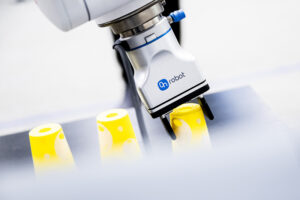
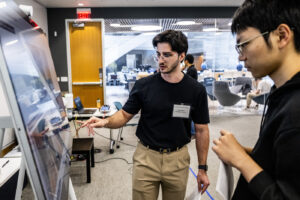
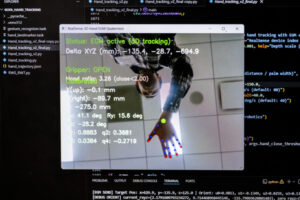
“Physical AI requires more than perception,” said Sarah Ostadabbas, associate professor of electrical and computer engineering. “You need to reason about what you have seen, or what you have perceived. This makes the reasoning component very important in physical AI systems.”
Yanzhi Wang, professor of electrical and computer engineering, described vision-language action systems as an emerging paradigm that combines perception, language understanding, and decision-making to enable intelligent behavior in real-world environments.
Importantly, NU-WORLD is not simply an infrastructure effort. Researchers associated with the platform are already advancing the state of the art in physical reasoning, trustworthy world models, physics-aware video generation, and real-time world-model-based robotic control.
Early results from the NU-WORLD effort include PanoWorld, a geometry-consistent world model for panoramic video generation, and PhyGround, a benchmark for evaluating physical reasoning and adherence to physical laws in AI-generated content. These advances were publicly debuted during the launch event through technical presentations, demonstrations, and discussions on future infrastructure development.
“NU-WORLD represents an important step toward open world-model infrastructure for Physical AI,” said Ostadabbas and Wang. “Our goal is to build shared platforms that support research, experimentation, collaboration, and innovation across a broad range of Physical AI applications.”
Building a Physical AI Ecosystem
The launch event was anchored by outstanding plenary talks from Leslie Kaelbling and Peter Stone, two internationally renowned leaders in AI and robotics. Kaelbling discussed how abstract causal world models and planning can enable highly general robots that learn efficiently in complex environments, while Stone presented “Ace,” the first autonomous robotic system shown to compete successfully against elite human table tennis players. Together, the talks highlighted both the scientific foundations and real-world potential of Physical AI and generated significant excitement among attendees.
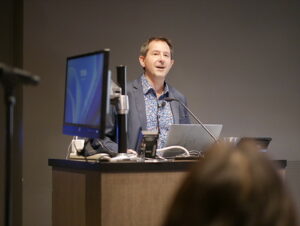
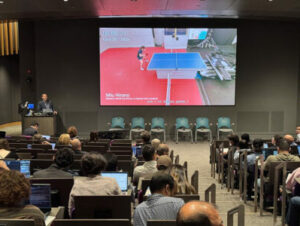
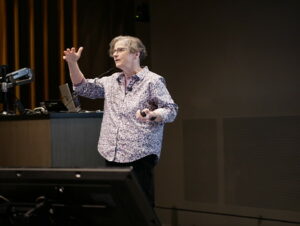
The event also featured technical presentations from Northeastern faculty highlighting the breadth of Physical AI research across the university. Professor of Computer Science and President Joseph E. Aoun Chair Lorenzo Torresani discussed human-centered Physical AI, Khoury College of Computer Sciences Assistant Professor Wengong Jin presented AI agents for molecular discovery, ECE Associate Professor Alireza Ramezani described bio-inspired super-locomotion robots, and ECE Professor Octavia Camps explored dynamics-inspired AI methods. Together, the talks illustrated how advances in AI, world models, robotics, scientific discovery, and intelligent systems are converging across a wide range of Physical AI applications.
One of the most notable outcomes of the launch event was the emergence of a broader Physical AI ecosystem spanning academia, industry, startups, government, and Northeastern researchers.
Industry participation was particularly strong and included leaders from NVIDIA, Microsoft, Amazon Robotics, Boston Dynamics, ABB Robotics, Epic Games, Sony, IBM-MIT, Analog Devices, MIT Lincoln Laboratory, Draper, MERL, American Tower, Evolv, Oura, Becton Dickinson, Kitware, and many other organizations spanning AI infrastructure, robotics, healthcare, manufacturing, sensing, simulation, and intelligent infrastructure.
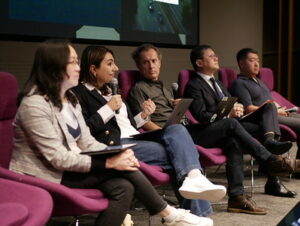
PAIR members discuss the necessary collaboration between academia and industry in Physical AI research.
“One of the clearest messages from the launch event was that industry is eager to engage,” said COE Distinguished Professor of Electrical and Computer Engineering and Professor of Computer Science Raymond Fu. “Physical AI requires a new level of collaboration between academia and industry to bridge fundamental research and real-world deployment. PAIR is helping build the partnerships and innovation ecosystem needed to accelerate that process.”
“Physical AI isn’t only about systems that act in the world: it’s also about systems that understand and support the humans in it,” said Torresani. “An AI that anticipates what a surgeon will need next, that adapts AR guidance to a user’s pace, or that knows when an assistive robot should step in. The next major frontier is closing the gap between what AI can see in the present and what it can anticipate, guide, and reason about—actually helping people, not just operating around them.”
The two-day program combined technical depth with extensive opportunities for interaction. Attendees moved continuously among talks, demonstrations, poster sessions, networking events, and breakout discussions, creating a highly dynamic and collaborative atmosphere. Many participants cited the demonstrations, poster sessions, and breakout groups as highlights of the event.

The event also featured a panel discussion with Dy, ECE Distinguished Professor David Kaeli, Jose Alvarez of NVIDIA, and Michael Lentine of Epic Games. Moderated by Ostadabbas, the discussion explored the opportunities and challenges of deploying Physical AI systems in the real world, emphasizing trustworthiness, human-centered design, and collaboration between academia and industry.
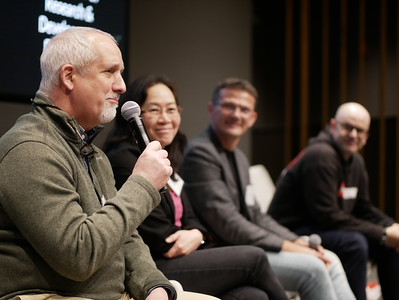
David Kaeli, Jennifer Dy, and leading industry representatives discuss the opportunities and challenges of deploying Physical AI in the real world.
“We are not simply launching a research initiative,” said Yeh. “We are helping build a community and ecosystem around Physical AI. The enthusiasm and engagement throughout the event demonstrated the tremendous momentum already building around this emerging field and the opportunity for Northeastern to help shape its future.”
PAIR leaders view the launch as the beginning of a broader effort to establish Northeastern as a leading center and convening platform for Physical AI research, open infrastructure, education, industry collaboration, and ecosystem development.