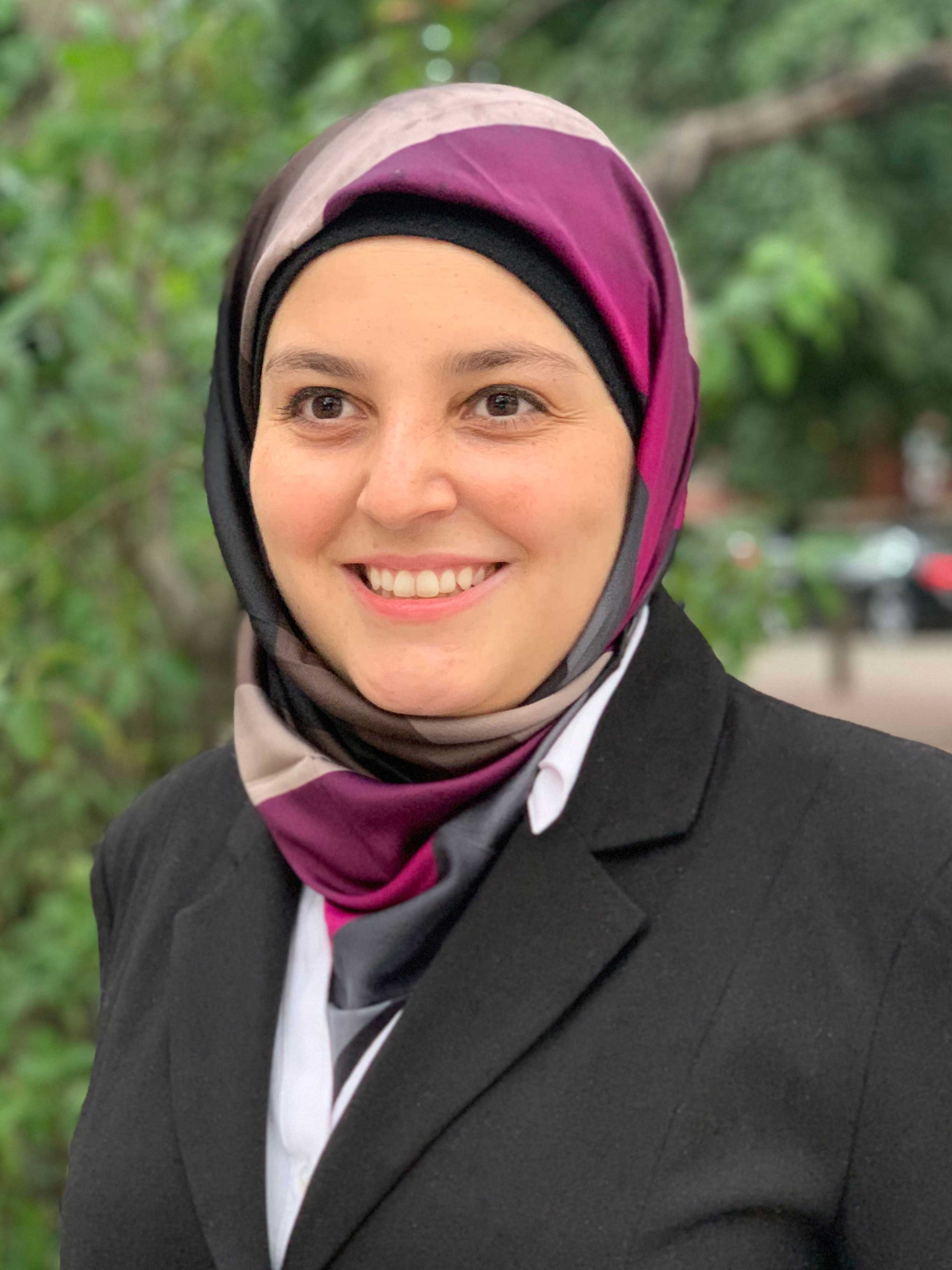
Mona Minkara
Assistant Professor,
Bioengineering
Affiliated Faculty,
Chemistry and Chemical Biology
Office
- 325 ISEC
- 617.373.2031
Research Focus
Computationally modeling the molecular interactions of the human pulmonary surfactant system, with a focus on collectins and their role in innate immune recognition
About
Professor Mona Minkara is an Assistant Professor of Bioengineering at Northeastern University and an Affiliated Faculty member in the Department of Chemistry and Chemical Biology. She leads the Computational Modeling for Biointerface Engineering (COMBINE) Lab, where her research focuses on the molecular components of human pulmonary surfactant, particularly the collectins SP-A and SP-D, and their roles in regulating breathing and mediating innate immune defense.
Her work investigates how molecular recognition and interfacial dynamics at the air–liquid interface give rise to physiological function in the lung. Using molecular dynamics, Monte Carlo simulations, quantum calculations, and multiscale computational workflows, her lab studies protein–lipid and protein–glycan interactions governing host–pathogen recognition and immune response. This research bridges molecular biophysics, computational chemistry, and bioengineering, with direct relevance to lung health, immunity, and therapeutic design.
Dr. Minkara’s group develops chemically rigorous computational methodologies for studying collectin–glycan recognition under physiologically relevant conditions. Her lab has established validated workflows that integrate binding-pose stability analysis, solvation and water-model benchmarking, and free-energy calculations to resolve how coordination chemistry, hydration, and molecular dynamics collectively determine recognition specificity.
The Minkara COMBINE Lab is among the few computational laboratories internationally dedicated to mechanistic modeling of surfactant collectins and their interactions with pathogenic glycans. Her research establishes a framework for understanding how SP-A and SP-D function at biological interfaces and advances a predictive computational approach to collectin-mediated innate immunity.
By generating molecular-level insight through computation, her group connects fundamental chemical mechanisms to translational strategies aimed at strengthening respiratory health and immune function.
As a blind scientist, Dr. Minkara develops and shares tools that support rigorous, multi-modal scientific practice through her website Blind Scientist Tools. She is the founding director of the Academy of Blind Scientists, a global network of blind PhD scientists advancing technical excellence in accessible scientific research.
Education
- Postdoctoral Fellow, University of Minnesota (2015-2019), Chemical Theory Center, Twin Cities, Minneapolis, MN
- PhD in Chemistry, University of Florida (2015), Quantum Theory Center, Gainesville, FL
- BA in Chemistry and Middle Eastern Studies, Wellesley College (2009), Wellesley, MA
Honors & Awards
- Alfred P. Sloan Research Fellow in Chemistry, 2026
- National Institutes of Health (NIH) MIRA (R35) Award, Foundational Investigations into Bacterial Surface Glycan Dynamics, 2024-2029
- National Science Foundation (NSF) CAREER Award, CAREER: Decoding the Code of Glycan-Collectin Interactions, 2024-2029
- Martin W. Essigmann Outstanding Teaching Award, Northeastern University, 2022
- Ford Foundation Fellowship, National Academies of Sciences, Engineering, and Medicine (NASEM) Postdoctoral Fellowship, 2016
- Howard Hughes Medical Institute (HHMI) Research Grant, 2009-2010
Professional Affiliations
- American Chemical Society (ACS), Computers in Chemistry Division (COMP), Chemists with Disabilities (CWD)
- American Institute of Chemical Engineers (AIChE), Computational Molecular Science Engineering Forum (CoMSEF)
- Biophysical Society, Theory and Computation
- Protein Society
Research Overview
Computationally modeling the molecular interactions of the human pulmonary surfactant system, with a focus on collectins and their role in innate immune recognition
The Minkara COMBINE Lab focuses on the computational modeling of biological interfaces, with particular emphasis on the air–liquid interface of the lung. The lab studies the human pulmonary surfactant system, centering on pulmonary surfactant collectins and their roles in mediating innate immune recognition and respiratory function.
A primary focus of the group’s research is understanding how pulmonary surfactant collectins, particularly SP-A and SP-D, recognize and discriminate among pathogenic glycans derived from viruses, bacteria, fungi, and environmental antigens such as pollen. These proteins act as pattern-recognition receptors in the innate immune system, yet the molecular logic by which they distinguish among structurally related glycans remains poorly understood.
Using multiscale computational approaches, the COMBINE Lab investigates collectin–glycan interactions under physiologically relevant, interfacial conditions. The group integrates molecular dynamics simulations, Monte Carlo methods, free-energy calculations, and curated digital glycan libraries to decode recognition patterns and identify the chemical determinants that govern binding specificity and stability.
While collectin–glycan recognition is the central focus of the lab, related work examines pulmonary surfactant interfacial phenomena more broadly, including how surfactant proteins such as SP-B and SP-C modulate lipid organization and breathing mechanics at the air–liquid interface. Together, these efforts establish a mechanistic and predictive framework for understanding how molecular interactions at pulmonary interfaces support both innate immunity and respiratory function.
By combining chemically rigorous computation with biological relevance, the COMBINE Lab aims to translate molecular-level insight into strategies for advancing respiratory health and innate immune defense.
Minkara COMBINE Lab
We use computer simulations to obtain a deeper understanding of molecular interactions at biological interfaces, especially the air–liquid interface of the lung, and leverage that knowledge to inform mechanistic insight, predictive modeling, and strategies for improving treatments and drug delivery.
Learn more:
Selected Research Projects
- CAREER: Decoding the Code of Glycan-Collectin Interactions: Computational Engineering of Surfactant Proteins for Tailored Glycan Recognition, Principal Investigator, National Science Foundation (NSF) CBET
- Foundational Investigations into Bacterial Surface Glycan Dynamics, Principal Investigator, National Institutes of Health (NIH) NIGMS
- Modeling and Computation for Discovery of Molecular Probes for SARS-CoV-2 Proteins, Co-Principal Investigator, National Science Foundation
Department Research Areas
Selected Publications
- Li, D.; Minkara, M. Investigating the structural basis of SP-D oligomerization: The role of disulfide bond architecture. Protein Science, 2026, under review.
- Li, D.; Minkara, M. Decoding SP-D and glycan binding mechanisms using a novel computational workflow. Biophysical Journal, 2025. DOI: 10.1016/j.bpj.2025.04.007
- Locke, T.; Ferrante, A.; Li, D.; Weaver, M.; Minkara, M. Conformational changes of surfactant protein B at the alveolar air–liquid interface revealed by molecular dynamics. Journal of Molecular Modeling, 2025.
- Li, D.; Minkara, M. Comparative assessment of water models in protein–glycan interactions: Insights from alchemical free energy calculations and molecular dynamics simulations. Journal of Chemical Information and Modeling, 2024, 64(24), 9459–9473. DOI: 10.1021/acs.jcim.4c01361 (Featured cover article)
- Li, D.; Minkara, M. Elucidating the enhanced binding affinity of a double mutant SP-D with trimannose on Influenza A using molecular dynamics. Computational and Structural Biotechnology Journal, 2022, 20, 4984–5000. DOI: 10.1016/j.csbj.2022.08.045
- Koone, J.C.; Dashnaw, C.M.; Alonzo, E.; Iglesias, M.A.; Patero, K.S.; Lopez, J.; Zhang, S.Y.; Zechmann, B.; Cook, N.; Minkara, M.; Supalo, C.A.; Wedler, H.B.; Guberman-Pfeffer, M.; Shaw, B.F. Data for all: tactile graphics that light up with picture-perfect resolution. Science Advances 2022, 8 (33). DOI: 10.1126/sciadv.abq2640 *Article featured on various platforms including NPR’s All Things Considered
- Greenvall, B.R.; Tiano, A.L.; Chandani, A.; Minkara, M. The influence of a blind professor in a bioengineering course. Biomedical Engineering Education 2021, 1 (2), 245-258. DOI: 10.1007/s43683-021-00052-1
Feb 19, 2026
Minkara Wins 2026 Sloan Fellowship for Pulmonary Protein Research
Assistant Professor Mona Minkara, bioengineering, was given the 2026 Alfred P. Sloan Fellowship for her research at Northeastern. She is studying a protein called collectins within the pulmonary surfactant, hoping to model its functions to enhance innate immunity from the lungs.
Jan 29, 2026
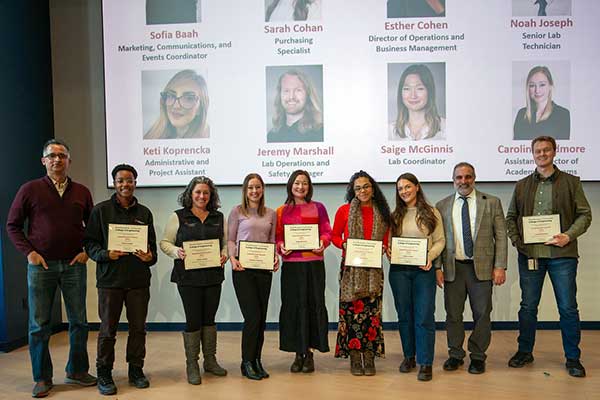
Faculty and Staff Awards 2026
Faculty and staff were recognized at the 28th Annual College of Engineering Faculty and Staff Awards for their exceptional service and dedication in support of students, the COE community, and the university during the 2025-2026 academic year.
Jan 23, 2026
Spring 2026 PEAK Experiences Awardees for Undergrad Research
Several COE, Bouvé, COS, DMSB, and Khoury students mentored by COE faculty are recipients of the Spring 2026 PEAK Experiences Awards from Northeastern’s Office of Undergraduate Research and Fellowships. This group of students from across the university will explore a wide variety of topics and questions from developing brain-computer interfaces, to analyzing air quiality data to inform future legislation, Socioeconomic Factors impact on twin infants, and more.

Nov 12, 2025
Integrating Data Analytics and Bioengineering to Enhance Lives
Isabella Ribeiro, E’25, bioengineering, MS’26, data analytics engineering, has always appreciated the analytical thinking and critical thinking skills that come with studying engineering. Her second co-op experience showed her how the analytical and critical thinking skills she values could be applied in the biotech industry, where she’s now passionate about using data and computation to enhance quality of life.

Nov 07, 2025
Northeastern Nominates 6 COE Students for Prestigious Knight-Hennessy Scholarship
Druhi Bhargava, E’24, computer engineering; Amanda Ferrante, E’26, bioengineering and biochemistry; Kevin Giordano, E’26, mechanical engineering and physics; Victoria Robbins, E’22, chemical engineering; Nishita Roy, E’26, bioengineering, and Zhenming Yang, E’26, electrical and computer engineering were were six of nine nominated by Northeastern for the Knight-Hennessy Scholarship, which develops a community of future global leaders to address complex challenges through collaboration and innovation.

Sep 29, 2025
Mona Minkara Uncovers Patterns in How Our Lungs Interact With Airborne Viruses
BioE Assistant Professor Mona Minkara was featured in the C&EN Trailblazer’s article “Mona Minkara uncovers patterns in how our lungs interact with airborne viruses.”

Apr 15, 2025
BioE PhD Receives Outstanding PhD Student Award in Leadership
Deng Li, PhD’25, bioengineering, received the Outstanding PhD Student Award in Leadership, which recognizes graduate students who have demonstrated significant leadership and a deep commitment to giving back to members of Northeastern’s community or surrounding neighborhoods.
Dec 04, 2024
BioE Assistant Professor Mona Minkara Profiled in Tatler
BioE Assistant Professor Mona Minkara was featured in the Tatler article “Meet Dr. Mona Minkara, the Blind Scientist Redefining Accessible Travel and Adventure.”
Sep 25, 2024
Fall 2024 PEAK Experiences Awardees for Undergrad Research
Several COE, COS, and Khoury students mentored by COE faculty are recipients of the Fall 2024 PEAK Experiences Awards from Northeastern’s Office of Undergraduate Research and Fellowships.
Sep 23, 2024
$1.95M NIH MIRA R35 Award for Developing New Strategies To Combat Bacterial Infections
BioE Assistant Professor Mona Minkara was awarded a $1.95 million NIH R35 MIRA Award for Early-Stage Investigators for “Foundational Investigations Into Bacterial Surface Glycan Dynamics.” The project aims to advance knowledge of bacterial and glycan behavior, leading to new ways to enhance health and prevent infections.