Driven by Impact: A Bioengineering Researcher’s Story
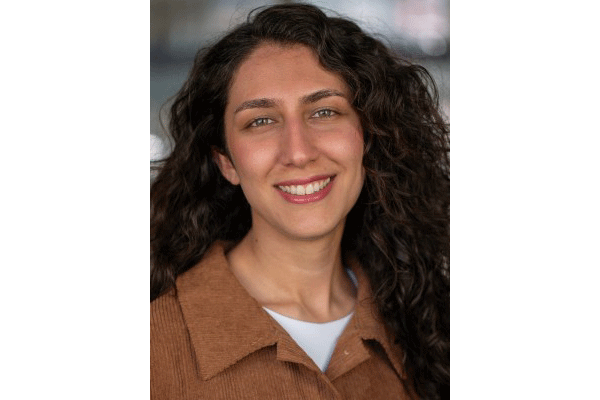
Portrait of Mahsa Karamzadeh. Photo sourced from LinkedIn.
Mahsa Karamzadeh, PhD ’27, bioengineering, blends her passion for engineering and call to service to fuel her research. Recently, Karamzadeh and her team published their study on Chiari Type 1 patients in the Magnetic Resonance Imaging journal.
Mahsa Karamzadeh is currently pursuing her PhD in bioengineering. Despite completing her bachelor’s degree in mechanical engineering at Sharif University of Technology in Iran, Karamzadeh discovered her long interest in engineering leaned more towards bioengineering. It was her desire to have a more human-focused impact on society while also interested in environmental studies that led her in this direction.
While exploring programs, she came across Northeastern’s bioengineering PhD and was drawn to its interdisciplinary opportunities. Her advisor, Professor Francis Loth, affiliated with both mechanical and bioengineering, led her to think it was “a perfect match” for her experience and interest. She applied for a direct PhD, allowing her to skip a master’s degree in exchange for completing more credit hours.
Karamzadeh is grateful for the interdisciplinary aspect of her program that drew her to Northeastern. She notes that bioengineering students come from diverse backgrounds, enabling them to pursue varied research directions. Each week, PhD students present their work at departmental seminars, and while Karamzadeh says, “the research is very different,” she emphasizes that all projects are “unified” by their shared goal of creating positive societal impact.
Into the deep end
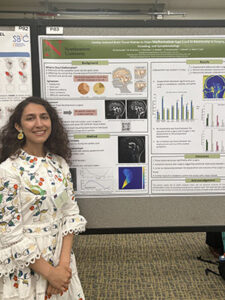
Karamzadeh next to the poster version of her recent publication. Courtesy Photo.
Her current research at the Institute for Mechanobiology focuses on a brain disease called Chiari Malformation Type 1. Specifically, Karamzedah and her lab mates focus on the brain imaging (MRI or CT scan) analysis of these patients. She was nervous coming to the United States without a strong grasp of the English language, which offered challenges in conducting her research. Additionally, she had no prior experience with the disease, brain anatomy, or brain imaging. However, “when you start making smaller steps, and break it into pieces, it starts looking more doable” Karamzadeh offered about her approach to working in this program.
In addition, the collaboration and welcoming of the bioengineering department helped her find her footing. With the department housed in ISEC’s open floor plan, Karamzadeh finds it easier to connect with her peers and mentors. “It’s kind of like a family,” she comments, in reference to the bioengineering department. She recognizes Associate Chair of PhD Program and Research and Associate Professor Chiara Bellini, Associate Professor Rouzbeh Amini, and Professor Loth as people who have generously helped her acclimate throughout her time in the program.
Research publication
Karamzadeh and her lab, in collaboration with Harvard Medical, recently published a new study called “Cardiac-Induced Brain Tissue Motion in Chiari Malformation Type I” in the Magnetic Resonance Imaging journal. This research focused on finding a biomarker in patients with this disease to determine the relationship between brain tissue motion and symptoms, as well as how brain tissue motion affects decompression surgery outcomes. In previous research, the abnormal motion of brain tissue in Chiari patients would decrease after surgery, hypothetically meaning that their symptoms would improve. However, Karamzadeh’s research found that there was no correlation between tissue motion and the outcomes of the surgery, meaning that tissue motion alone is not a viable parameter to predict the outcome of surgery.
Karamzadeh and her team initially faced rejection from one journal, which she attributes to a culture of favoring “positive results” where the hypothesis and outcome align neatly. Undeterred, she successfully published the study in a different journal. As she puts it, “You cannot fake your results, you cannot change your data, you should be loyal to what you have.” Her persistence underscores an important truth: knowing what doesn’t work can be just as valuable as knowing what does.
Extracurriculars and the future
Beyond her research, Karamzadeh participates in a few organizations at Northeastern. One is the Northeastern Huskiers and Outing Club, an outdoors activity club for the university. She has enjoyed several camping and hiking outings, as well as making use of their rentable resources like tents and sleeping pads. Karamzadeh also belongs to the Iranian Student Association of Northeastern (ISAN), where she has been able to celebrate her culture and find community with other Iranians at Northeastern.
Karamzadeh plans to pursue a job as a bioengineer. With a strong interest in her current research, she would like to work with image analysis at a biotech company. She remains committed to advancing human health through her research. The supportive environment at Northeastern has shaped what she seeks in her future career—a workplace that values collaboration and mentorship as much as innovation. Whether in her lab at Northeastern or beyond, she will continue learning from her peers and working toward positive impact.